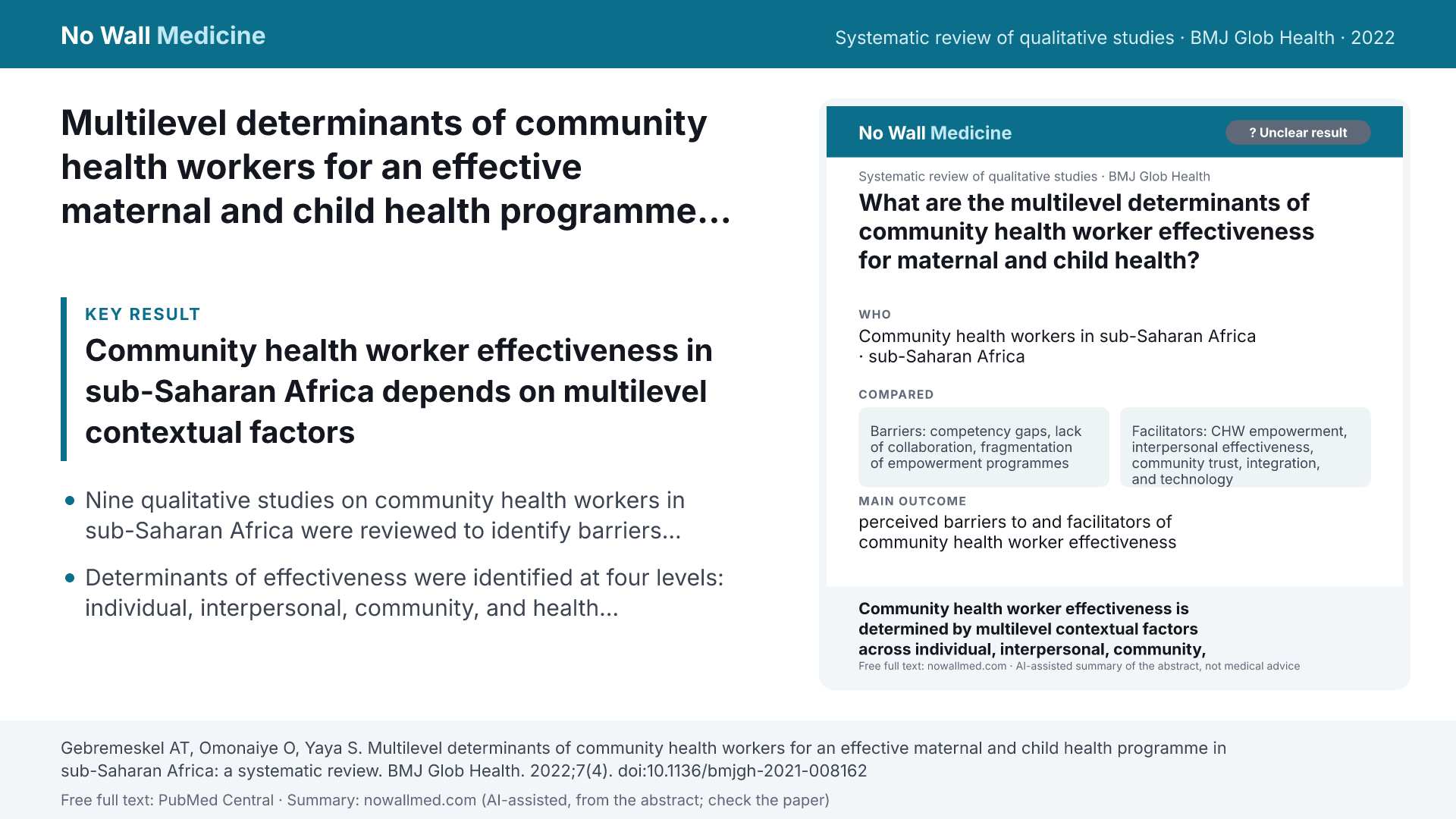
Community health worker effectiveness in sub-Saharan Africa depends on multilevel contextual factors
Multilevel determinants of community health workers for an effective maternal and child health programme in sub-Saharan Africa: a systematic review
Systematic review of qualitative studiesUnclear result
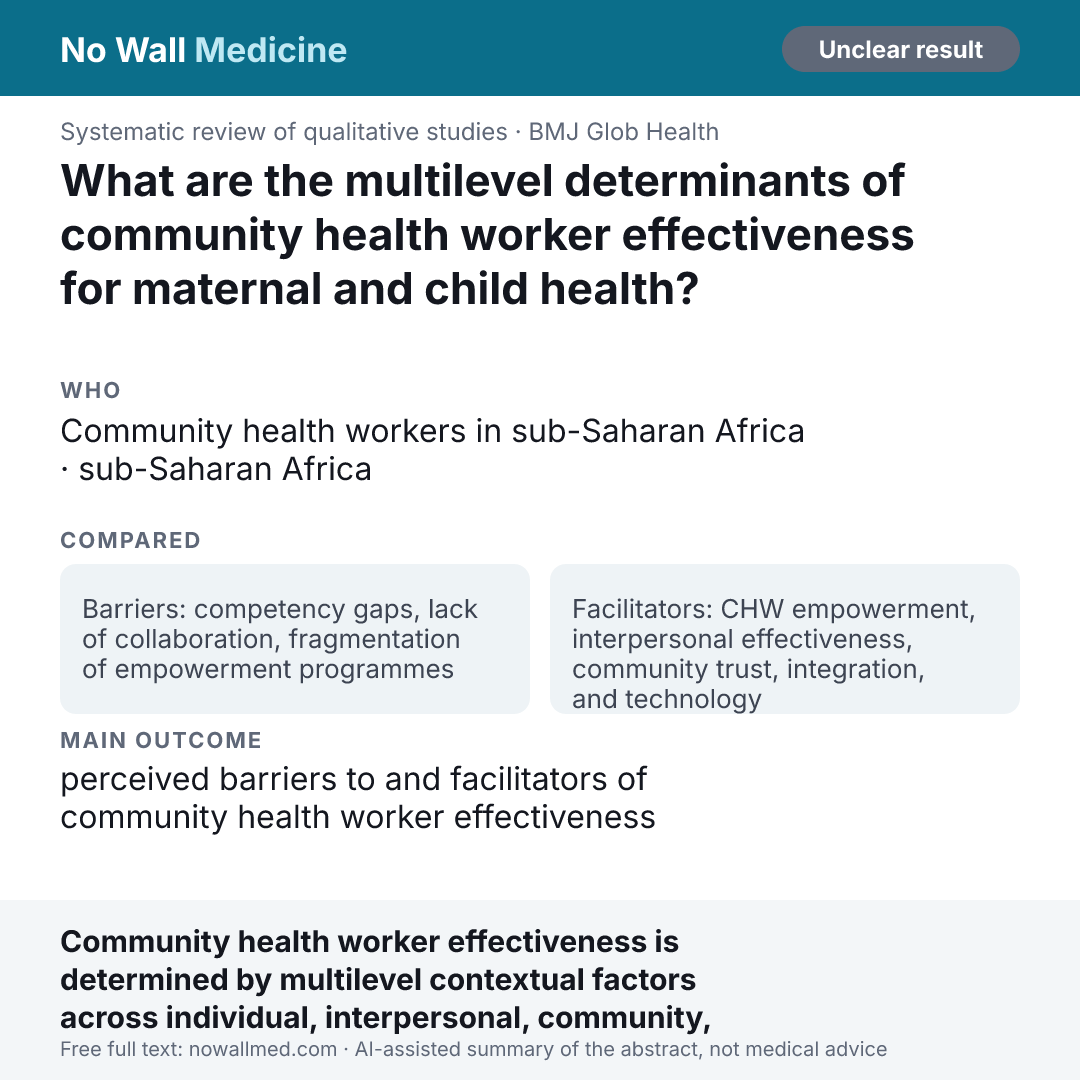
What are the multilevel determinants of community health worker effectiveness for maternal and child health?
Who
Community health workers in sub-Saharan Africa · sub-Saharan Africa
Compared
Barriers: competency gaps, lack of collaboration, fragmentation of empowerment programmes
Facilitators: CHW empowerment, interpersonal effectiveness, community trust, integration, and technology
Main outcome
perceived barriers to and facilitators of community health worker effectiveness
Bottom line: Community health worker effectiveness is determined by multilevel contextual factors across individual, interpersonal, community, and health system levels.
BMJ Glob Health · 2022-04-08 · Save PNG
Clinical question: What are the multilevel determinants of community health worker effectiveness for maternal and child health?
Key points
- Nine qualitative studies on community health workers in sub-Saharan Africa were reviewed to identify barriers and enablers of maternal and child health programmes.
- Determinants of effectiveness were identified at four levels: individual, interpersonal, community, and health system logistics.
- Key barriers included competency gaps and lack of collaboration, while facilitators included community trust and integration into health systems.
Limitation the authors note: Only nine articles met the inclusion criteria for the final review.
Headline and key points written with AI from the paper’s abstract, with every number checked against it. Read the paper before relying on them.
Was this summary helpful?
Abstract
Background
Countries in sub-Saharan Africa (SSA) continue to have the highest maternal and under-five child deaths in the world. The ongoing COVID-19 pandemic is amplifying the problems and overwhelming already fragile health systems. Community health workers (CHWs) are increasingly being acknowledged as crucial members of the healthcare workforce in improving maternal and child health (MCH). However, evidence is limited on multilevel determinants of an effective CHWs programme using CHWs' perspective. The objective of this systematic review is to examine perceived barriers to and enablers of different levels of the determinants of the CHWs' engagement to enhance MCH equity and a resilient community health system in SSA. Methods
We systematically conducted a literature search from inception in MEDLINE complete, EMBASE, CINAHL complete and Global Health for relevant studies. Qualitative studies that presented information on perceived barriers to and facilitators of effectiveness of CHWs in SSA were eligible for inclusion. Quality appraisal was conducted according to the Critical Appraisal Skills Programme qualitative study checklist. We used a framework analysis to identify key findings. Findings
From the database search, 1561 articles were identified. Nine articles met the inclusion criteria and were included in the final review. Using socio-ecological framework, we identified the determinants of CHWs' effectiveness at 4 levels: individual/CHWs, interpersonal, community and health system logistics. Under each level, we identified themes of perceived barriers such as competency gaps, lack of collaboration, fragmentation of empowerment programmes. In terms of facilitators, we identified themes such as CHW empowerment, interpersonal effectiveness, community trust, integration of CHWs into health systems and technology. Conclusion
Evidence from this review revealed that effectiveness of CHW/MCH programme is determined by multilevel contextual factors. The socio-ecological framework can provide a lens of understanding diverse context that impedes or enhances CHWs' engagement and effectiveness at different levels. Hence, there is a need for health programme policy makers and practitioners to adopt a multilevel CHW/MCH programme guided by the socio-ecological framework to transform CHW programmes. The framework can help to address the barriers and scale up the facilitators to ensuring MCH equity and a resilient community health system in SSA.
Abstract reproduced under the article’s CC BY NC licence.
Subject terms
Headline, design, result, key points, caveat and citation as plain text.
Cite this article
Gebremeskel AT, Omonaiye O, Yaya S. Multilevel determinants of community health workers for an effective maternal and child health programme in sub-Saharan Africa: a systematic review. BMJ Glob Health. 2022;7(4). doi:10.1136/bmjgh-2021-008162
Spotted a mistake? Suggest a correction