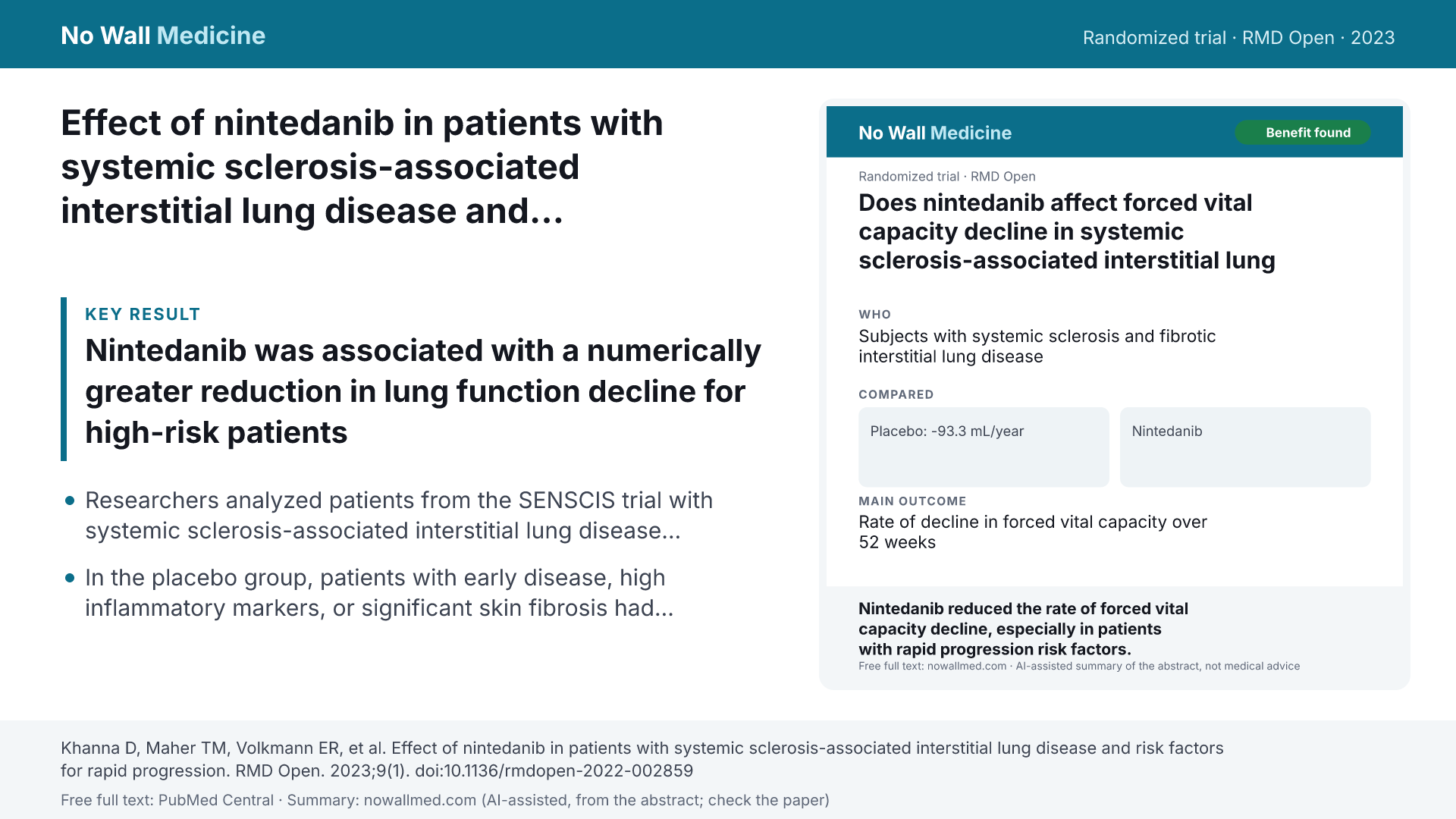
Effect of nintedanib in patients with systemic sclerosis-associated interstitial lung disease and risk factors for rapid progression
Key result: Nintedanib was associated with a numerically greater reduction in lung function decline for high-risk patients
Randomized trialBenefit found
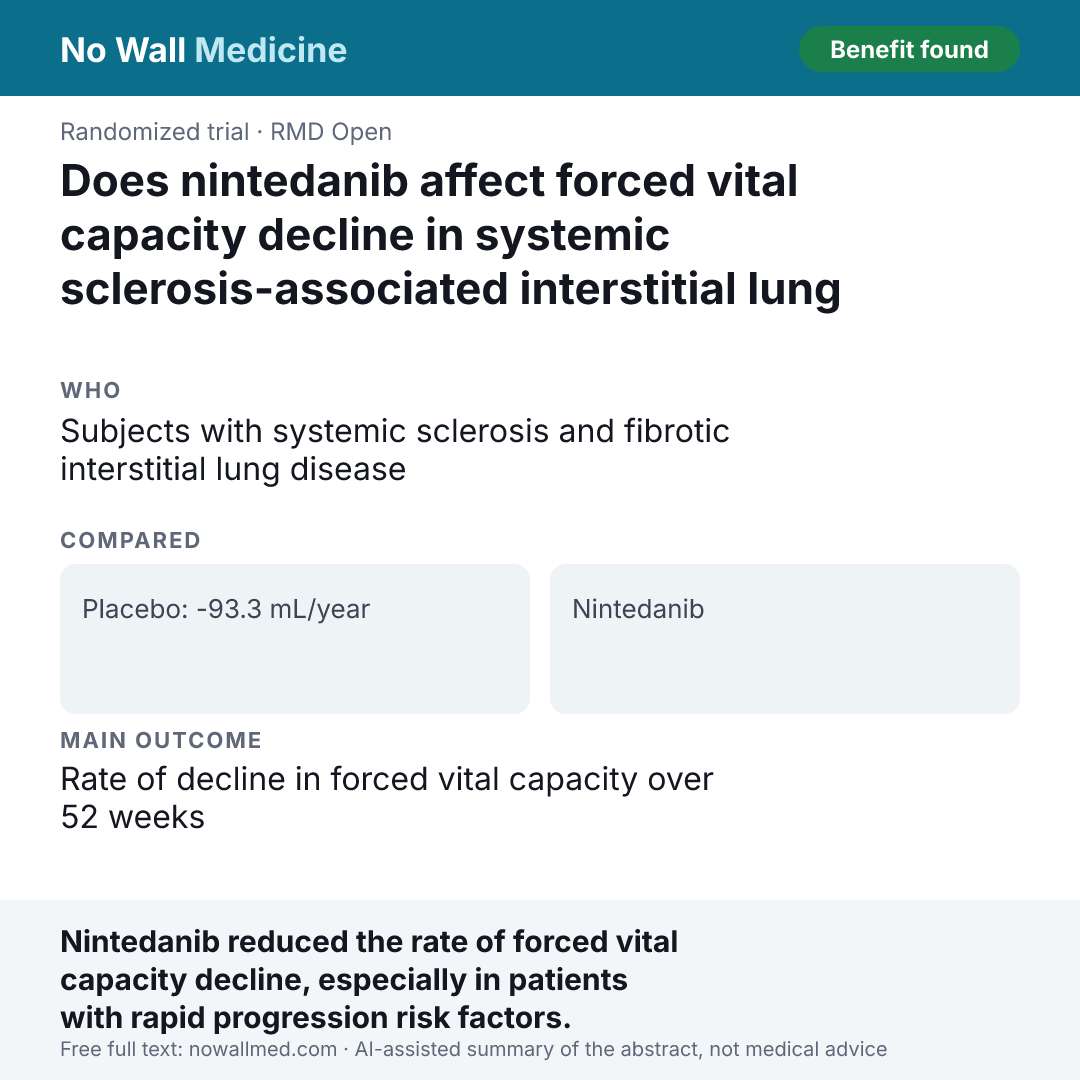
Does nintedanib affect forced vital capacity decline in systemic sclerosis-associated interstitial lung disease?
Who
Subjects with systemic sclerosis and fibrotic interstitial lung disease
Compared
Placebo: -93.3 mL/year
Nintedanib
Main outcome
Rate of decline in forced vital capacity over 52 weeks
Bottom line: Nintedanib reduced the rate of forced vital capacity decline, especially in patients with rapid progression risk factors.
RMD Open · 2023-02-16 · Save PNG
Key points
- Researchers analyzed patients from the SENSCIS trial with systemic sclerosis-associated interstitial lung disease and fibrotic lung disease of 10% extent or more.
- In the placebo group, patients with early disease, high inflammatory markers, or significant skin fibrosis had a numerically greater decline in forced vital capacity than the overall group.
- Nintedanib was associated with a numerically greater effect on reducing the rate of forced vital capacity decline in patients with these specific risk factors.
Discussion prompts
- Would these patients look like yours? Who was left out?
- Is the main outcome one that matters to patients?
- Is the difference large enough to change what you do?
Cite: Khanna D, Maher TM, Volkmann ER, et al. Effect of nintedanib in patients with systemic sclerosis-associated interstitial lung disease and risk factors for rapid progression. RMD Open. 2023;9(1). doi:10.1136/rmdopen-2022-002859
Free full text: PubMed Central · Summary and visual abstract: nowallmed.com/a/effect-of-nintedanib-in-patients-with-systemic-sclerosis-associated-14rjc1/ (AI-assisted from the abstract; check the paper before relying on it).