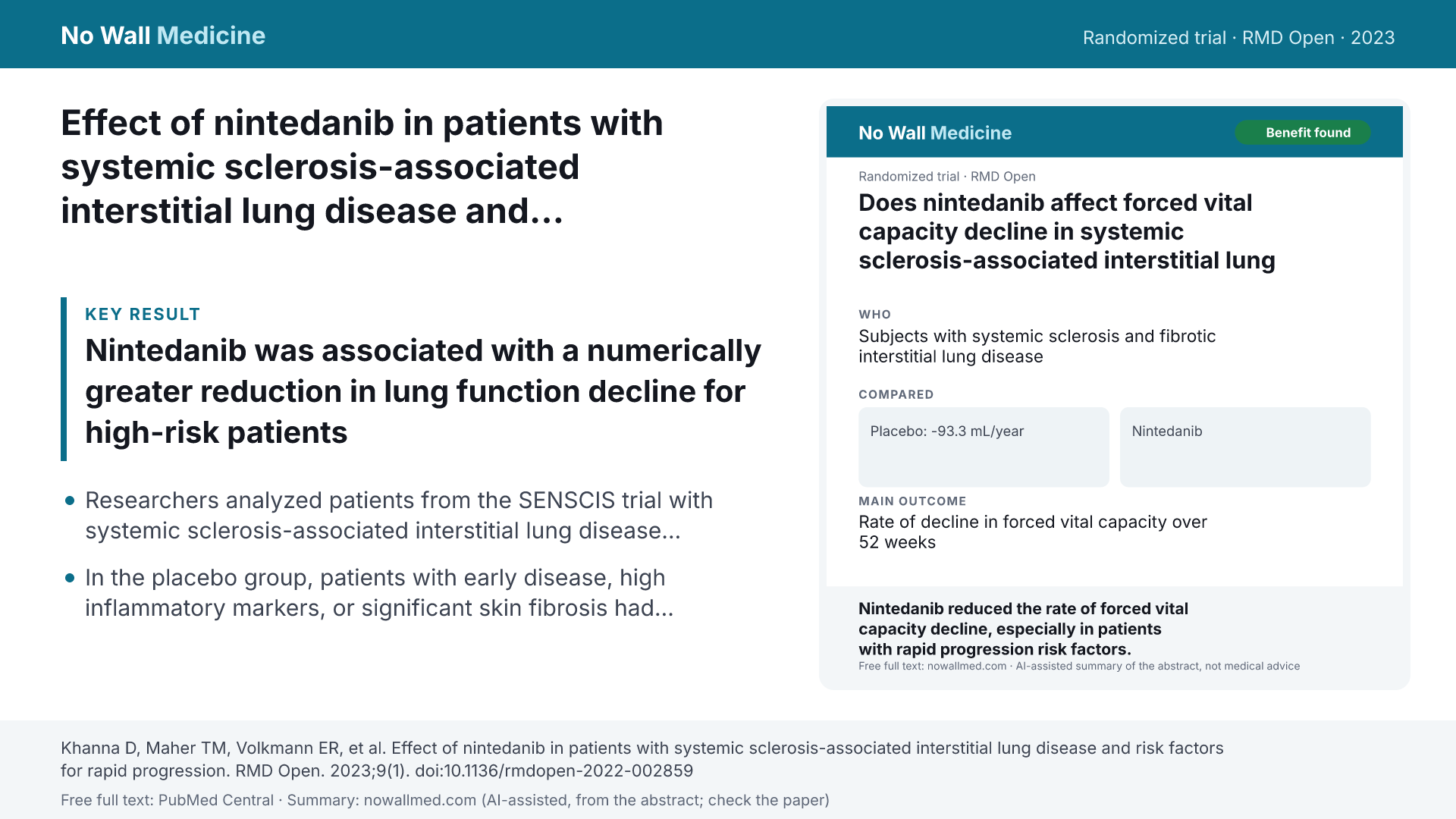
Nintedanib was associated with a numerically greater reduction in lung function decline for high-risk patients
Effect of nintedanib in patients with systemic sclerosis-associated interstitial lung disease and risk factors for rapid progression
Randomized trialBenefit found
Does nintedanib affect forced vital capacity decline in systemic sclerosis-associated interstitial lung disease?
Who
Subjects with systemic sclerosis and fibrotic interstitial lung disease
Compared
Placebo: -93.3 mL/year
Nintedanib
Main outcome
Rate of decline in forced vital capacity over 52 weeks
Bottom line: Nintedanib reduced the rate of forced vital capacity decline, especially in patients with rapid progression risk factors.
RMD Open · 2023-02-16Download image
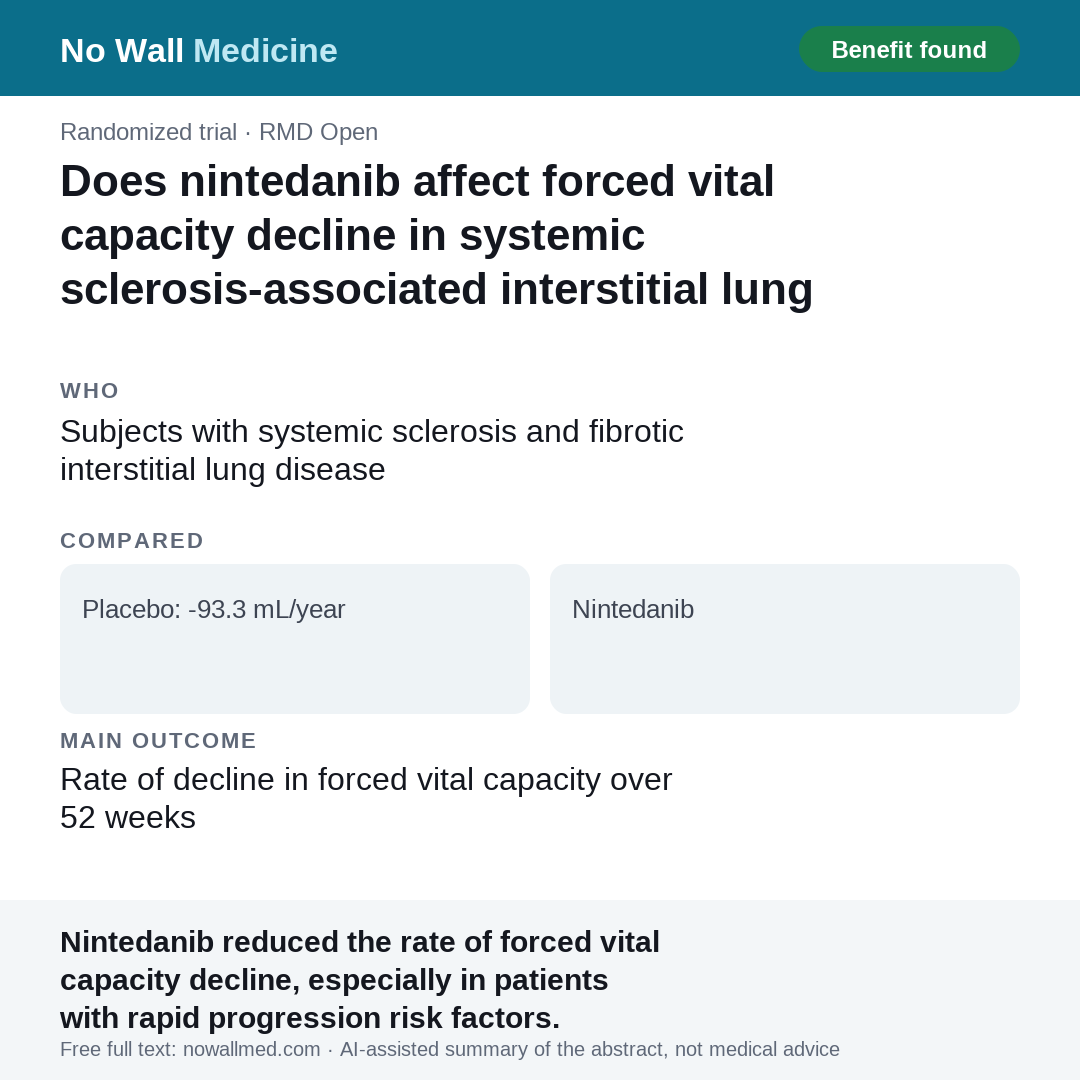
Clinical question: Does nintedanib affect forced vital capacity decline in systemic sclerosis-associated interstitial lung disease?
Why it matters: It was unknown if nintedanib affects the rate of lung function decline differently in patients with specific risk factors for rapid progression.
Key points
- Researchers analyzed patients from the SENSCIS trial with systemic sclerosis-associated interstitial lung disease and fibrotic lung disease of 10% extent or more.
- In the placebo group, patients with early disease, high inflammatory markers, or significant skin fibrosis had a numerically greater decline in forced vital capacity than the overall group.
- Nintedanib was associated with a numerically greater effect on reducing the rate of forced vital capacity decline in patients with these specific risk factors.
Headline and key points written with AI from the paper’s abstract, with every number checked against it. Read the paper before relying on them.
Was this summary helpful?
Abstract
Objective
To investigate the rate of decline in forced vital capacity (FVC), and the effect of nintedanib on the rate of decline in FVC, in subjects with systemic sclerosis-associated interstitial lung disease (SSc-ILD) who had risk factors for rapid decline in FVC. Methods
The SENSCIS trial enrolled subjects with SSc and fibrotic ILD of ≥10% extent on high-resolution CT. The rate of decline in FVC over 52 weeks was analysed in all subjects and in those with early SSc (<18 months since first non-Raynaud symptom), elevated inflammatory markers (C reactive protein ≥6 mg/L and/or platelets ≥330×109/L) or significant skin fibrosis (modified Rodnan skin score (mRSS) 15-40 or mRSS ≥18) at baseline. Results
In the placebo group, the rate of decline in FVC was numerically greater in subjects with <18 months since first non-Raynaud symptom (-167.8 mL/year), elevated inflammatory markers (-100.7 mL/year), mRSS 15-40 (-121.7 mL/year) or mRSS ≥18 (-131.7 mL/year) than in all subjects (-93.3 mL/year). Nintedanib reduced the rate of FVC decline across subgroups, with a numerically greater effect in patients with these risk factors for rapid FVC decline. Conclusion
In the SENSCIS trial, subjects with SSc-ILD who had early SSc, elevated inflammatory markers or extensive skin fibrosis had a more rapid decline in FVC over 52 weeks than the overall trial population. Nintedanib had a numerically greater effect in patients with these risk factors for rapid ILD progression.
Abstract reproduced under the article’s CC BY NC licence.
Subject terms
Cite this article
Khanna D, Maher TM, Volkmann ER, et al. Effect of nintedanib in patients with systemic sclerosis-associated interstitial lung disease and risk factors for rapid progression. RMD Open. 2023. doi:10.1136/rmdopen-2022-002859
Spotted a mistake? Suggest a correction