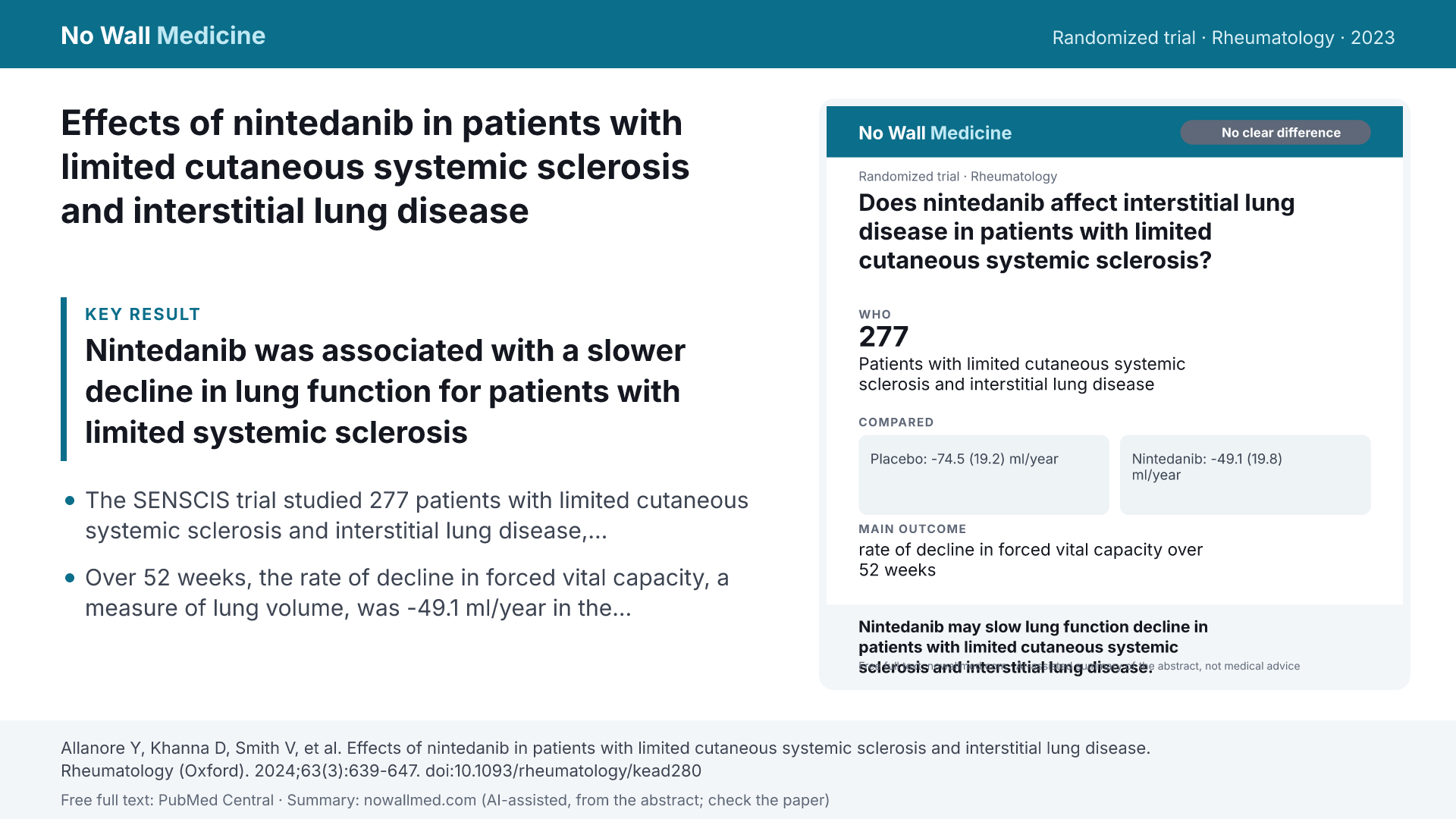
Nintedanib was associated with a slower decline in lung function for patients with limited systemic sclerosis
Effects of nintedanib in patients with limited cutaneous systemic sclerosis and interstitial lung disease
Randomized trialNo clear difference
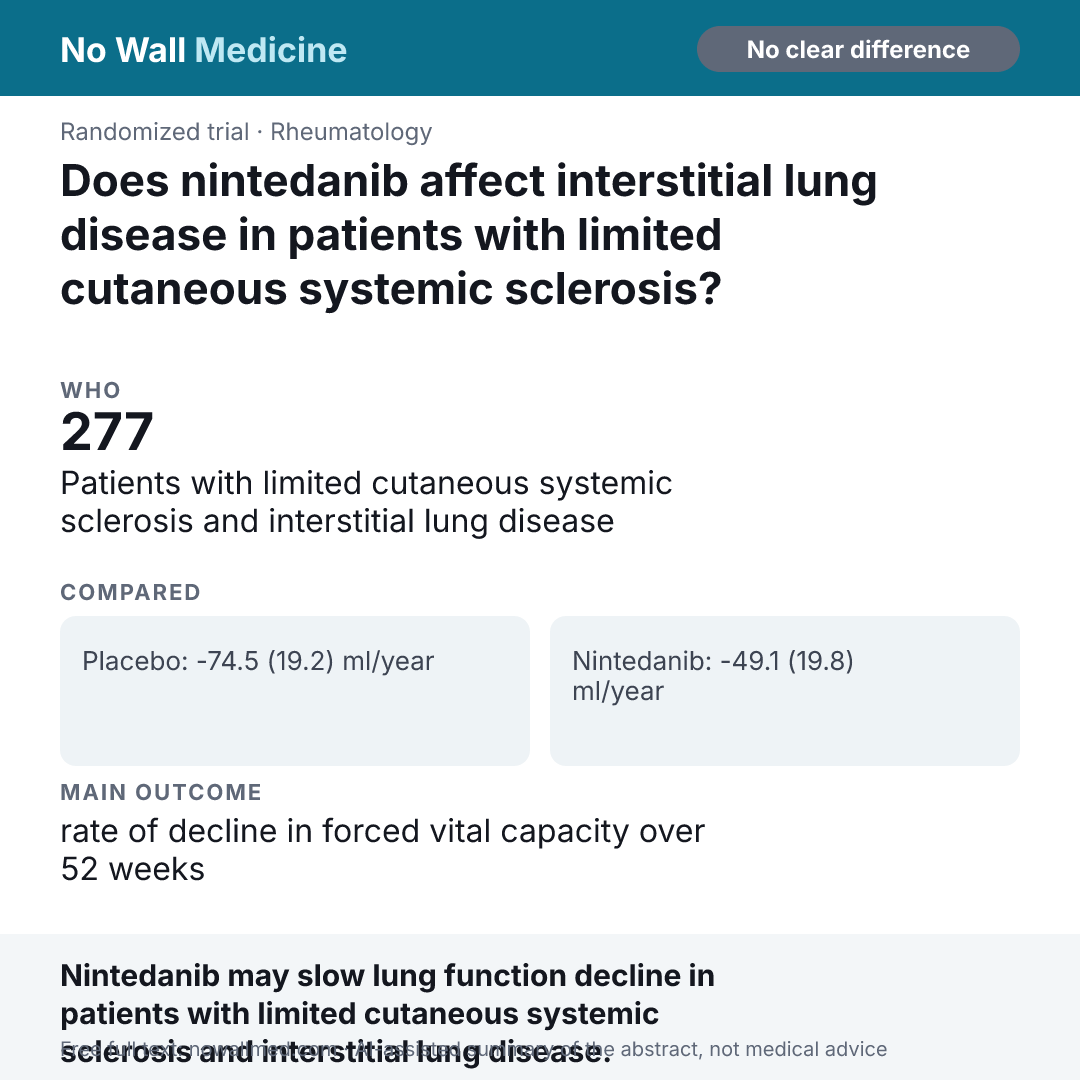
Does nintedanib affect interstitial lung disease in patients with limited cutaneous systemic sclerosis?
Who
277
Patients with limited cutaneous systemic sclerosis and interstitial lung disease
Compared
Placebo: -74.5 (19.2) ml/year
Nintedanib: -49.1 (19.8) ml/year
Main outcome
rate of decline in forced vital capacity over 52 weeks
Result: difference: 25.3 (95% CI -28.9 to 79.6)
Bottom line: Nintedanib may slow lung function decline in patients with limited cutaneous systemic sclerosis and interstitial lung disease.
Rheumatology · 2023-06-09 · Save PNG
Same trial (NCT02597933, NCT03313180)
Papers we list that report this registered trial, oldest first. Read a secondary analysis alongside the main results.
- Secondary analysis Benefit found
Nintedanib efficacy in lung disease was similar regardless of mycophenolate use at baseline Lancet Respir Med 2021-01 - Secondary analysis No clear difference
Nintedanib effect on lung function decline was similar regardless of cough or shortness of breath Rheumatology 2022-02 - Main results No clear difference
This paper Rheumatology 2023-06
Clinical question: Does nintedanib affect interstitial lung disease in patients with limited cutaneous systemic sclerosis?
Key points
- The SENSCIS trial studied 277 patients with limited cutaneous systemic sclerosis and interstitial lung disease, comparing nintedanib to a placebo.
- Over 52 weeks, the rate of decline in forced vital capacity, a measure of lung volume, was -49.1 ml/year in the nintedanib group versus -74.5 ml/year in the placebo group.
- In the SENSCIS-ON extension, patients who switched from placebo to nintedanib had a mean change in lung volume of -41.5 ml compared to -45.1 ml for those continuing nintedanib.
Headline and key points written with AI from the paper’s abstract, with every number checked against it. Read the paper before relying on them.
Was this summary helpful?
Subject terms
Headline, design, result, key points, caveat and citation as plain text.
Cite this article
Allanore Y, Khanna D, Smith V, et al. Effects of nintedanib in patients with limited cutaneous systemic sclerosis and interstitial lung disease. Rheumatology (Oxford). 2024;63(3):639-647. doi:10.1093/rheumatology/kead280
Spotted a mistake? Suggest a correction