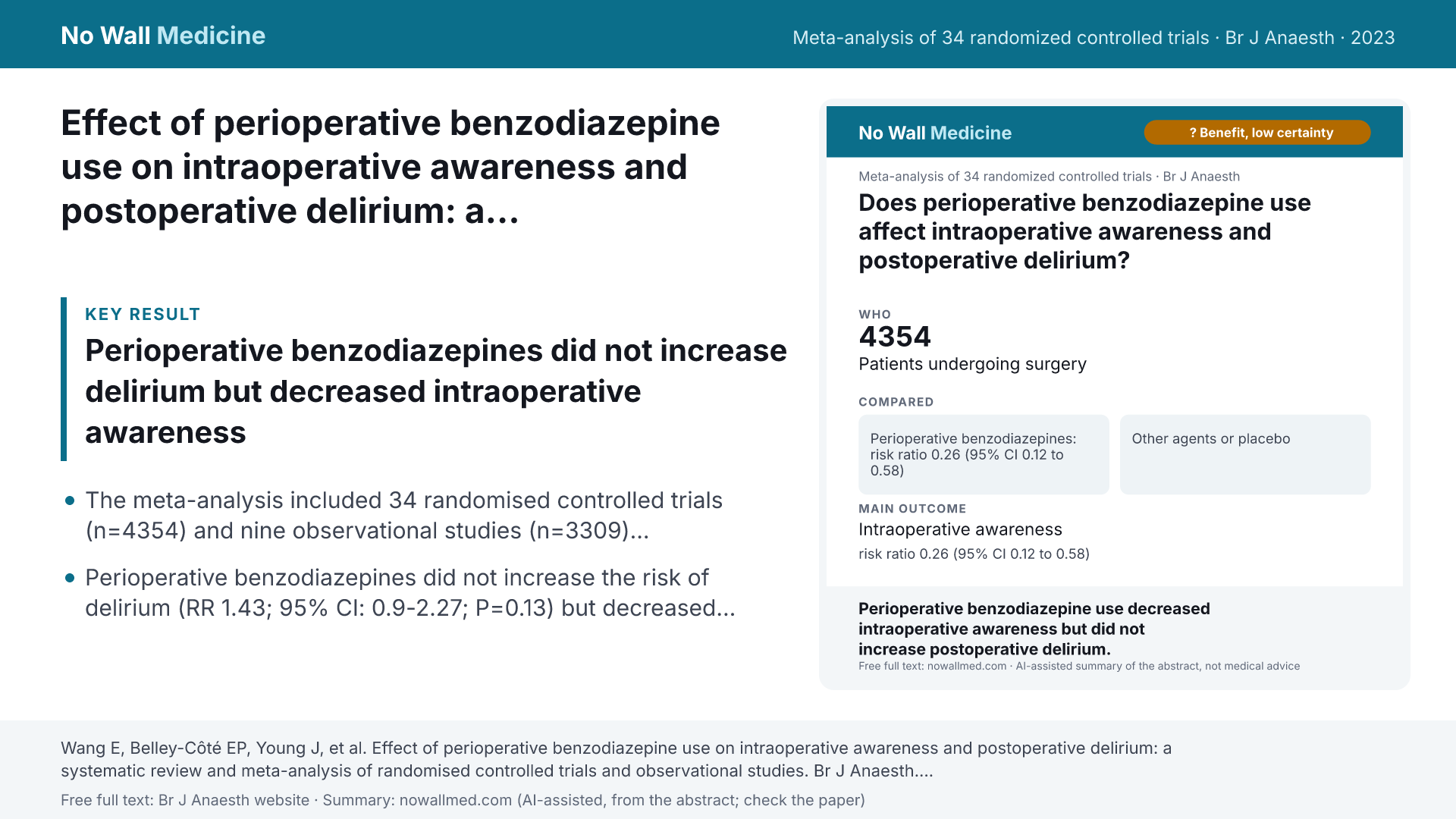
Effect of perioperative benzodiazepine use on intraoperative awareness and postoperative delirium: a systematic review and meta-analysis of randomised controlled trials and observational studies
Key result: Perioperative benzodiazepines did not increase delirium but decreased intraoperative awareness
Key points
- The meta-analysis included 34 randomised controlled trials (n=4354) and nine observational studies (n=3309) comparing perioperative benzodiazepines with other agents or placebo.
- Perioperative benzodiazepines did not increase the risk of delirium (RR 1.43; 95% CI: 0.9-2.27; P=0.13) but decreased the risk of intraoperative awareness (RR 0.26; 95% CI: 0.12-0.58; P=0.001).
- Using benzodiazepines instead of dexmedetomidine increased the risk of delirium (RR 1.83; 95% CI: 1.24-2.72; P=0.002) in five studies involving 429 patients.
Why it matters: Guidelines recommend avoiding benzodiazepines in older patients due to delirium risk, yet their perioperative use remains common because of perceived benefits.
Limitation the authors note: The evidence for the primary outcomes of delirium and intraoperative awareness was rated as very low-quality.
Discussion prompts
- Would these patients look like yours? Who was left out?
- Is the main outcome one that matters to patients?
- Is the difference large enough to change what you do?
Cite: Wang E, Belley-Côté EP, Young J, et al. Effect of perioperative benzodiazepine use on intraoperative awareness and postoperative delirium: a systematic review and meta-analysis of randomised controlled trials and observational studies. Br J Anaesth. 2023;131(2):302-313. doi:10.1016/j.bja.2022.12.001
Free full text: Br J Anaesth website · Summary and visual abstract: nowallmed.com/a/effect-of-perioperative-benzodiazepine-use-on-intraoperative-1lyubvg/ (AI-assisted from the abstract; check the paper before relying on it).