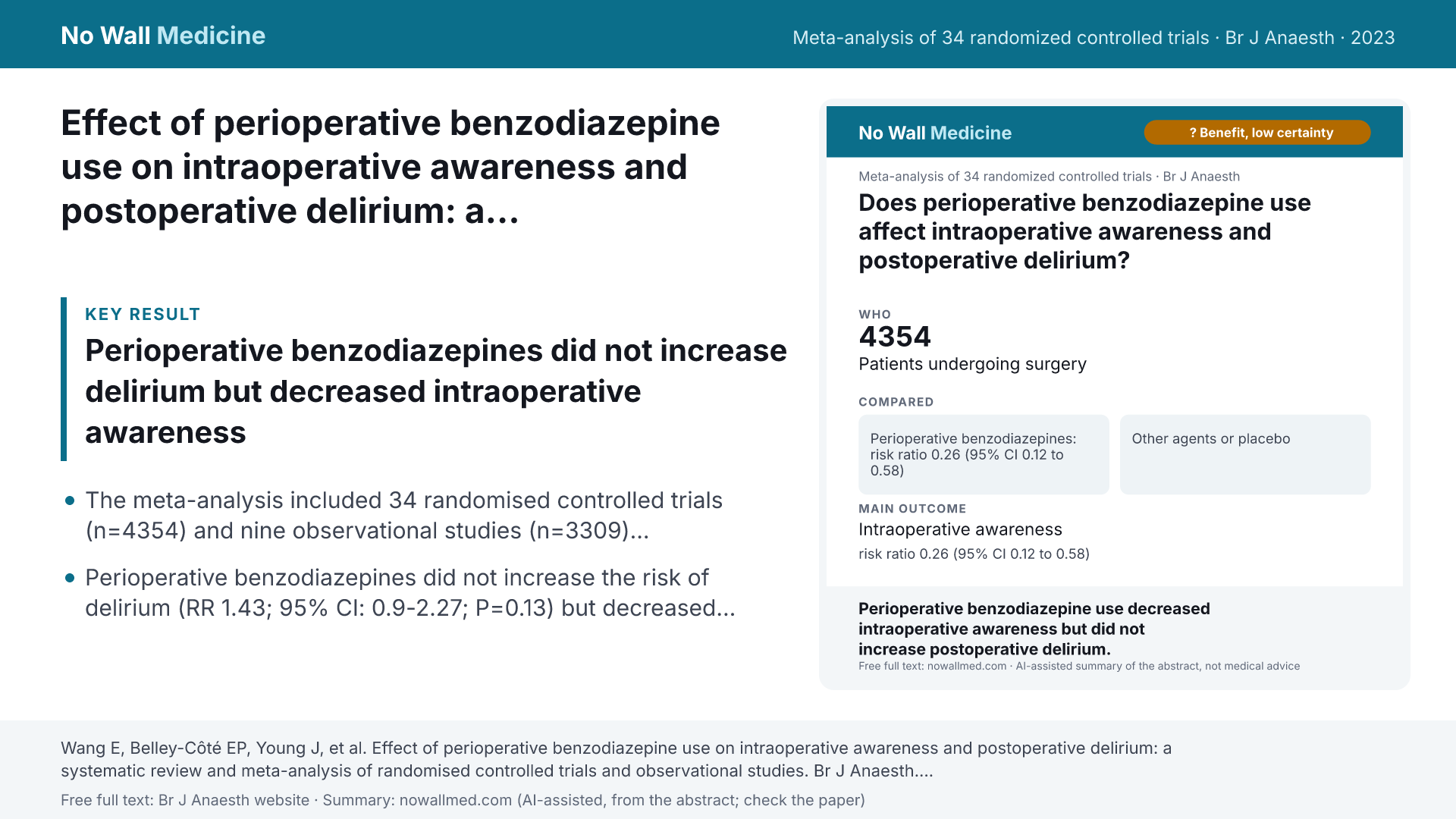
Perioperative benzodiazepines did not increase delirium but decreased intraoperative awareness
Effect of perioperative benzodiazepine use on intraoperative awareness and postoperative delirium: a systematic review and meta-analysis of randomised controlled trials and observational studies
Why it matters: Guidelines recommend avoiding benzodiazepines in older patients due to delirium risk, yet their perioperative use remains common because of perceived benefits.
Key points
- The meta-analysis included 34 randomised controlled trials (n=4354) and nine observational studies (n=3309) comparing perioperative benzodiazepines with other agents or placebo.
- Perioperative benzodiazepines did not increase the risk of delirium (RR 1.43; 95% CI: 0.9-2.27; P=0.13) but decreased the risk of intraoperative awareness (RR 0.26; 95% CI: 0.12-0.58; P=0.001).
- Using benzodiazepines instead of dexmedetomidine increased the risk of delirium (RR 1.83; 95% CI: 1.24-2.72; P=0.002) in five studies involving 429 patients.
Limitation the authors note: The evidence for the primary outcomes of delirium and intraoperative awareness was rated as very low-quality.
Headline and key points written with AI from the paper’s abstract, with every number checked against it. Read the paper before relying on them.
Was this summary helpful?
Subject terms
Headline, design, result, key points, caveat and citation as plain text.
Cite this article
Wang E, Belley-Côté EP, Young J, et al. Effect of perioperative benzodiazepine use on intraoperative awareness and postoperative delirium: a systematic review and meta-analysis of randomised controlled trials and observational studies. Br J Anaesth. 2023. doi:10.1016/j.bja.2022.12.001
Spotted a mistake? Suggest a correction