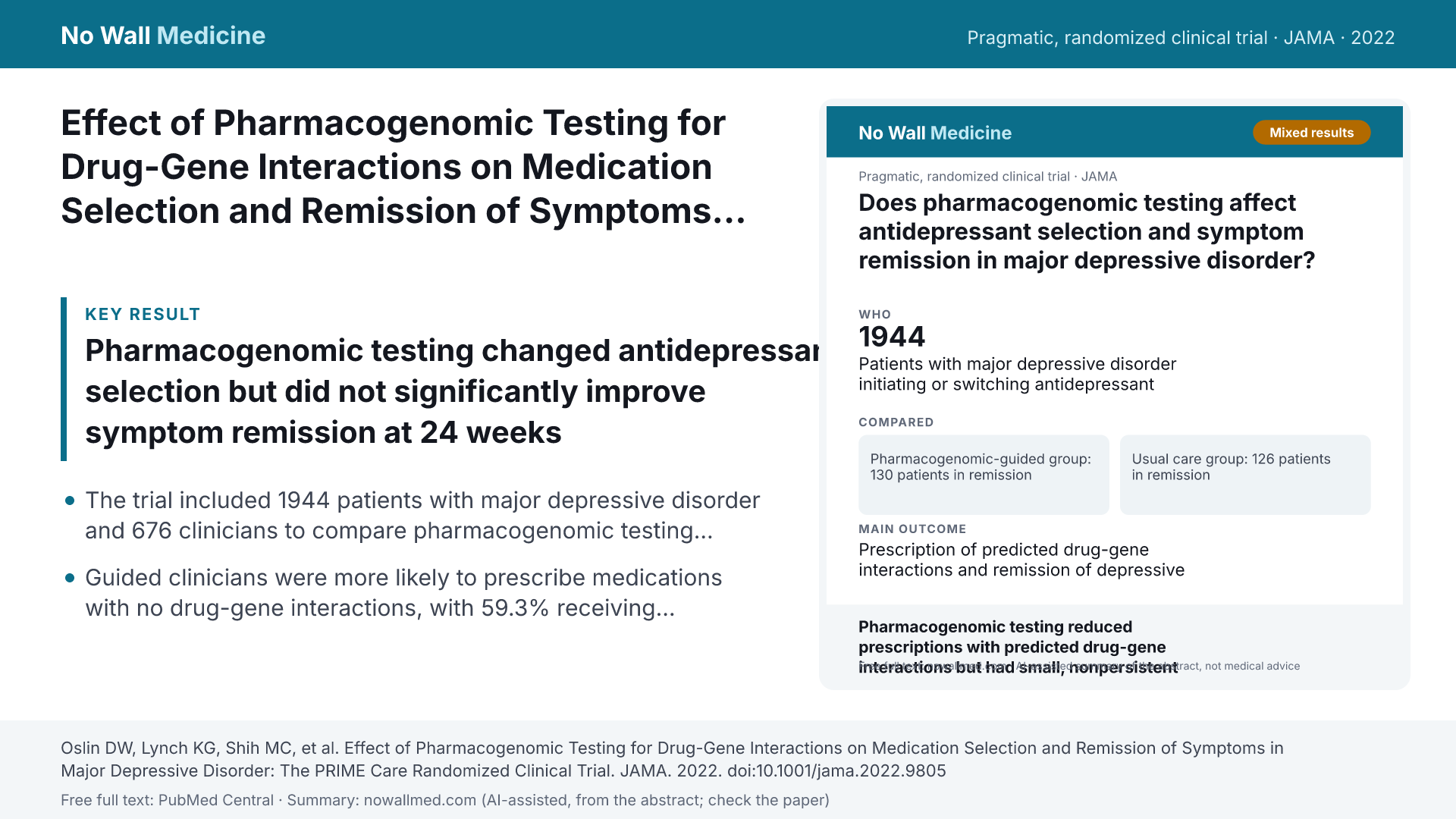
Effect of Pharmacogenomic Testing for Drug-Gene Interactions on Medication Selection and Remission of Symptoms in Major Depressive Disorder: The PRIME Care Randomized Clinical Trial
Key result: Pharmacogenomic testing changed antidepressant selection but did not significantly improve symptom remission at 24 weeks
Key points
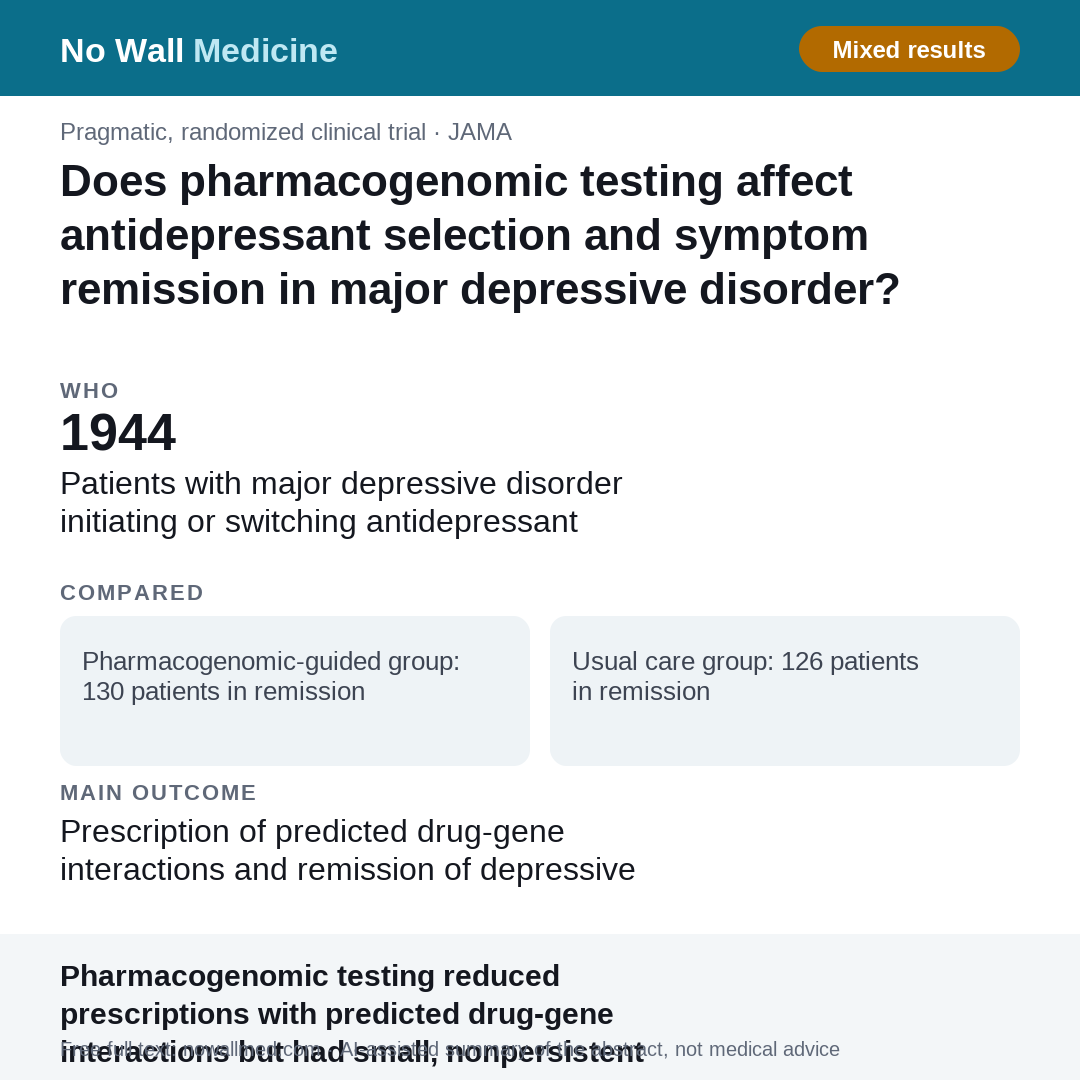
- The trial included 1944 patients with major depressive disorder and 676 clinicians to compare pharmacogenomic testing against usual care.
- Guided clinicians were more likely to prescribe medications with no drug-gene interactions, with 59.3% receiving none compared to 25.7% in the usual care group.
- While remission rates were higher during the 24-week period, the difference was not statistically significant at week 24 with 130 guided patients and 126 usual care patients in remission.
Why it matters: It is unknown if using genetic testing to guide antidepressant selection improves clinical outcomes for patients with major depressive disorder.
Discussion prompts
- Would these patients look like yours? Who was left out?
- Is the main outcome one that matters to patients?
- Is the difference large enough to change what you do?
Cite: Oslin DW, Lynch KG, Shih MC, Ingram EP, Wray LO, Chapman SR. Effect of Pharmacogenomic Testing for Drug-Gene Interactions on Medication Selection and Remission of Symptoms in Major Depressive Disorder: The PRIME Care Randomized Clinical Trial. JAMA. 2022. doi:10.1001/jama.2022.9805
Free full text: PubMed Central · Summary and visual abstract: nowallmed.com/a/effect-of-pharmacogenomic-testing-for-drug-gene-interactions-on-8ylrd2/ (AI-assisted from the abstract; check the paper before relying on it).