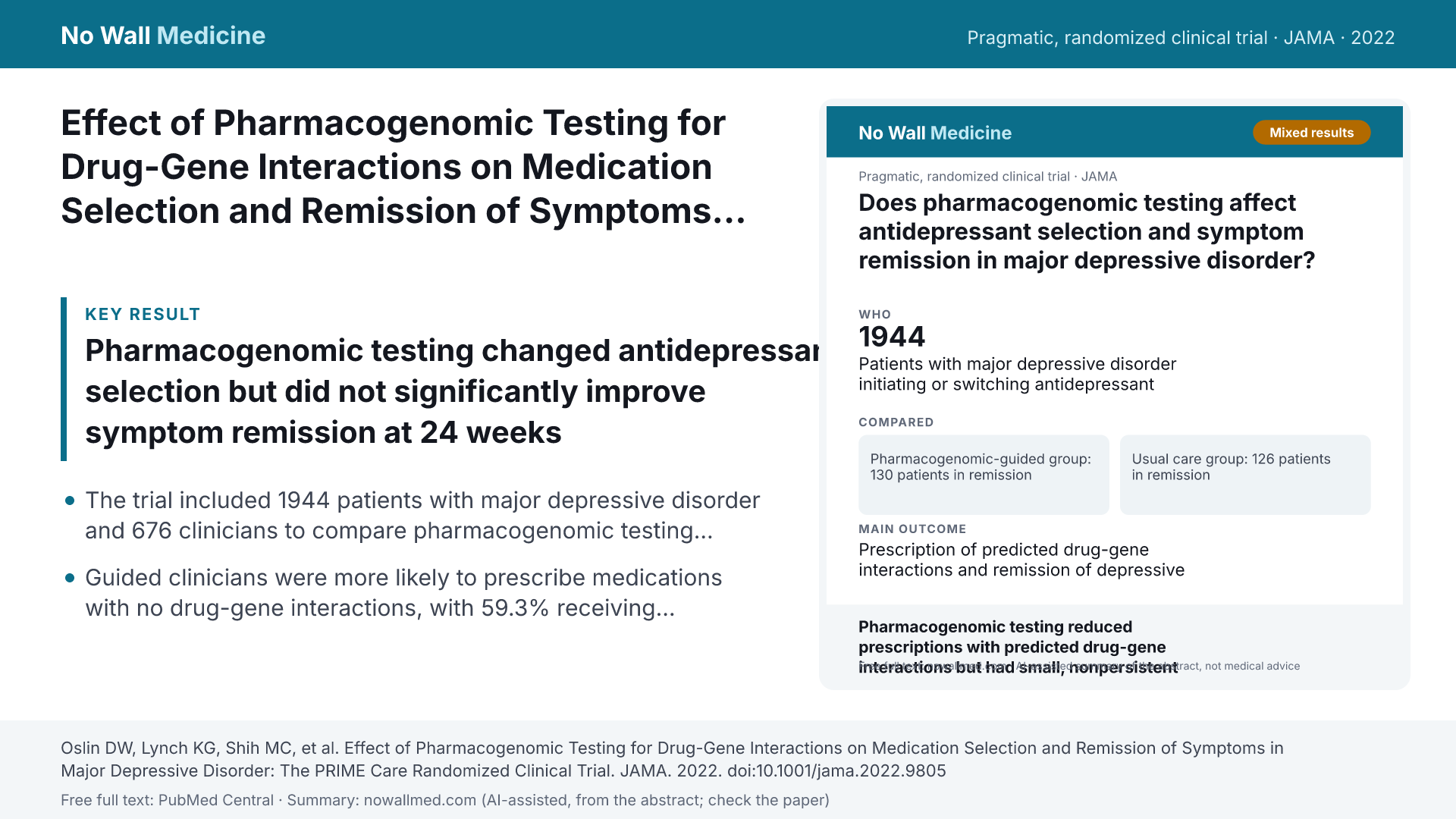
Pharmacogenomic testing changed antidepressant selection but did not significantly improve symptom remission at 24 weeks
Effect of Pharmacogenomic Testing for Drug-Gene Interactions on Medication Selection and Remission of Symptoms in Major Depressive Disorder: The PRIME Care Randomized Clinical Trial
Pragmatic, randomized clinical trialMixed results
Does pharmacogenomic testing affect antidepressant selection and symptom remission in major depressive disorder?
Who
1944
Patients with major depressive disorder initiating or switching antidepressant treatment · 22 Department of Veterans Affairs medical centers
Compared
Pharmacogenomic-guided group: 130 patients in remission
Usual care group: 126 patients in remission
Main outcome
Prescription of predicted drug-gene interactions and remission of depressive symptoms
Result: risk difference, 1.5% (95% CI -2.4% to 5.3%)
Bottom line: Pharmacogenomic testing reduced prescriptions with predicted drug-gene interactions but had small, nonpersistent effects on symptom remission.
JAMA · 2022-07-12Download image
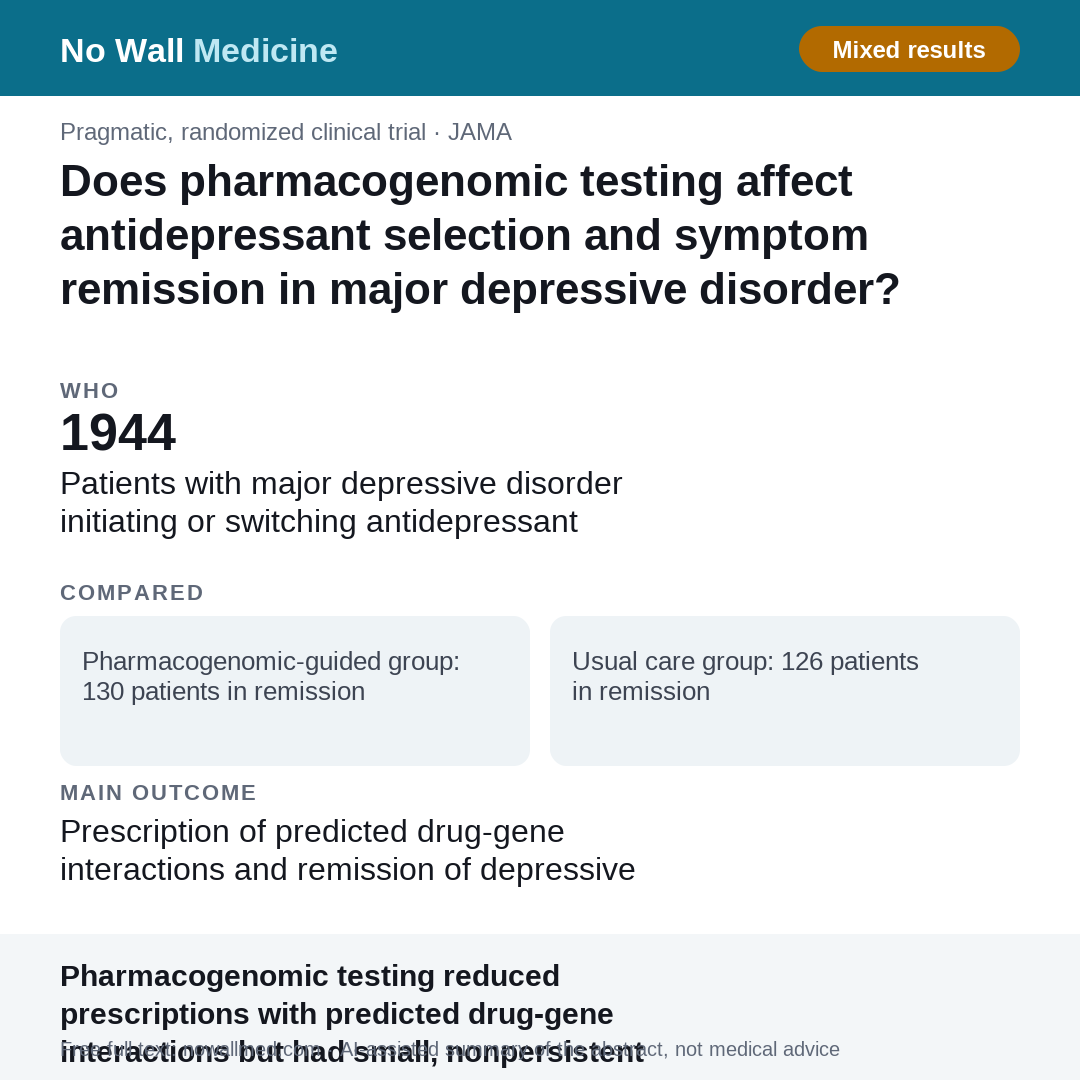
Clinical question: Does pharmacogenomic testing affect antidepressant selection and symptom remission in major depressive disorder?
Why it matters: It is unknown if using genetic testing to guide antidepressant selection improves clinical outcomes for patients with major depressive disorder.
Key points
- The trial included 1944 patients with major depressive disorder and 676 clinicians to compare pharmacogenomic testing against usual care.
- Guided clinicians were more likely to prescribe medications with no drug-gene interactions, with 59.3% receiving none compared to 25.7% in the usual care group.
- While remission rates were higher during the 24-week period, the difference was not statistically significant at week 24 with 130 guided patients and 126 usual care patients in remission.
Headline and key points written with AI from the paper’s abstract, with every number checked against it. Read the paper before relying on them.
Was this summary helpful?
Subject terms
Cite this article
Oslin DW, Lynch KG, Shih MC, Ingram EP, Wray LO, Chapman SR. Effect of Pharmacogenomic Testing for Drug-Gene Interactions on Medication Selection and Remission of Symptoms in Major Depressive Disorder: The PRIME Care Randomized Clinical Trial. JAMA. 2022. doi:10.1001/jama.2022.9805
Spotted a mistake? Suggest a correction
Top studies every Monday
The week’s key trials and guidelines in your specialties, plus any topics you follow. By email, free.
Get the weekly digest