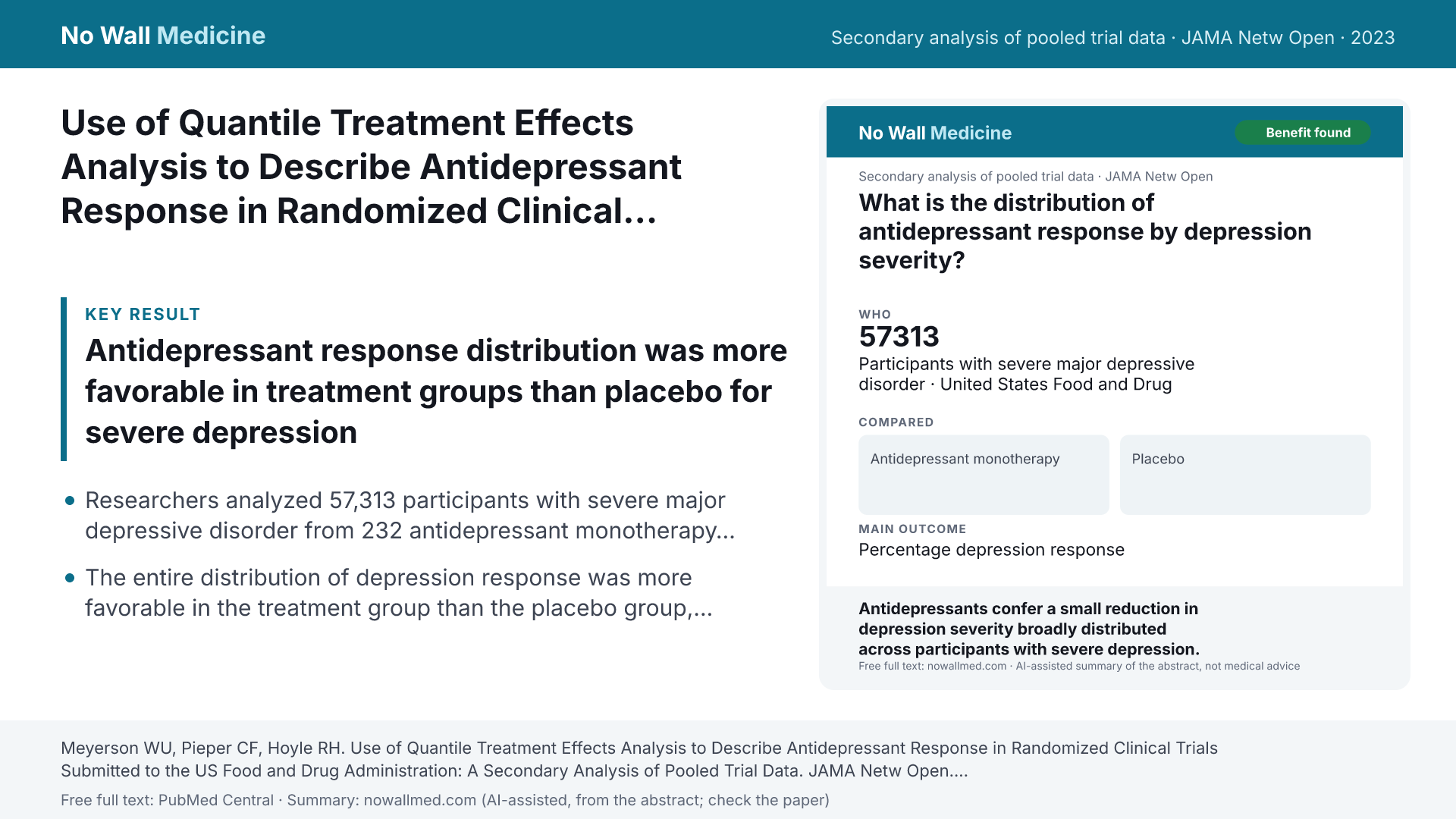
Antidepressant response distribution was more favorable in treatment groups than placebo for severe depression
Use of Quantile Treatment Effects Analysis to Describe Antidepressant Response in Randomized Clinical Trials Submitted to the US Food and Drug Administration: A Secondary Analysis of Pooled Trial Data
Secondary analysis of pooled trial dataBenefit found
What is the distribution of antidepressant response by depression severity?
Who
57313
Participants with severe major depressive disorder · United States Food and Drug Administration database
Compared
Antidepressant monotherapy
Placebo
Main outcome
Percentage depression response
Result: absolute improvement in depression due to active drug of 13.5% (95% CI, 12.4%-14.4%)
Bottom line: Antidepressants confer a small reduction in depression severity broadly distributed across participants with severe depression.
JAMA Netw Open · 2023-06-01Download image
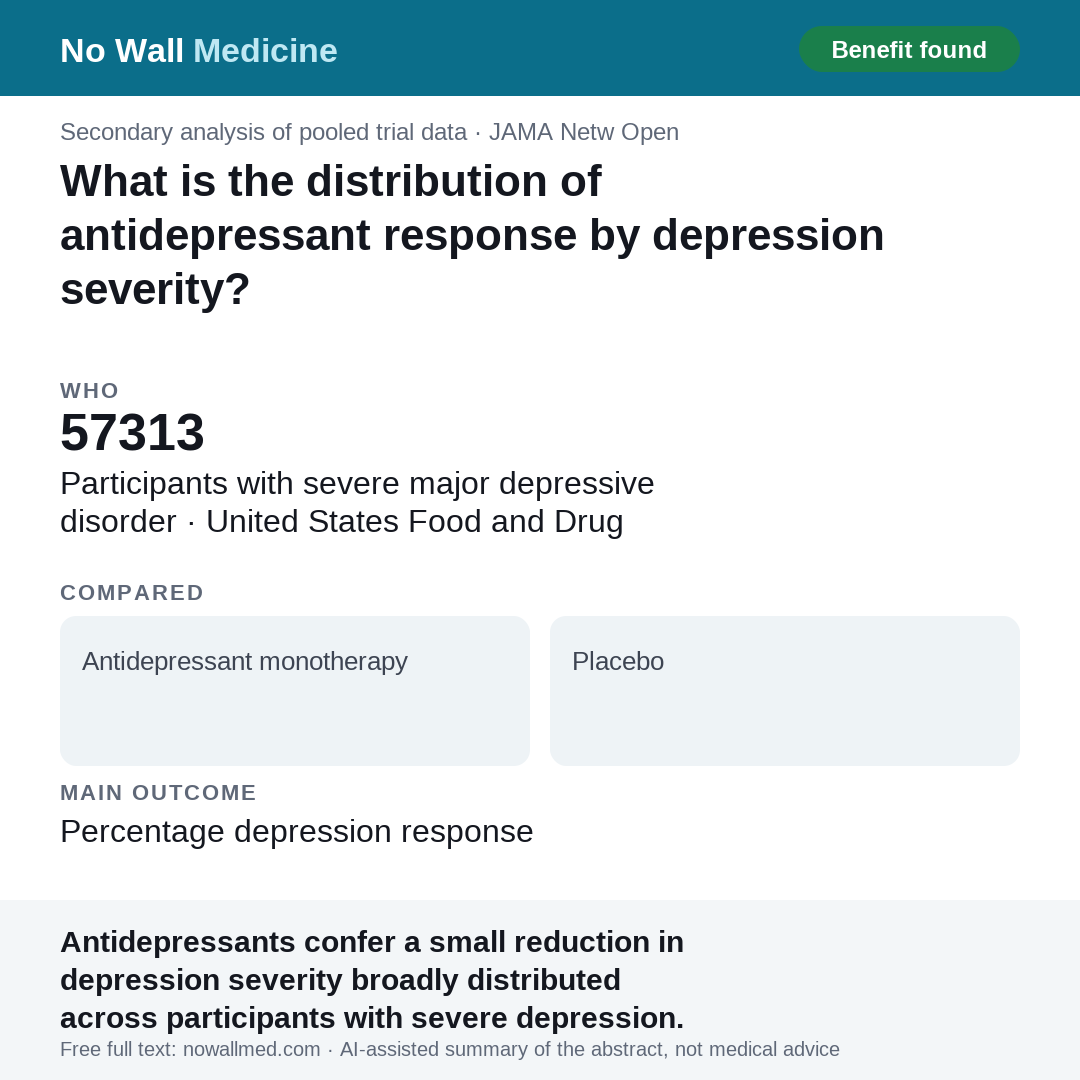
Clinical question: What is the distribution of antidepressant response by depression severity?
Why it matters: While average antidepressant effects are known, the full distribution of symptom reduction across different levels of response remains unknown.
Key points
- Researchers analyzed 57,313 participants with severe major depressive disorder from 232 antidepressant monotherapy trials submitted to the FDA between 1979 and 2016.
- The entire distribution of depression response was more favorable in the treatment group than the placebo group, with maximum separation at the 55th quantile.
- The maximum absolute improvement in depression due to active drug was 13.5% (95% CI, 12.4%-14.4%) at the 55th quantile.
Limitation the authors note: The authors state that if the assumptions behind the quantile treatment effect analysis are not met, the data could be compatible with antidepressants eliciting more complete response in a smaller subset of participants.
Headline and key points written with AI from the paper’s abstract, with every number checked against it. Read the paper before relying on them.
Was this summary helpful?
Subject terms
Cite this article
Meyerson WU, Pieper CF, Hoyle RH. Use of Quantile Treatment Effects Analysis to Describe Antidepressant Response in Randomized Clinical Trials Submitted to the US Food and Drug Administration: A Secondary Analysis of Pooled Trial Data. JAMA Netw Open. 2023. doi:10.1001/jamanetworkopen.2023.17714
Spotted a mistake? Suggest a correction