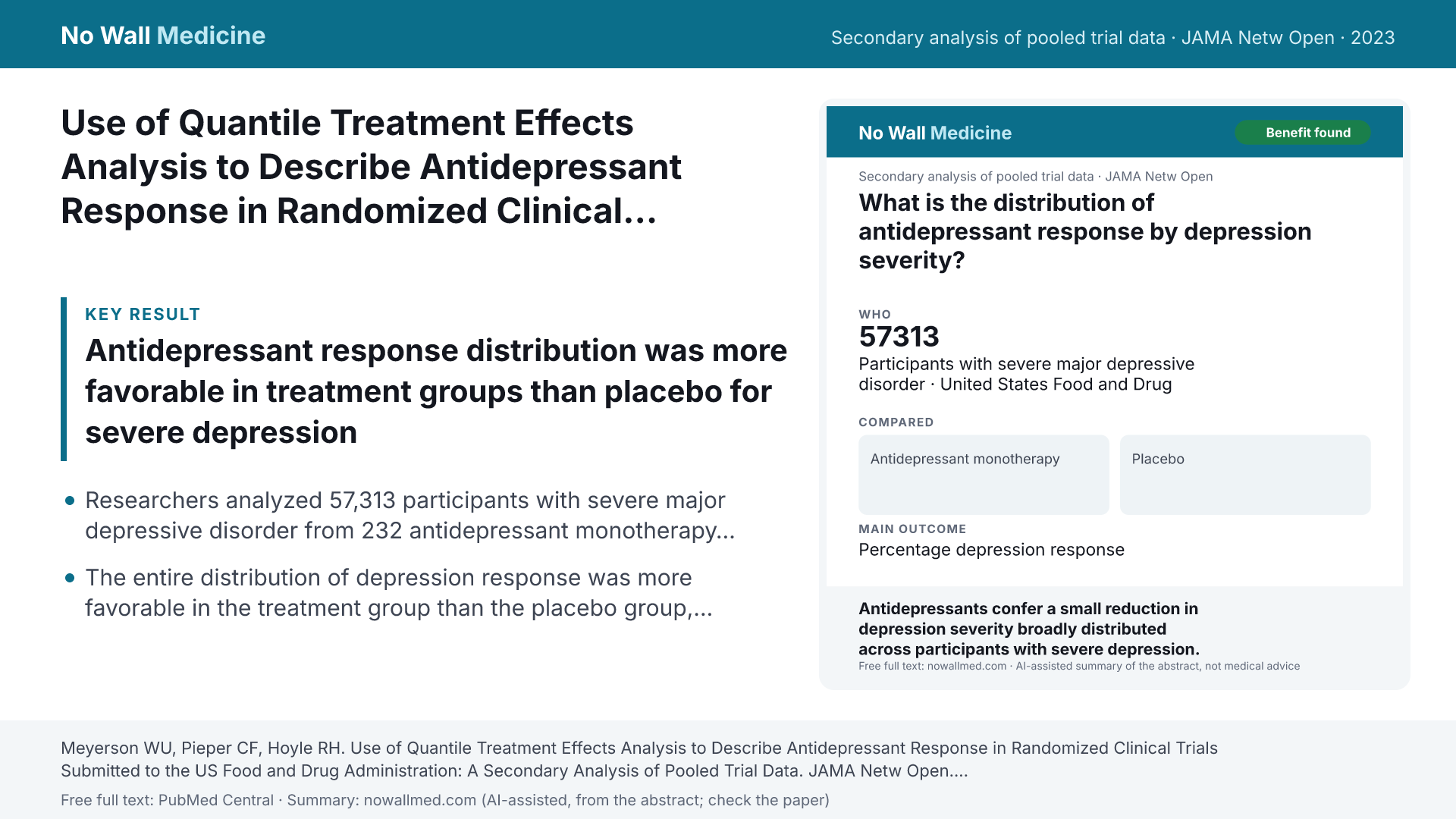
Use of Quantile Treatment Effects Analysis to Describe Antidepressant Response in Randomized Clinical Trials Submitted to the US Food and Drug Administration: A Secondary Analysis of Pooled Trial Data
Key result: Antidepressant response distribution was more favorable in treatment groups than placebo for severe depression
Key points
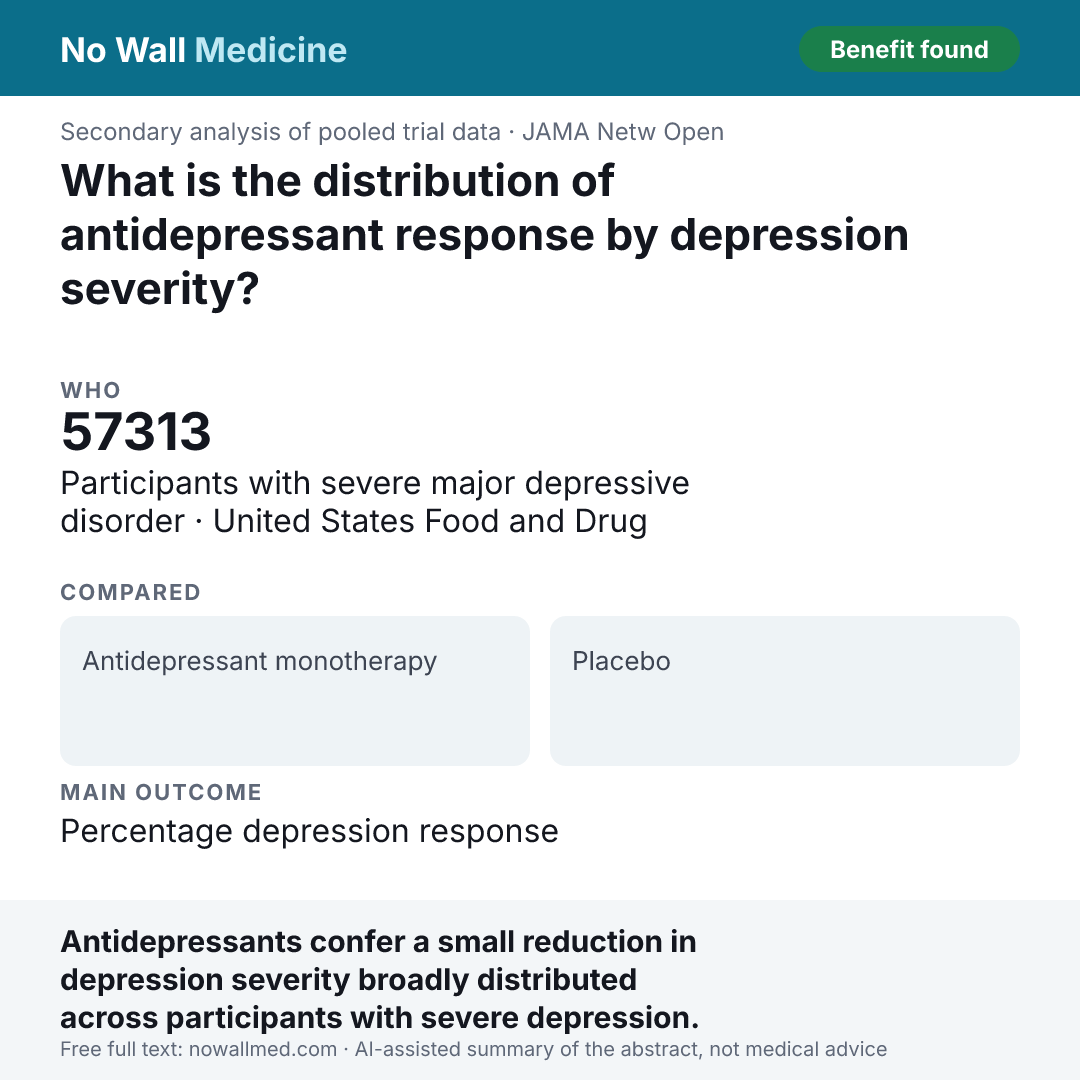
- Researchers analyzed 57,313 participants with severe major depressive disorder from 232 antidepressant monotherapy trials submitted to the FDA between 1979 and 2016.
- The entire distribution of depression response was more favorable in the treatment group than the placebo group, with maximum separation at the 55th quantile.
- The maximum absolute improvement in depression due to active drug was 13.5% (95% CI, 12.4%-14.4%) at the 55th quantile.
Limitation the authors note: The authors state that if the assumptions behind the quantile treatment effect analysis are not met, the data could be compatible with antidepressants eliciting more complete response in a smaller subset of participants.
Discussion prompts
- Would these patients look like yours? Who was left out?
- Is the main outcome one that matters to patients?
- Is the difference large enough to change what you do?
Cite: Meyerson WU, Pieper CF, Hoyle RH. Use of Quantile Treatment Effects Analysis to Describe Antidepressant Response in Randomized Clinical Trials Submitted to the US Food and Drug Administration: A Secondary Analysis of Pooled Trial Data. JAMA Netw Open. 2023;6(6):e2317714. doi:10.1001/jamanetworkopen.2023.17714
Free full text: PubMed Central · Summary and visual abstract: nowallmed.com/a/use-of-quantile-treatment-effects-analysis-to-describe-antidepressant-45ebs1/ (AI-assisted from the abstract; check the paper before relying on it).