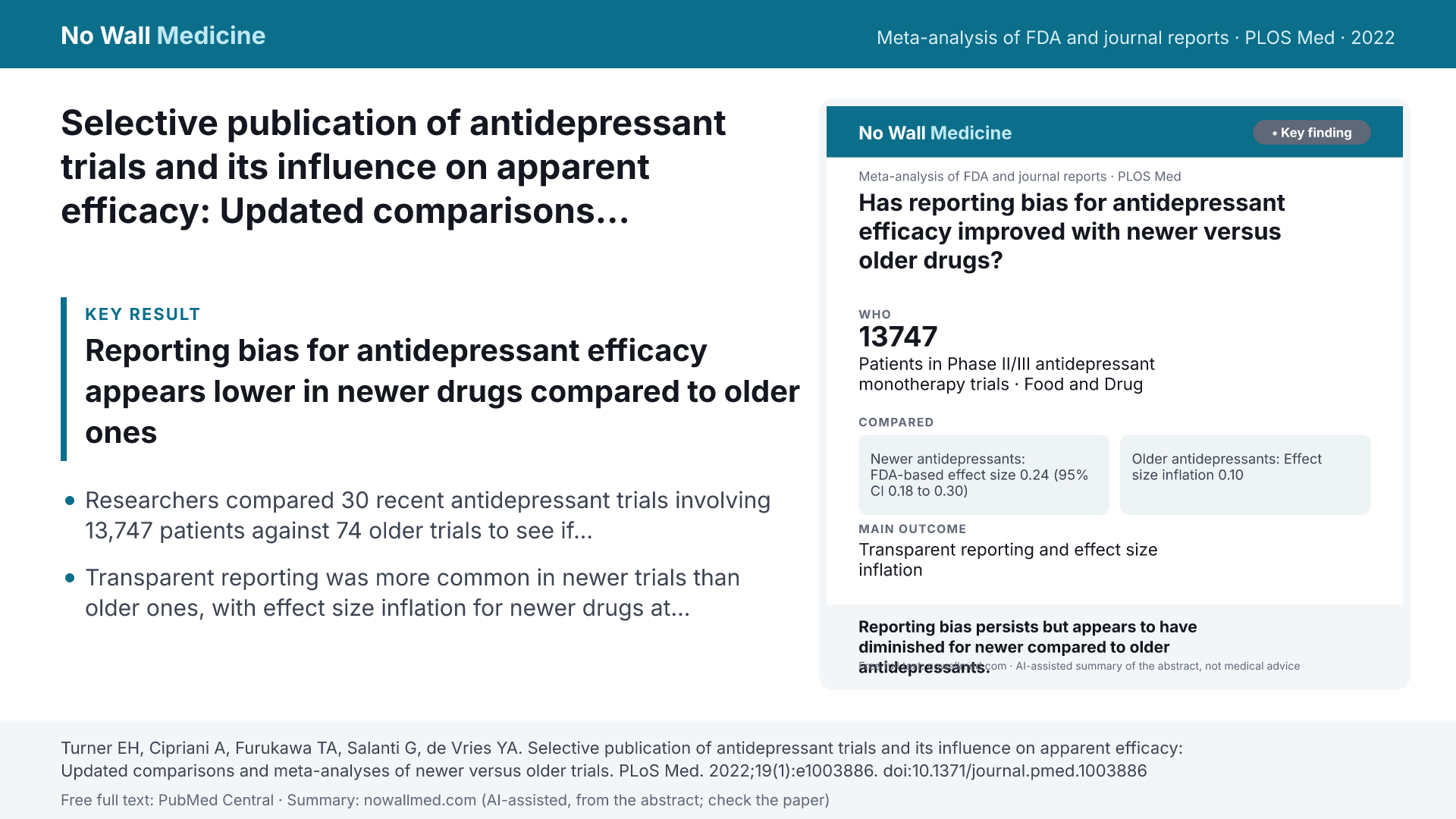
Reporting bias for antidepressant efficacy appears lower in newer drugs compared to older ones
Selective publication of antidepressant trials and its influence on apparent efficacy: Updated comparisons and meta-analyses of newer versus older trials
Meta-analysis of FDA and journal reportsBenefit found
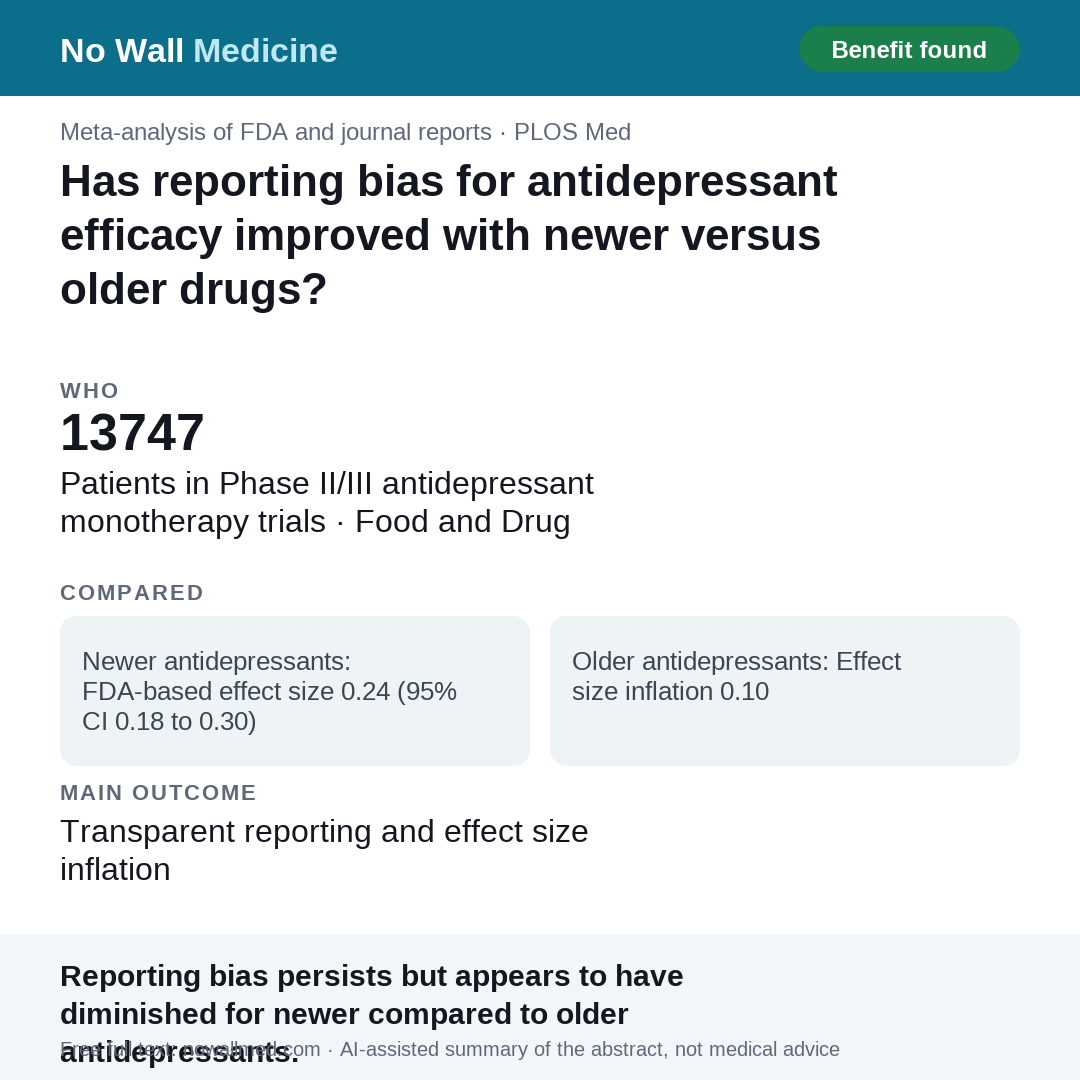
Has reporting bias for antidepressant efficacy improved with newer versus older drugs?
Who
13747
Patients in Phase II/III antidepressant monotherapy trials · Food and Drug Administration drug approval packages
Compared
Newer antidepressants: FDA-based effect size 0.24 (95% CI 0.18 to 0.30)
Older antidepressants: Effect size inflation 0.10
Main outcome
Transparent reporting and effect size inflation
Result: OR 6.6 (95% CI 1.6 to 26.4) for transparent publication
Bottom line: Reporting bias persists but appears to have diminished for newer compared to older antidepressants.
Limitation: Small number of trials, single drug class, and focus on efficacy versus safety.
PLOS Med · 2022-01-19Download image
Clinical question: Has reporting bias for antidepressant efficacy improved with newer versus older drugs?
Why it matters: It was unknown if the inflation of antidepressant efficacy caused by selective publication of trial results has improved for more recently approved medications.
Key points
- Researchers compared 30 recent antidepressant trials involving 13,747 patients against 74 older trials to see if published results matched Food and Drug Administration findings.
- Transparent reporting was more common in newer trials than older ones, with effect size inflation for newer drugs at 0.05 compared to 0.10 for older drugs.
- Among newer antidepressants, transparent publication occurred in 100% of positive trials but only 47% of negative trials.
Limitation the authors note: The study was limited by a small number of trials and drugs belonging to a single class, and it focused on efficacy rather than safety.
Headline and key points written with AI from the paper’s abstract, with every number checked against it. Read the paper before relying on them.
Was this summary helpful?
Subject terms
Cite this article
Turner EH, Cipriani A, Furukawa TA, Salanti G, de Vries YA. Selective publication of antidepressant trials and its influence on apparent efficacy: Updated comparisons and meta-analyses of newer versus older trials. PLOS Med. 2022. doi:10.1371/journal.pmed.1003886
Spotted a mistake? Suggest a correction