Noninvasive ventilation with active humidification was superior to high-flow nasal cannula for preventing reintubation
Effect of postextubation noninvasive ventilation with active humidification vs high-flow nasal cannula on reintubation in patients at very high risk for extubation failure: a randomized trial
Randomized controlled trialBenefit found
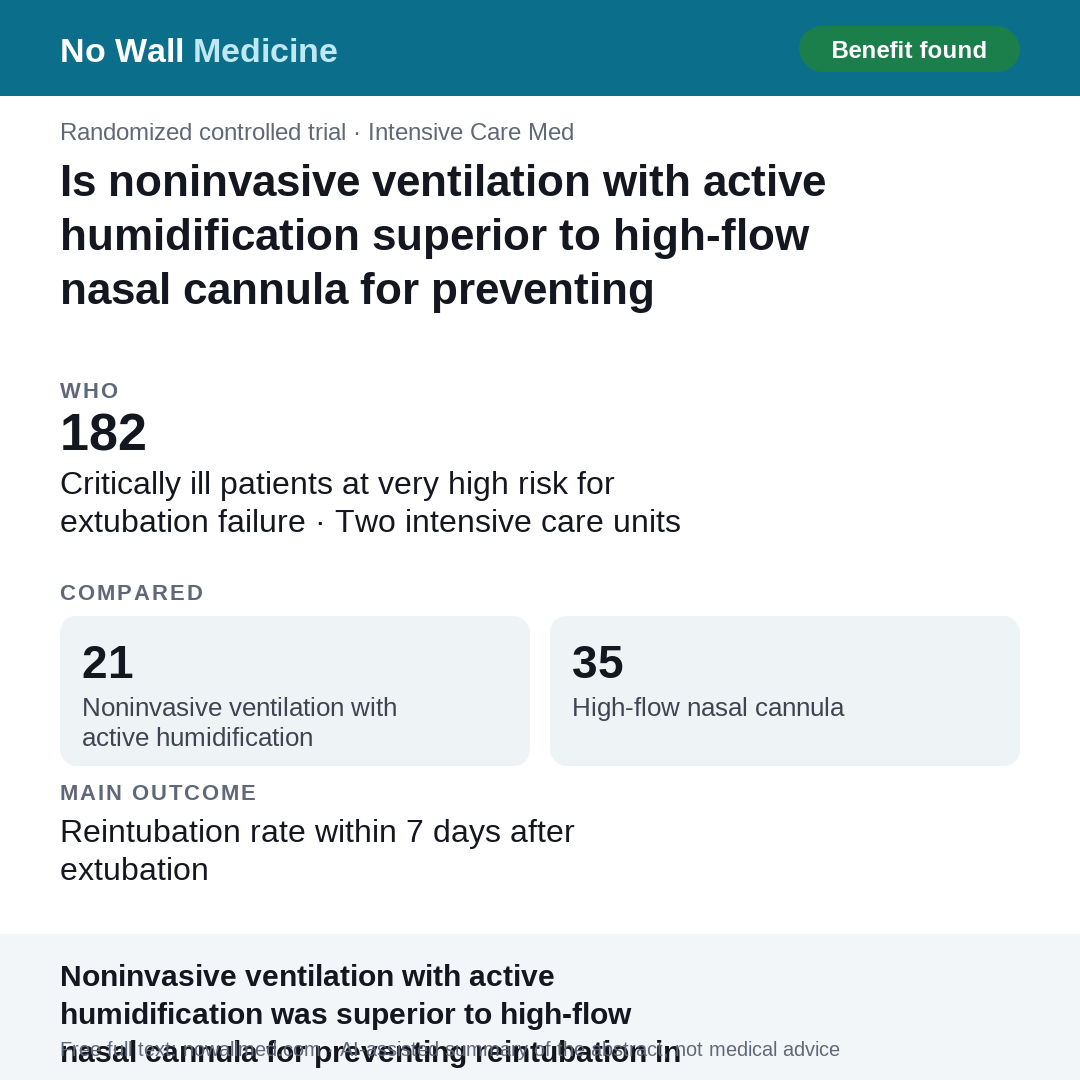
Is noninvasive ventilation with active humidification superior to high-flow nasal cannula for preventing reintubation?
Who
182
Critically ill patients at very high risk for extubation failure · Two intensive care units in Spain
Compared
21Noninvasive ventilation with active humidification (23.3%)
35High-flow nasal cannula (38.8%)
Main outcome
Reintubation rate within 7 days after extubation
Result: difference -15.5% (95% CI -28.3 to -1%)
Bottom line: Noninvasive ventilation with active humidification was superior to high-flow nasal cannula for preventing reintubation in very high-risk patients.
Intensive Care Med · 2022-11-18Download image
Clinical question: Is noninvasive ventilation with active humidification superior to high-flow nasal cannula for preventing reintubation?
Why it matters: It was unknown if noninvasive ventilation with active humidification is superior to high-flow nasal cannula for preventing reintubation in patients with 4 or more risk factors.
Key points
- Researchers studied 182 patients at very high risk for extubation failure who were randomized to receive either noninvasive ventilation with active humidification or high-flow nasal cannula for 48 hours.
- Reintubation occurred in 21 (23.3%) patients receiving noninvasive ventilation compared to 35 (38.8%) patients receiving high-flow nasal cannula, a difference of -15.5%.
- Hospital length of stay was lower in the noninvasive ventilation group at 20 days compared to 26.5 days in the high-flow nasal cannula group.
Headline and key points written with AI from the paper’s abstract, with every number checked against it. Read the paper before relying on them.
Was this summary helpful?
Subject terms
Cite this article
Hernández G, Paredes I, Moran F, Buj M, Colinas L, Rodríguez ML. Effect of postextubation noninvasive ventilation with active humidification vs high-flow nasal cannula on reintubation in patients at very high risk for extubation failure: a randomized trial. Intensive Care Med. 2022. doi:10.1007/s00134-022-06919-3
Spotted a mistake? Suggest a correction
Top studies every Monday
The week’s key trials and guidelines in your specialties, plus any topics you follow. By email, free.
Get the weekly digest