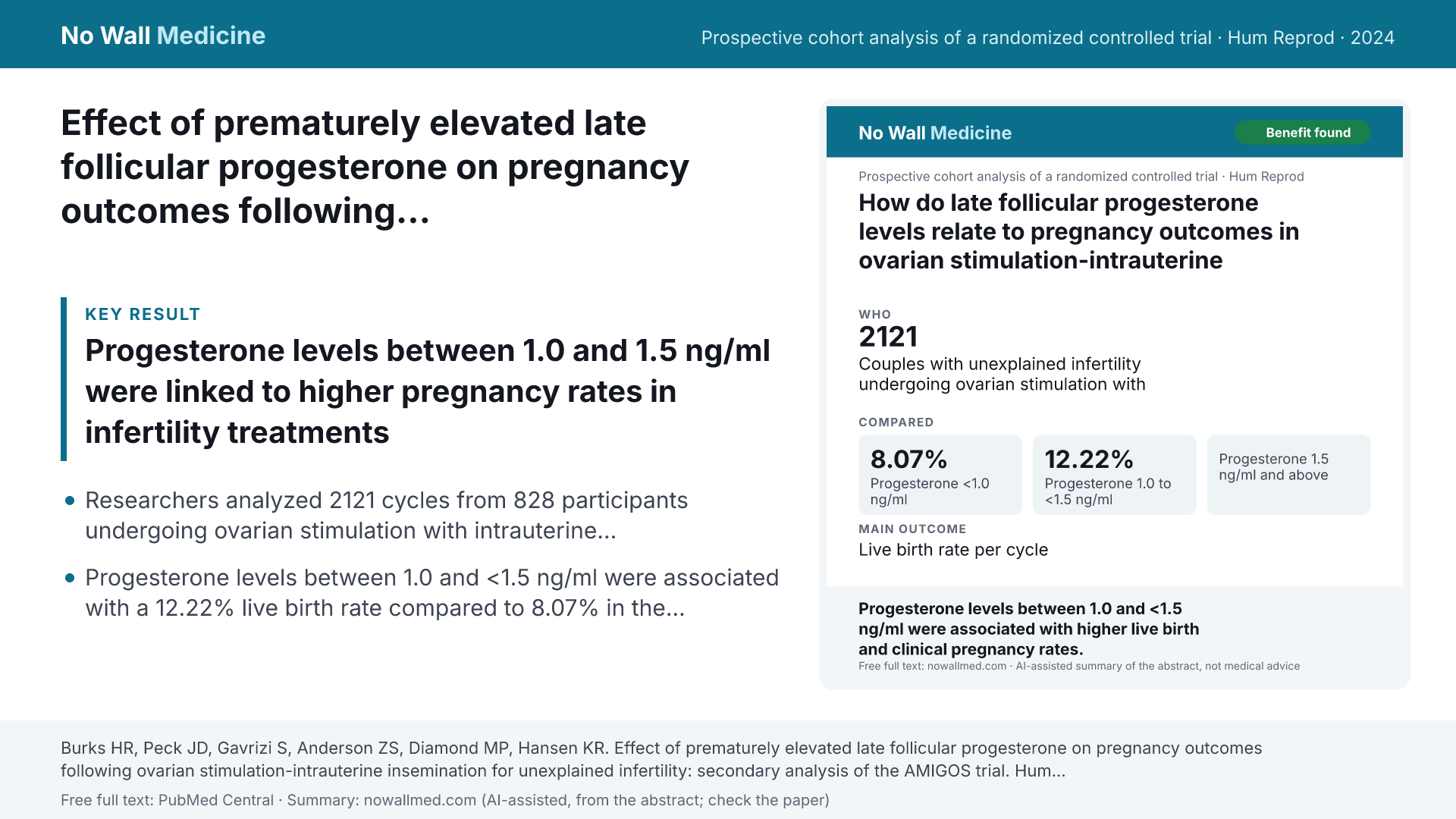
Progesterone levels between 1.0 and 1.5 ng/ml were linked to higher pregnancy rates in infertility treatments
Effect of prematurely elevated late follicular progesterone on pregnancy outcomes following ovarian stimulation-intrauterine insemination for unexplained infertility: secondary analysis of the AMIGOS trial
Prospective cohort analysis of a randomized controlled trialBenefit found
How do late follicular progesterone levels relate to pregnancy outcomes in ovarian stimulation-intrauterine insemination?
Who
2121
Couples with unexplained infertility undergoing ovarian stimulation with intrauterine insemination
Compared
8.07%Progesterone <1.0 ng/ml
12.22%Progesterone 1.0 to <1.5 ng/ml
Progesterone 1.5 ng/ml and above
Main outcome
Live birth rate per cycle
Result: RR 1.51 (95% CI 1.10 to 2.06)
Bottom line: Progesterone levels between 1.0 and <1.5 ng/ml were associated with higher live birth and clinical pregnancy rates.
Limitation: The trial was not designed for this question and some categories were underpowered.
Hum Reprod · 2024-06-01 · Save PNG
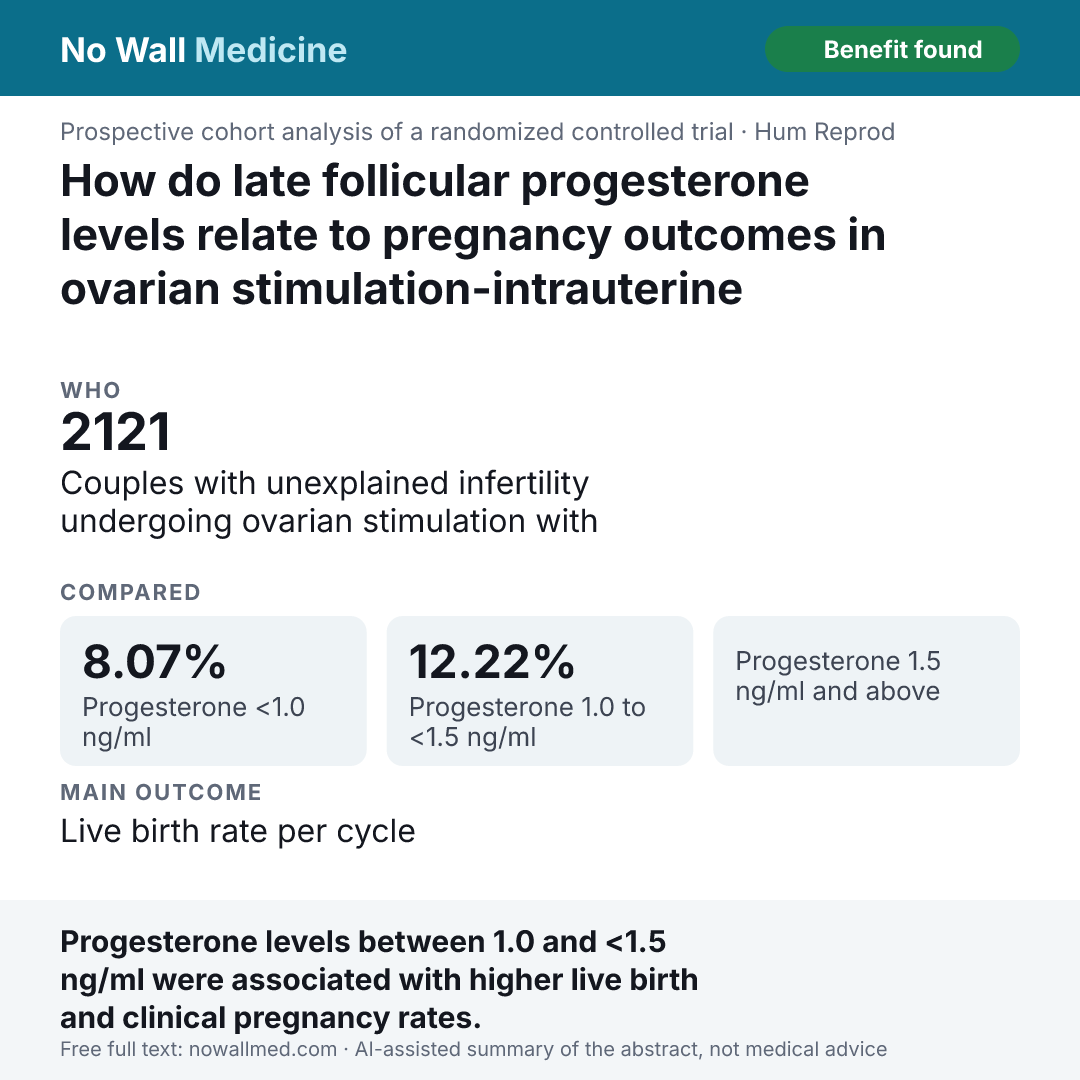
Clinical question: How do late follicular progesterone levels relate to pregnancy outcomes in ovarian stimulation-intrauterine insemination?
Key points
- Researchers analyzed 2121 cycles from 828 participants undergoing ovarian stimulation with intrauterine insemination for unexplained infertility.
- Progesterone levels between 1.0 and <1.5 ng/ml were associated with a 12.22% live birth rate compared to 8.07% in the <1.0 ng/ml group.
- Clinical pregnancy rates were also higher in the 1.0 to <1.5 ng/ml group at 13.72% compared to 9.54% in the reference group.
Limitation the authors note: The study was not designed to answer this specific question and had small numbers in some progesterone categories, which may have limited the ability to detect differences.
Headline and key points written with AI from the paper’s abstract, with every number checked against it. Read the paper before relying on them.
Was this summary helpful?
Subject terms
Headline, design, result, key points, caveat and citation as plain text.
Cite this article
Burks HR, Peck JD, Gavrizi S, Anderson ZS, Diamond MP, Hansen KR. Effect of prematurely elevated late follicular progesterone on pregnancy outcomes following ovarian stimulation-intrauterine insemination for unexplained infertility: secondary analysis of the AMIGOS trial. Hum Reprod. 2024;39(8):1684-1691. doi:10.1093/humrep/deae113
Spotted a mistake? Suggest a correction