Three prenatal nutritional supplementation strategies showed no significant difference in birth weight or maternal weight gain
Effect of prenatal multiple micronutrient supplements and medium-quantity lipid-based nutritional supplements on maternal weight gain and infant birth weight in rural Niger: a cluster-randomised trial
Cluster-randomised trialNo clear difference
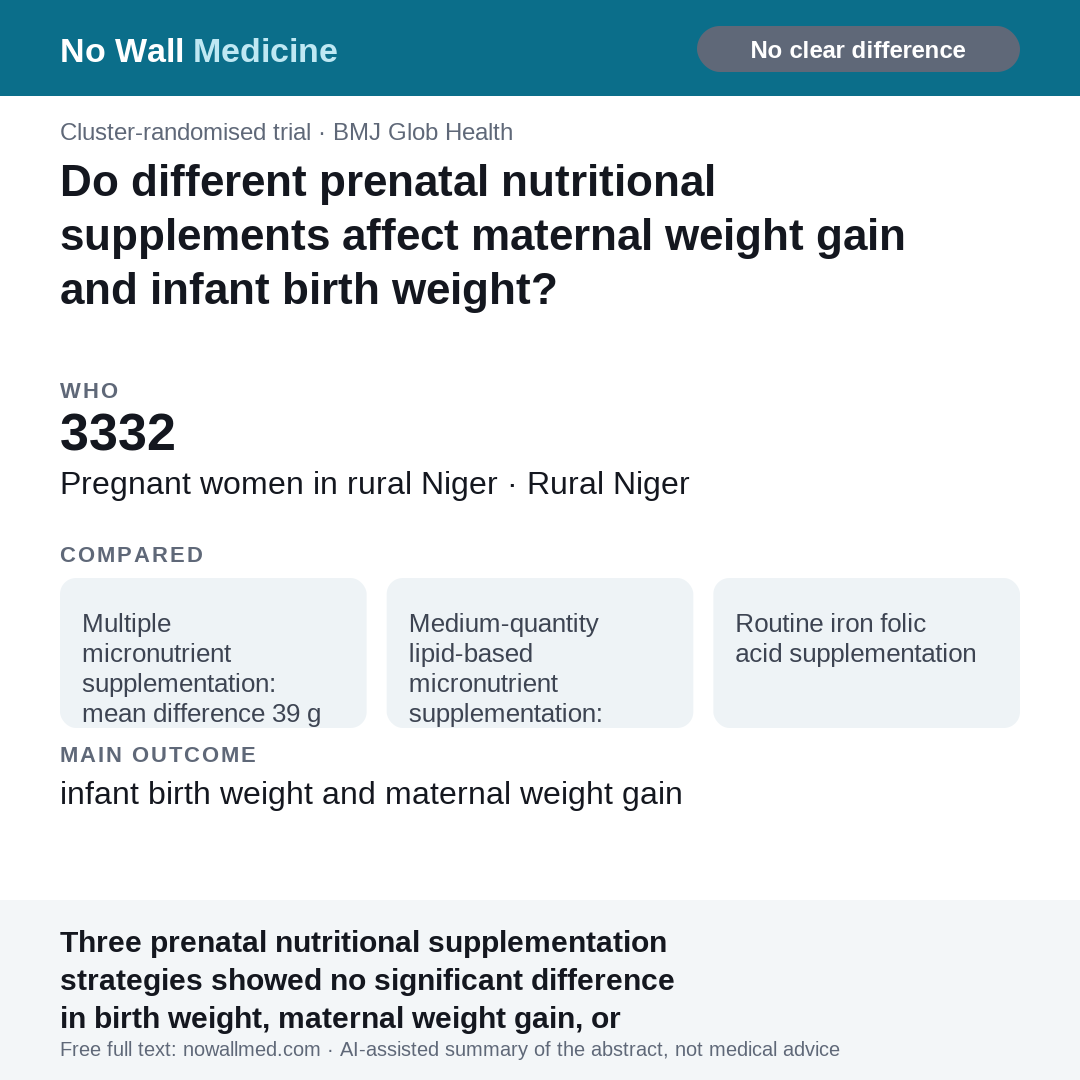
Do different prenatal nutritional supplements affect maternal weight gain and infant birth weight?
Who
3332
Pregnant women in rural Niger · Rural Niger
Compared
Multiple micronutrient supplementation: mean difference 39 g (95% CI -55, 134)
Medium-quantity lipid-based micronutrient supplementation: mean difference 50 g (95% CI -55, 156)
Routine iron folic acid supplementation
Main outcome
infant birth weight and maternal weight gain
Bottom line: Three prenatal nutritional supplementation strategies showed no significant difference in birth weight, maternal weight gain, or anaemia.
Limitation: statistical power in the trial was limited
BMJ Glob Health · 2025-11-03Download image
Clinical question: Do different prenatal nutritional supplements affect maternal weight gain and infant birth weight?
Why it matters: Poor maternal nutrition and weight gain during pregnancy are associated with low birth weight and increased infant mortality.
Key points
- Researchers conducted a cluster-randomised trial in rural Niger involving 3332 pregnant women receiving either multiple micronutrients, lipid-based supplements, or routine iron folic acid.
- No significant differences were found in infant birth weight, maternal weight gain, or maternal haemoglobin levels between the supplementation groups.
- Mean differences in birth weight compared to routine iron folic acid were 39 g for multiple micronutrients and 50 g for lipid-based supplements.
Limitation the authors note: The authors state that statistical power in the trial was limited.
Headline and key points written with AI from the paper’s abstract, with every number checked against it. Read the paper before relying on them.
Abstract
Introduction
The risk of adverse birth outcomes, such as low birth weight (<2500 g, LBW), is associated with poor maternal nutrition and weight gain in pregnancy and can increase the risk of infant mortality. We evaluated the effect of three prenatal nutritional supplementation strategies to improve maternal nutrition and adverse pregnancy and birth outcomes. Methods
A cluster-randomised trial of three prenatal nutritional supplements was conducted in rural Niger. Villages (n=53) were randomised to receive either daily prenatal multiple micronutrient supplementation with 20 micronutrients and 30 mg iron (MMN), medium-quantity lipid-based micronutrient supplementation with 30 mg iron and 237 kcal (MQ-LNS), or routine iron folic acid supplementation with 60 mg of iron (IFA). Pregnant women were identified through monthly, community-based pregnancy surveillance. Study outcomes included infant birth weight, maternal weight gain during pregnancy (including total weight gain, rate of weight gain and adequacy of weight gain) and maternal haemoglobin (Hb) concentration and anaemia (Hb <110 g/L) in the second and third trimesters. Results
A total of 3332 pregnant women were enrolled between September 2015 and February 2017. Birth weight did not significantly differ by supplementation group (mean difference MMN vs IFA=39 g, 95% CI -55, 134; mean difference MQ-LNS vs IFA=50 g, 95% CI -55, 156). There was also no statistically significant effect of MMN or MQ-LNS compared with IFA on total weight gain in pregnancy, the rate of weight gain per week during the second and third trimesters or adequacy of gestational weight gain (p values >0.05). We found no effect of MMN or MQ-LNS on maternal haemoglobin concentration or anaemia in the second and third trimesters (p values >0.05). Conclusion
There was no statistically significant difference in birth weight, maternal weight gain or anaemia by prenatal nutritional supplementation strategy. However, statistical power in the trial was limited. A combination of strategies may be required to make large improvements in birth and pregnancy outcomes in rural Niger.
Abstract reproduced under the article’s CC BY NC licence.
Topics
Cite this article
Rattigan SM, Garba S, Plikaytis B, Sudfeld C, Guindo O, Soumana I. Effect of prenatal multiple micronutrient supplements and medium-quantity lipid-based nutritional supplements on maternal weight gain and infant birth weight in rural Niger: a cluster-randomised trial. BMJ Glob Health. 2025. doi:10.1136/bmjgh-2025-021013
Spotted a mistake? Suggest a correction