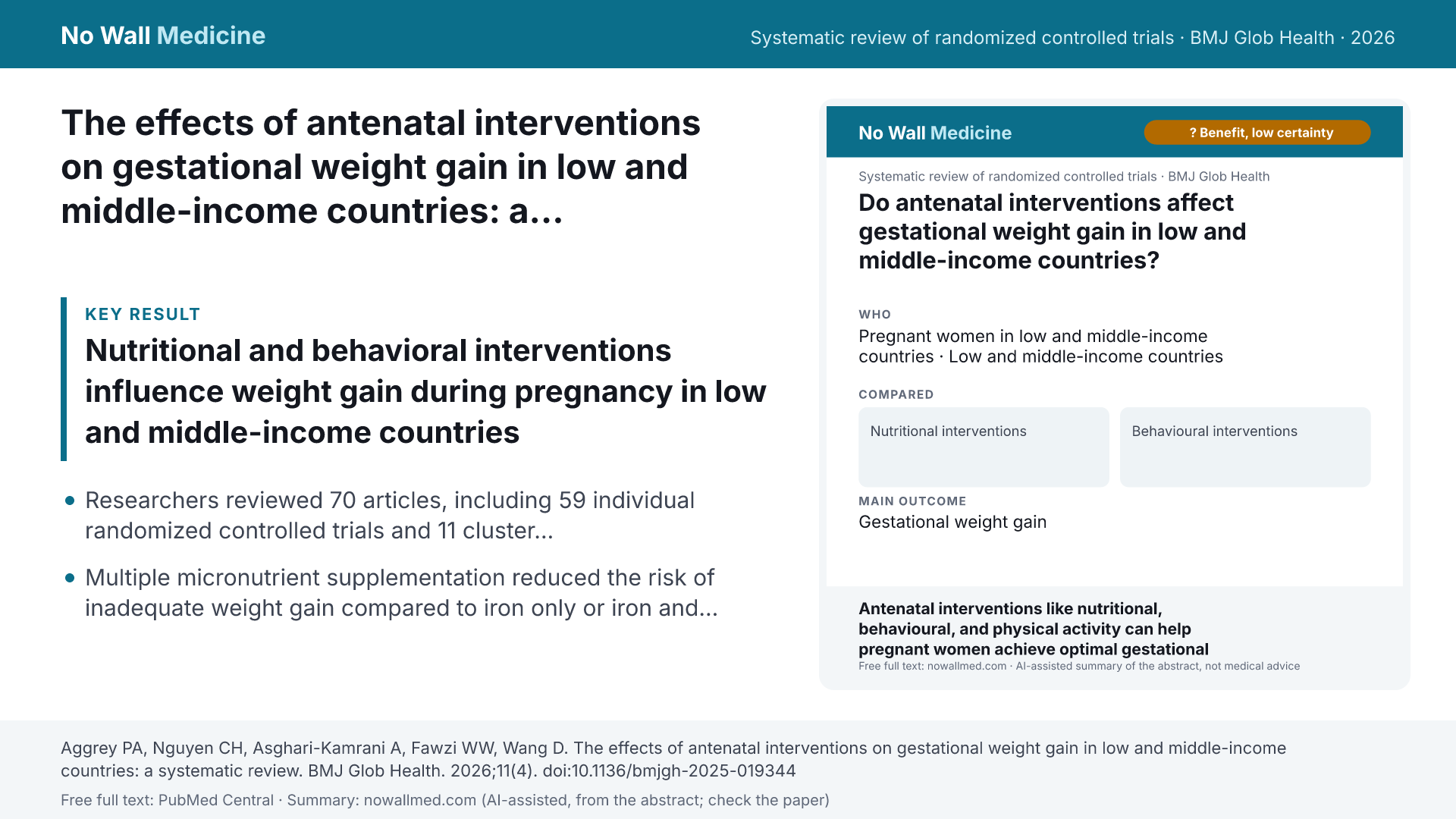
Nutritional and behavioral interventions influence weight gain during pregnancy in low and middle-income countries
The effects of antenatal interventions on gestational weight gain in low and middle-income countries: a systematic review
Systematic review of randomized controlled trialsBenefit, low certainty
Do antenatal interventions affect gestational weight gain in low and middle-income countries?
Who
Pregnant women in low and middle-income countries · Low and middle-income countries
Compared
Nutritional interventions
Behavioural interventions
Main outcome
Gestational weight gain
Bottom line: Antenatal interventions like nutritional, behavioural, and physical activity can help pregnant women achieve optimal gestational weight gain.
BMJ Glob Health · 2026-04-02 · Save PNG
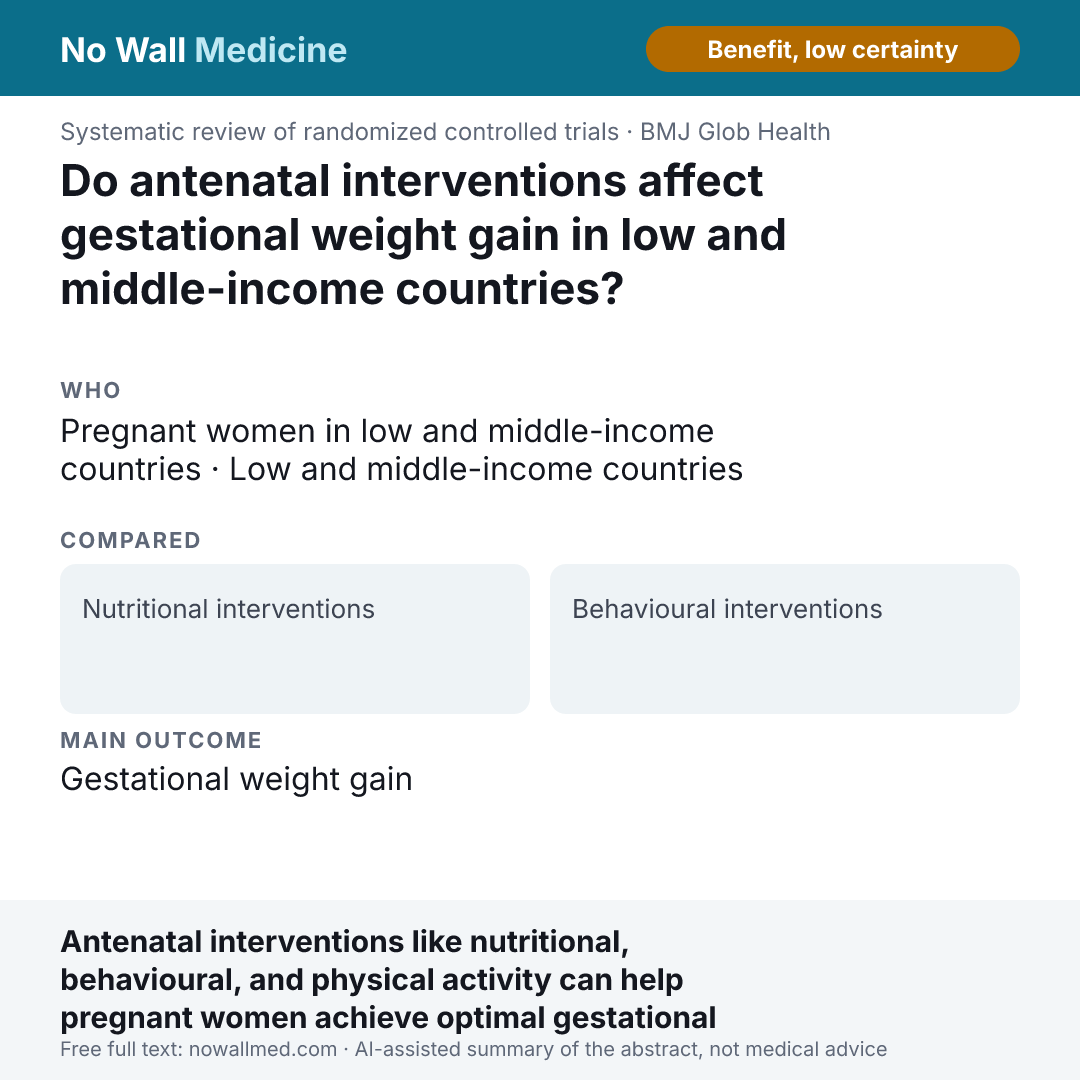
Clinical question: Do antenatal interventions affect gestational weight gain in low and middle-income countries?
Why it matters: Inadequate and excessive weight gain during pregnancy are overlooked challenges affecting maternal and child health in low and middle-income countries.
Key points
- Researchers reviewed 70 articles, including 59 individual randomized controlled trials and 11 cluster randomized controlled trials, regarding pregnancy weight interventions.
- Multiple micronutrient supplementation reduced the risk of inadequate weight gain compared to iron only or iron and folic acid supplementation.
- Behavioral counseling and physical activity were associated with reduced risks of excessive weight gain among pregnant women.
Headline and key points written with AI from the paper’s abstract, with every number checked against it. Read the paper before relying on them.
Was this summary helpful?
Abstract
Background
Gestational weight gain (GWG) during pregnancy is a critical factor that affects maternal and child health outcomes. The considerable burden of inadequate GWG and the rising tide of excessive GWG are overlooked challenges in low and middle-income countries (LMICs). Methods
This systematic review assessed the impact of antenatal interventions on GWG in LMICs. Randomised controlled trials (RCTs) on antenatal interventions on GWG in LMICs were included. These interventions included educational, behavioural, nutritional supplementation and pharmacological therapies. A systematic literature search was conducted using PubMed, Embase, Web of Science, CINAHL and the Cochrane Library from the start of each database through September 2025. Results
Out of the 33 642 unique articles identified, 70 articles were included in our systematic review, with 59 individual RCTs and 11 cluster RCTs. Nutritional interventions (31 studies) included food and micronutrient supplementations. Micronutrient supplementation such as multiple micronutrient supplementations was found to reduce the risk of severely inadequate or inadequate GWG among pregnant women compared to iron only or iron and folic acid supplementation (Grading of Recommendations Assessment, Development and Evaluation [GRADE]: moderate certainty). Food supplementation showed mixed results, although most trials demonstrated higher mean GWG among undernourished pregnant women and a greater likelihood of achieving Institute of Medicine-recommended ranges (GRADE: moderate certainty). Behavioural (counselling/education) interventions (20 studies) were associated with significant reductions in excessive GWG among pregnant women with overweight or obesity and improved adequacy of GWG (GRADE: moderate certainty). Physical activity (seven studies) was found to reduce the risk of excessive GWG (GRADE: moderate certainty). Combined dietary and physical activity interventions (six studies) were found to reduce the risk of excessive GWG among pregnant women (GRADE: low certainty). Conclusions
Well-structured antenatal interventions, initiated before 20 weeks of gestation and continuing beyond this period, tailored to local cultural contexts and available resources, can effectively help pregnant women in LMICs in achieving optimal GWG. Prospero registration number
CRD42022366354.
Abstract reproduced under the article’s CC BY NC licence.
Subject terms
Headline, design, result, key points, caveat and citation as plain text.
Cite this article
Aggrey PA, Nguyen CH, Asghari-Kamrani A, Fawzi WW, Wang D. The effects of antenatal interventions on gestational weight gain in low and middle-income countries: a systematic review. BMJ Glob Health. 2026;11(4). doi:10.1136/bmjgh-2025-019344
Spotted a mistake? Suggest a correction