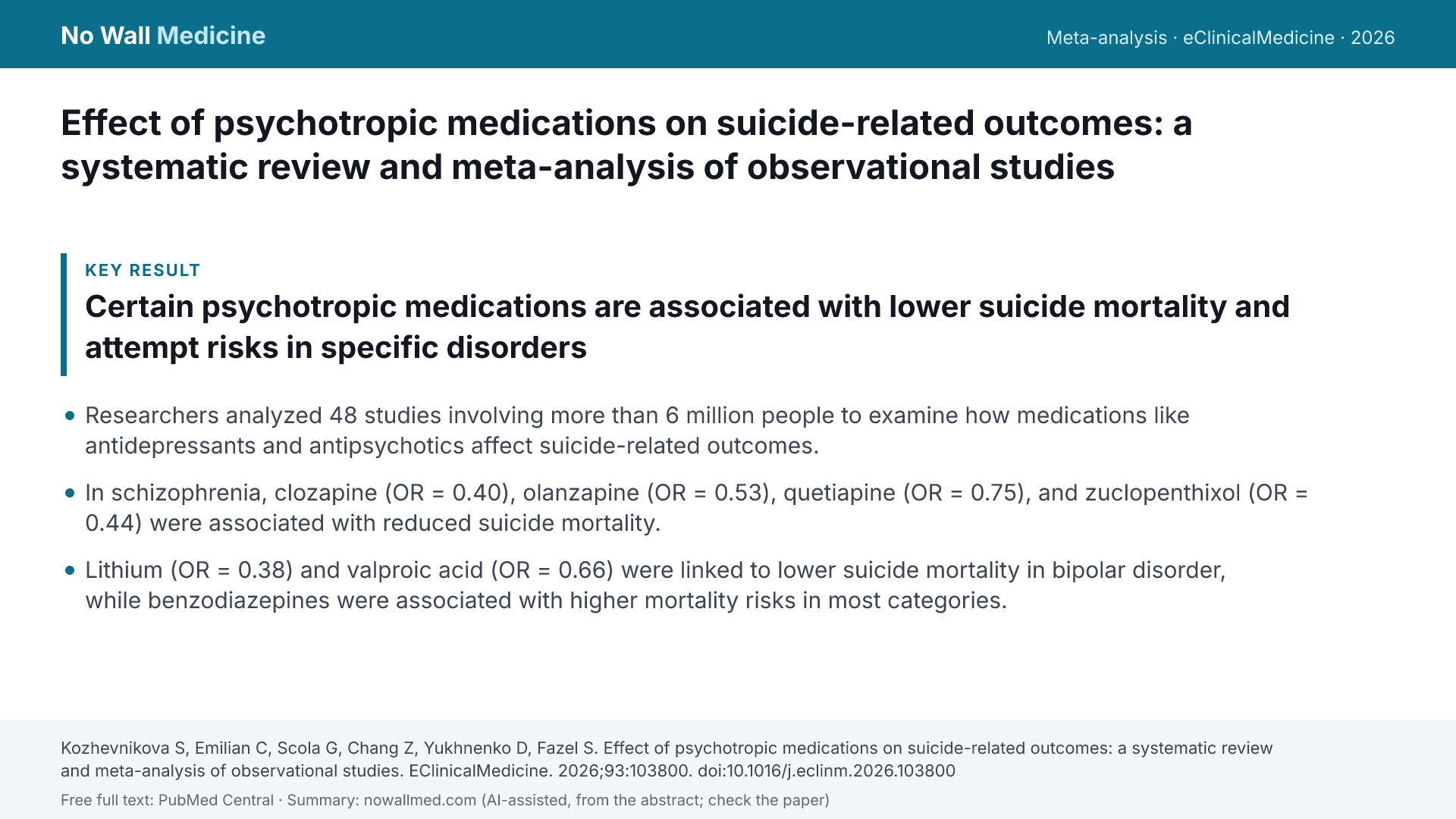
Certain psychotropic medications are associated with lower suicide mortality and attempt risks in specific disorders
Effect of psychotropic medications on suicide-related outcomes: a systematic review and meta-analysis of observational studies
Why it matters: The impact of pharmacological treatments on suicide-related outcomes is uncertain because randomized controlled trials may not provide externally valid results for psychiatric populations.
Key points
- Researchers analyzed 48 studies involving more than 6 million people to examine how medications like antidepressants and antipsychotics affect suicide-related outcomes.
- In schizophrenia, clozapine (OR = 0.40), olanzapine (OR = 0.53), quetiapine (OR = 0.75), and zuclopenthixol (OR = 0.44) were associated with reduced suicide mortality.
- Lithium (OR = 0.38) and valproic acid (OR = 0.66) were linked to lower suicide mortality in bipolar disorder, while benzodiazepines were associated with higher mortality risks in most categories.
Limitation the authors note: There was some evidence for publication bias for lithium in bipolar disorder and clozapine in schizophrenia spectrum disorders.
Headline and key points written with AI from the paper’s abstract, with every number checked against it. Read the paper before relying on them.
Was this summary helpful?
Cite this article
Kozhevnikova S, Emilian C, Scola G, Chang Z, Yukhnenko D, Fazel S. Effect of psychotropic medications on suicide-related outcomes: a systematic review and meta-analysis of observational studies. EClinicalMedicine. 2026;93:103800. doi:10.1016/j.eclinm.2026.103800
Spotted a mistake? Suggest a correction