Radiation therapy alone was not inferior to chemoradiotherapy for low-risk nasopharyngeal carcinoma
Effect of Radiotherapy Alone vs Radiotherapy With Concurrent Chemoradiotherapy on Survival Without Disease Relapse in Patients With Low-risk Nasopharyngeal Carcinoma: A Randomized Clinical Trial
Multicenter, open-label, randomized, phase 3, noninferiority clinical trialBenefit found
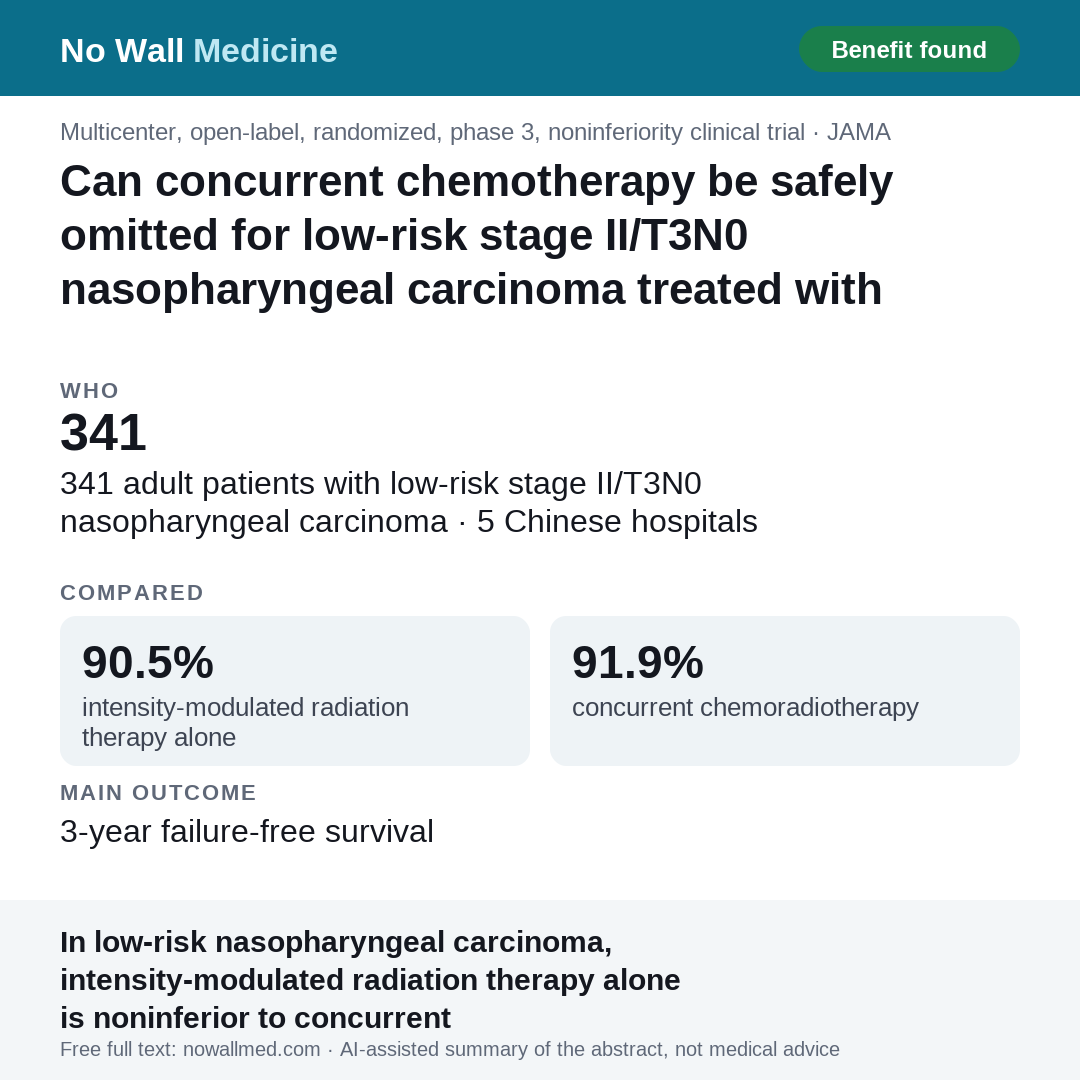
Can concurrent chemotherapy be safely omitted for low-risk stage II/T3N0 nasopharyngeal carcinoma treated with intensity-modulated radiation therapy?
Who
341
341 adult patients with low-risk stage II/T3N0 nasopharyngeal carcinoma · 5 Chinese hospitals
Compared
90.5%intensity-modulated radiation therapy alone
91.9%concurrent chemoradiotherapy
Main outcome
3-year failure-free survival
Result: difference, -1.4%; 1-sided 95% CI, -7.4% to ∞
Bottom line: In low-risk nasopharyngeal carcinoma, intensity-modulated radiation therapy alone is noninferior to concurrent chemoradiotherapy with fewer adverse events.
JAMA · 2022-08-23Download image
Clinical question: Can concurrent chemotherapy be safely omitted for low-risk stage II/T3N0 nasopharyngeal carcinoma treated with intensity-modulated radiation therapy?
Why it matters: It was unknown if concurrent chemotherapy could be safely omitted for patients with low-risk stage II nasopharyngeal carcinoma treated with intensity-modulated radiation therapy.
Key points
- The trial studied 341 adult patients with low-risk stage II nasopharyngeal carcinoma, comparing intensity-modulated radiation therapy (IMRT) alone to IMRT combined with cisplatin chemotherapy.
- Three-year failure-free survival was 90.5% for the radiation-only group compared to 91.9% for the chemoradiotherapy group.
- The radiation-only group had a lower incidence of grade 3 to 4 adverse events at 17% compared to 46% in the chemotherapy group.
Headline and key points written with AI from the paper’s abstract, with every number checked against it. Read the paper before relying on them.
Was this summary helpful?
Subject terms
Cite this article
Tang LL, Guo R, Zhang N, Deng B, Chen L, Cheng ZB. Effect of Radiotherapy Alone vs Radiotherapy With Concurrent Chemoradiotherapy on Survival Without Disease Relapse in Patients With Low-risk Nasopharyngeal Carcinoma: A Randomized Clinical Trial. JAMA. 2022. doi:10.1001/jama.2022.13997
Spotted a mistake? Suggest a correction
Top studies every Monday
The week’s key trials and guidelines in your specialties, plus any topics you follow. By email, free.
Get the weekly digest