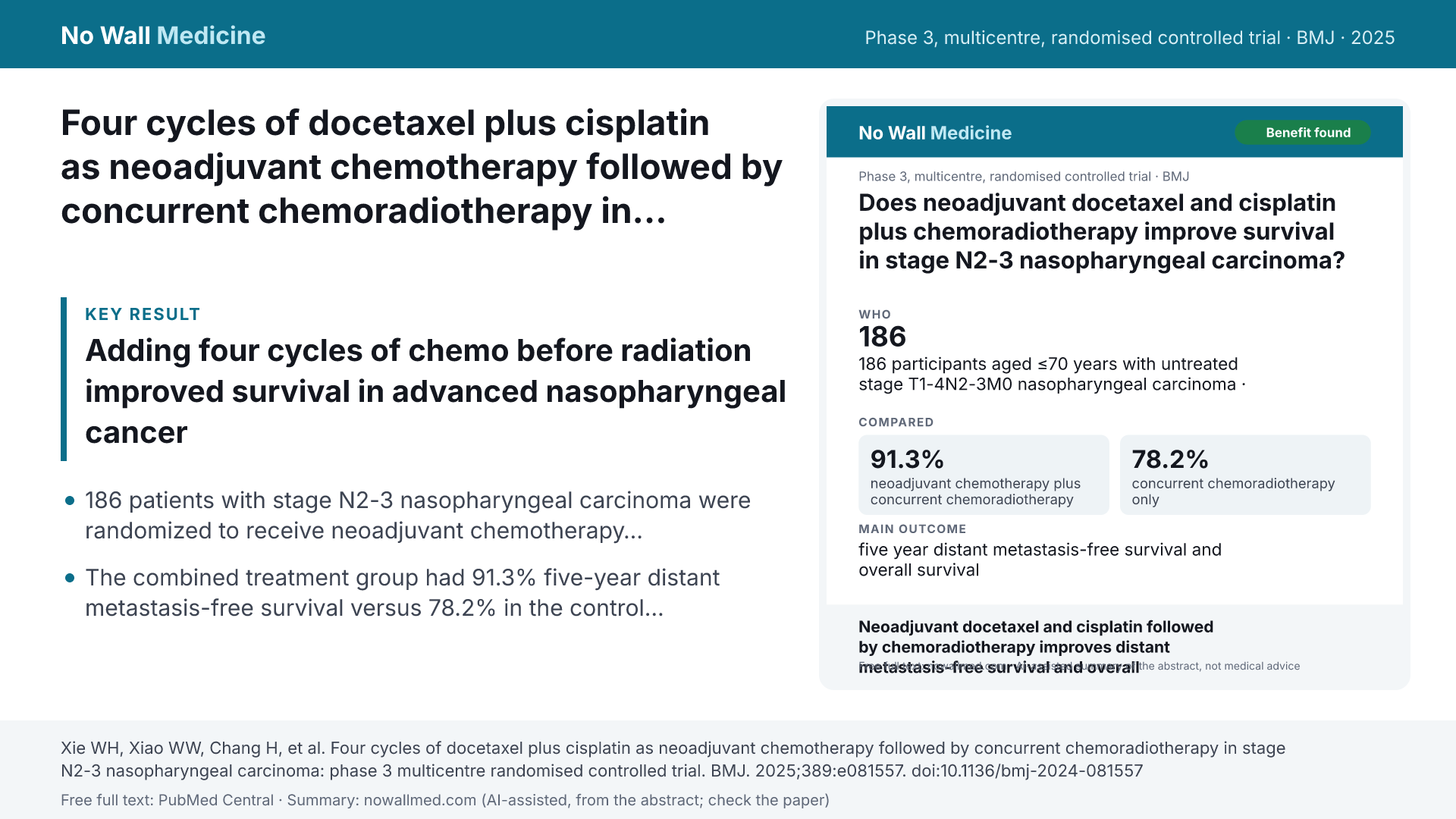
Adding four cycles of chemo before radiation improved survival in advanced nasopharyngeal cancer
Four cycles of docetaxel plus cisplatin as neoadjuvant chemotherapy followed by concurrent chemoradiotherapy in stage N2-3 nasopharyngeal carcinoma: phase 3 multicentre randomised controlled trial
Phase 3, multicentre, randomised controlled trialBenefit found
Does neoadjuvant docetaxel and cisplatin plus chemoradiotherapy improve survival in stage N2-3 nasopharyngeal carcinoma?
Who
186
186 participants aged ≤70 years with untreated stage T1-4N2-3M0 nasopharyngeal carcinoma · Six sites in China
Compared
91.3%neoadjuvant chemotherapy plus concurrent chemoradiotherapy (95% CI 85.4% to 97.2%)
78.2%concurrent chemoradiotherapy only (69.8% to 86.6%)
Main outcome
five year distant metastasis-free survival and overall survival
Result: hazard ratio 0.41 (95% CI 0.19 to 0.87)
Bottom line: Neoadjuvant docetaxel and cisplatin followed by chemoradiotherapy improves distant metastasis-free survival and overall survival in N2-3 nasopharyngeal carcinoma.
BMJ · 2025-04-15 · Save PNG
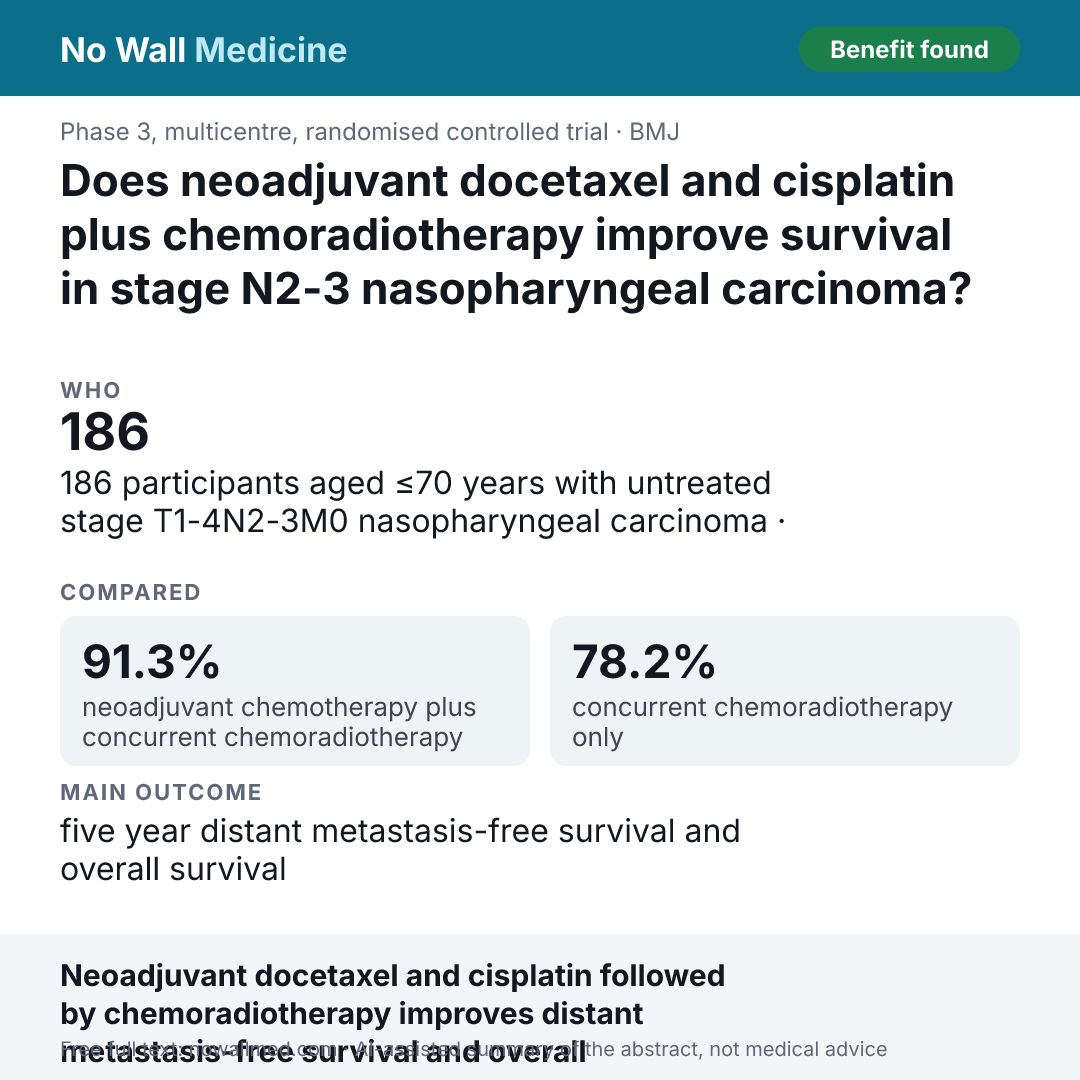
Clinical question: Does neoadjuvant docetaxel and cisplatin plus chemoradiotherapy improve survival in stage N2-3 nasopharyngeal carcinoma?
Key points
- 186 patients with stage N2-3 nasopharyngeal carcinoma were randomized to receive neoadjuvant chemotherapy plus chemoradiotherapy or chemoradiotherapy alone.
- The combined treatment group had 91.3% five-year distant metastasis-free survival versus 78.2% in the control group (P=0.02).
- Five-year overall survival was 90.3% for the combined group versus 82.6% for the control group (P=0.01).
Headline and key points written with AI from the paper’s abstract, with every number checked against it. Read the paper before relying on them.
Was this summary helpful?
Abstract
Objective
To compare the effects of four cycles of docetaxel with cisplatin as a neoadjuvant chemotherapy followed by concurrent chemoradiotherapy with concurrent chemoradiotherapy alone by assessing reductions in distant metastasis and improvements in survival in patients with stage N2-3nasopharyngeal carcinoma. Design
Phase 3, multicentre, randomised controlled trial. Setting
Six sites in China from 23 February 2016 to 18 February 2019. Participants
186 participants aged ≤70 years with a diagnosis of untreated stage T1-4N2-3M0 nasopharyngeal carcinoma. Intervention
Participants were prospectively enrolled and randomly allocated to either the neoadjuvant chemotherapy plus concurrent chemoradiotherapy group (four cycles of neoadjuvant chemotherapy (docetaxel 75 mg/m2 on day 1 and cisplatin 37.5 mg/m2 on days 2-3, every 3 weeks) followed by concurrent chemoradiotherapy (intensity modulated radiotherapy plus weekly cisplatin 40 mg/m2) or the concurrent chemoradiotherapy only group, in a 1:1 ratio. Main outcome measures
Five year distant metastasis-free survival and overall survival were analysed using the intention-to-treat approach. Results
93 participants were assigned to each of the neoadjuvant chemotherapy plus concurrent chemoradiotherapy and concurrent chemoradiotherapy only groups. After a median follow-up time of 76.9 (interquartile range 65.4-85.9) months, the neoadjuvant chemotherapy plus concurrent chemoradiotherapy group had superior five year distant metastasis-free survival (91.3% (95% confidence interval (CI) 85.4% to 97.2%) versus 78.2% (69.8% to 86.6%); hazard ratio 0.41 (95% CI 0.19 to 0.87); P=0.02) and five year overall survival (90.3% (84.2% to 96.4%) versus 82.6% (75.0% to 90.2%); hazard ratio 0.38 (0.18 to 0.82); P=0.01). Grade 3/4 acute toxicities were observed in 60 (65%) and 46 (51%) patients in the neoadjuvant chemotherapy plus concurrent chemoradiotherapy and concurrent chemoradiotherapy only groups, respectively (P=0.05). The higher acute toxicity observed in the neoadjuvant chemotherapy plus concurrent chemoradiotherapy group was primarily due to grade 3/4 neutropenia (43 (47%) v 10 (11%); P<0.001). No significant difference in any late toxicity was observed between the two groups, and participants in the neoadjuvant chemotherapy plus concurrent chemoradiotherapy group tended to have a better quality of life five years after enrolment. Conclusions
Four cycles of docetaxel plus cisplatin neoadjuvant chemotherapy with concurrent chemoradiotherapy can effectively reduce distant metastasis and improve survival for patients with stage N2-3 nasopharyngeal carcinoma with manageable toxicities. Trial registration
ClinicalTrials.gov NCT02512315.
Abstract reproduced under the article’s CC BY NC licence.
Subject terms
Headline, design, result, key points, caveat and citation as plain text.
Cite this article
Xie WH, Xiao WW, Chang H, et al. Four cycles of docetaxel plus cisplatin as neoadjuvant chemotherapy followed by concurrent chemoradiotherapy in stage N2-3 nasopharyngeal carcinoma: phase 3 multicentre randomised controlled trial. BMJ. 2025;389:e081557. doi:10.1136/bmj-2024-081557
Spotted a mistake? Suggest a correction