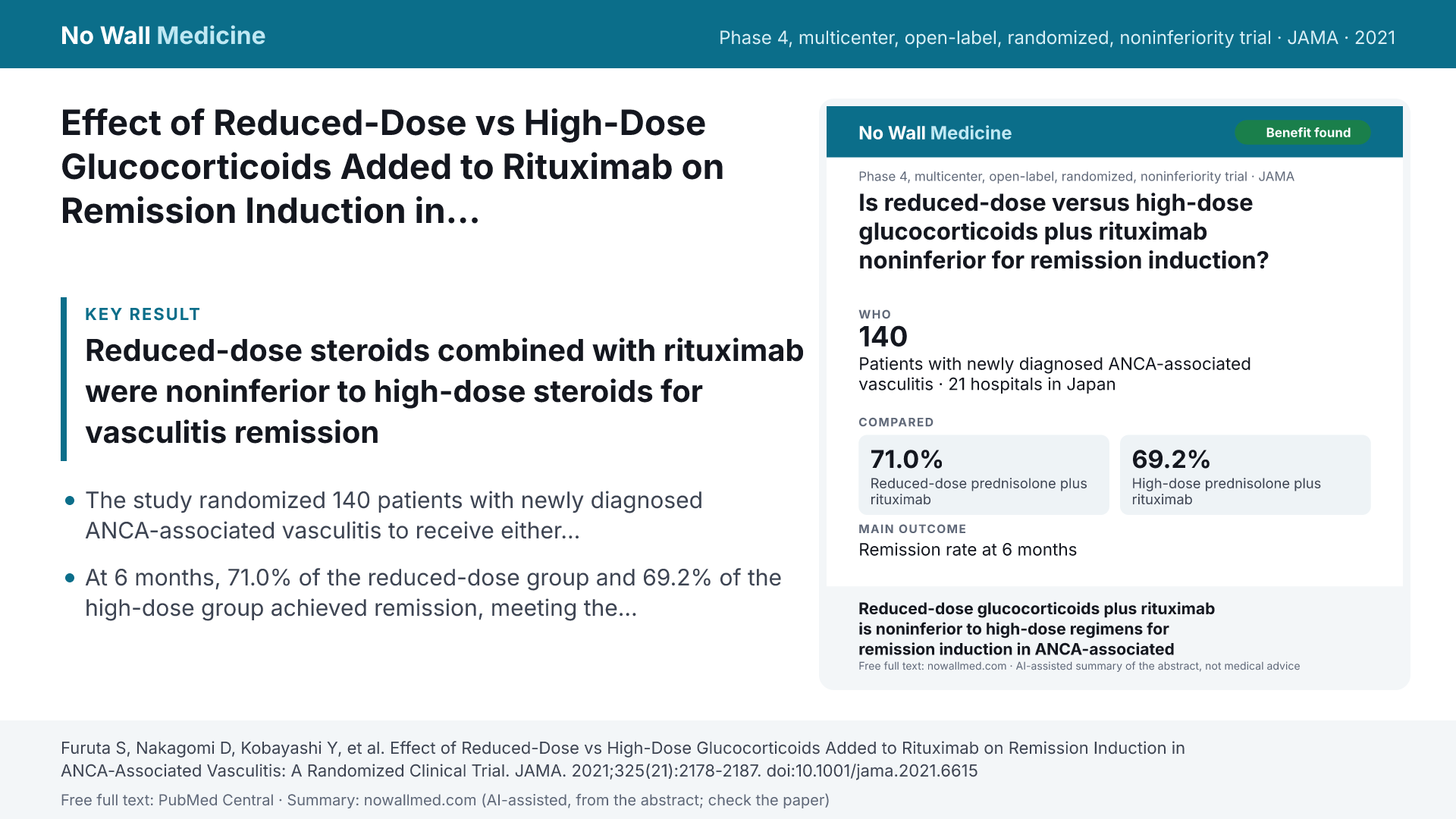
Reduced-dose steroids combined with rituximab were noninferior to high-dose steroids for vasculitis remission
Effect of Reduced-Dose vs High-Dose Glucocorticoids Added to Rituximab on Remission Induction in ANCA-Associated Vasculitis: A Randomized Clinical Trial
Phase 4, multicenter, open-label, randomized, noninferiority trialBenefit found
Is reduced-dose versus high-dose glucocorticoids plus rituximab noninferior for remission induction?
Who
140
Patients with newly diagnosed ANCA-associated vasculitis · 21 hospitals in Japan
Compared
71.0%Reduced-dose prednisolone plus rituximab (49/69)
69.2%High-dose prednisolone plus rituximab (45/65)
Main outcome
Remission rate at 6 months
Result: treatment difference 1.8 percentage points (1-sided 97.5% CI, -13.7 to ∞)
Bottom line: Reduced-dose glucocorticoids plus rituximab is noninferior to high-dose regimens for remission induction in ANCA-associated vasculitis.
JAMA · 2021-06-01 · Save PNG
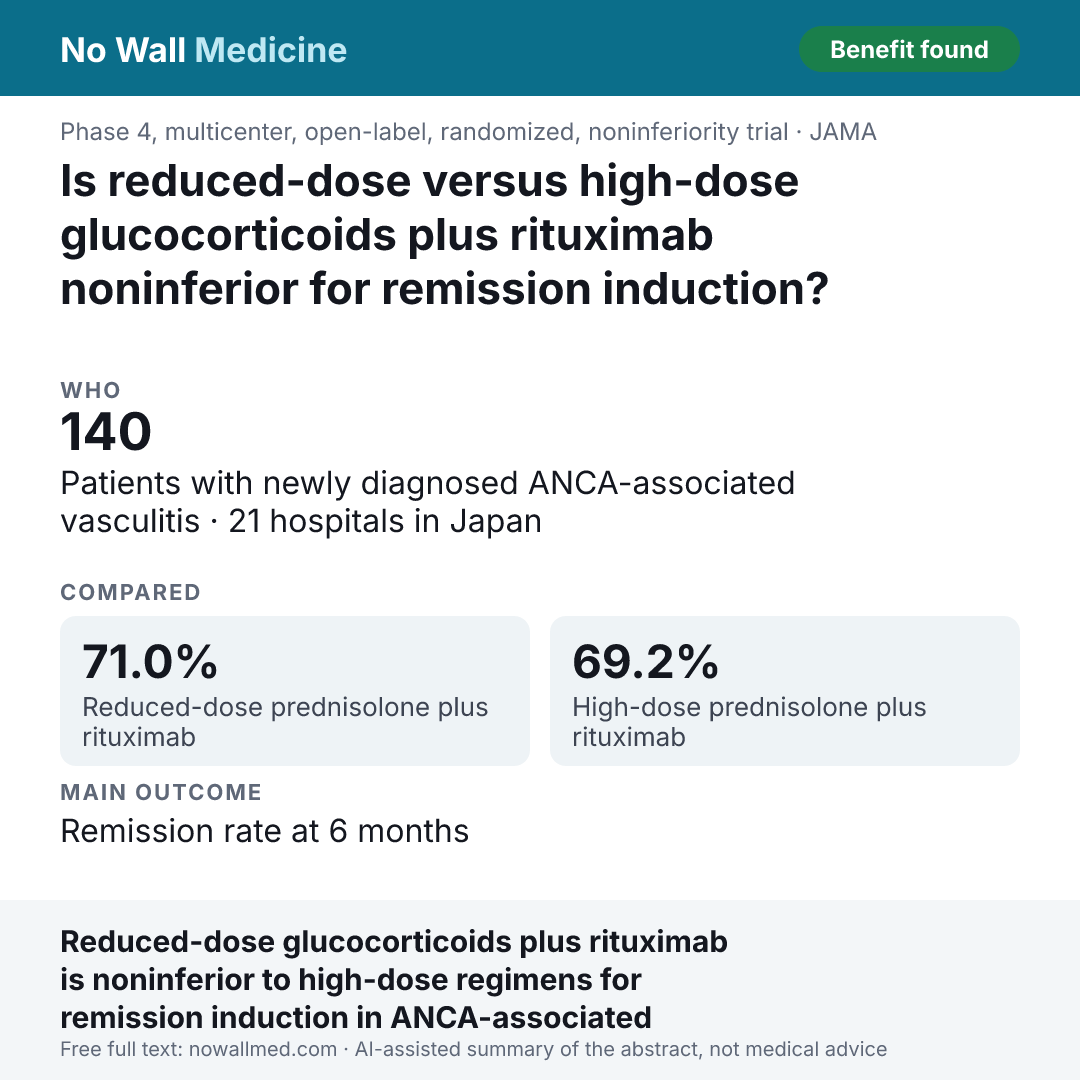
Clinical question: Is reduced-dose versus high-dose glucocorticoids plus rituximab noninferior for remission induction?
Why it matters: Standard induction therapy using high-dose glucocorticoids, a type of steroid, is associated with considerable adverse events.
Key points
- The study randomized 140 patients with newly diagnosed ANCA-associated vasculitis to receive either reduced-dose prednisolone plus rituximab or high-dose prednisolone plus rituximab.
- At 6 months, 71.0% of the reduced-dose group and 69.2% of the high-dose group achieved remission, meeting the noninferiority criterion.
- Serious adverse events occurred in 18.8% of the reduced-dose group compared to 36.9% in the high-dose group, and serious infections occurred in 7.2% versus 20.0%.
Headline and key points written with AI from the paper’s abstract, with every number checked against it. Read the paper before relying on them.
Was this summary helpful?
Subject terms
Headline, design, result, key points, caveat and citation as plain text.
Cite this article
Furuta S, Nakagomi D, Kobayashi Y, et al. Effect of Reduced-Dose vs High-Dose Glucocorticoids Added to Rituximab on Remission Induction in ANCA-Associated Vasculitis: A Randomized Clinical Trial. JAMA. 2021. doi:10.1001/jama.2021.6615
Spotted a mistake? Suggest a correction