Effect of Remote Ischemic Conditioning on the Form and Function of Red Blood Cells in Patients With Acute Ischemic Stroke
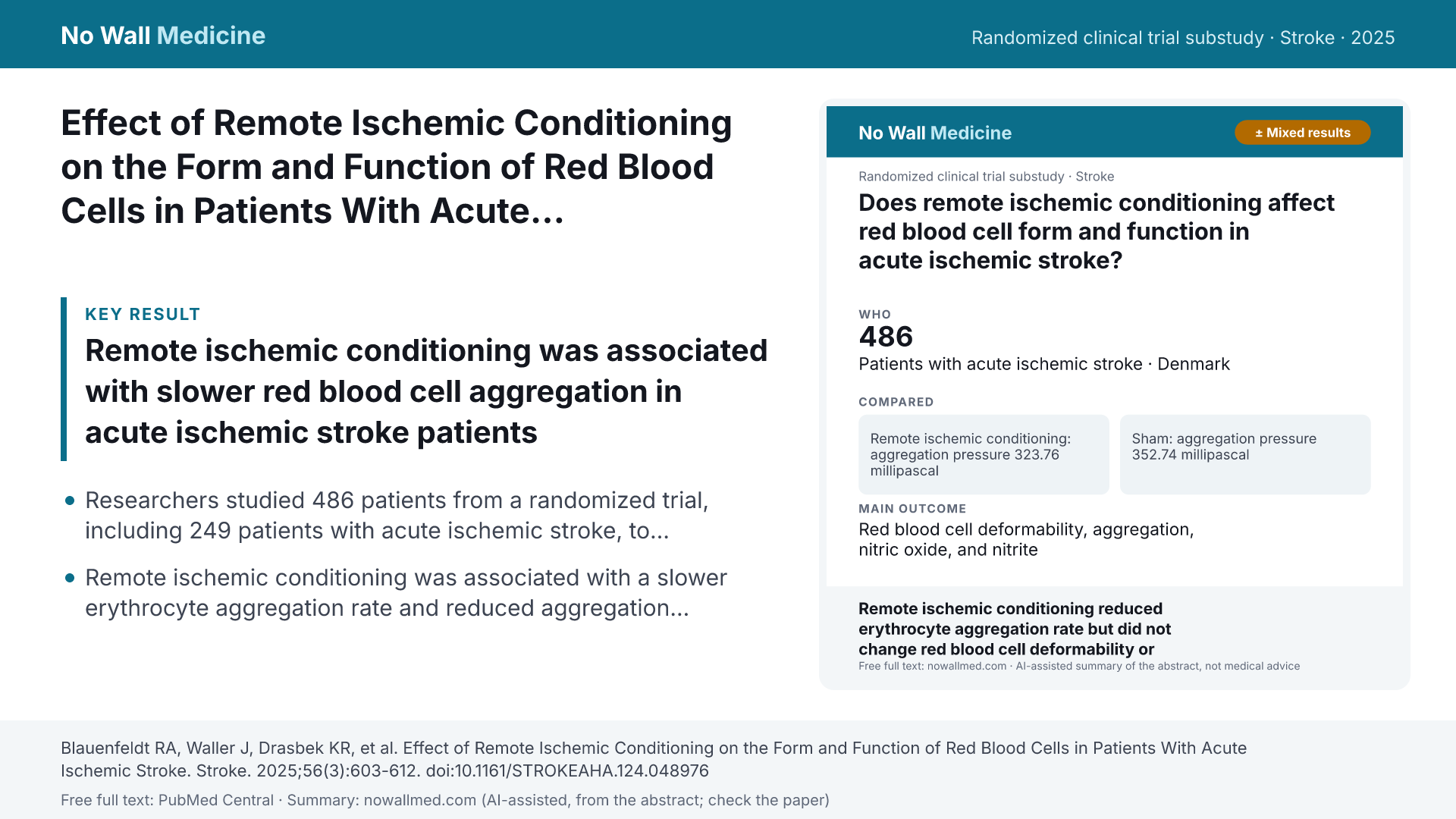
Key result: Remote ischemic conditioning was associated with slower red blood cell aggregation in acute ischemic stroke patients
Randomized clinical trial substudyMixed results
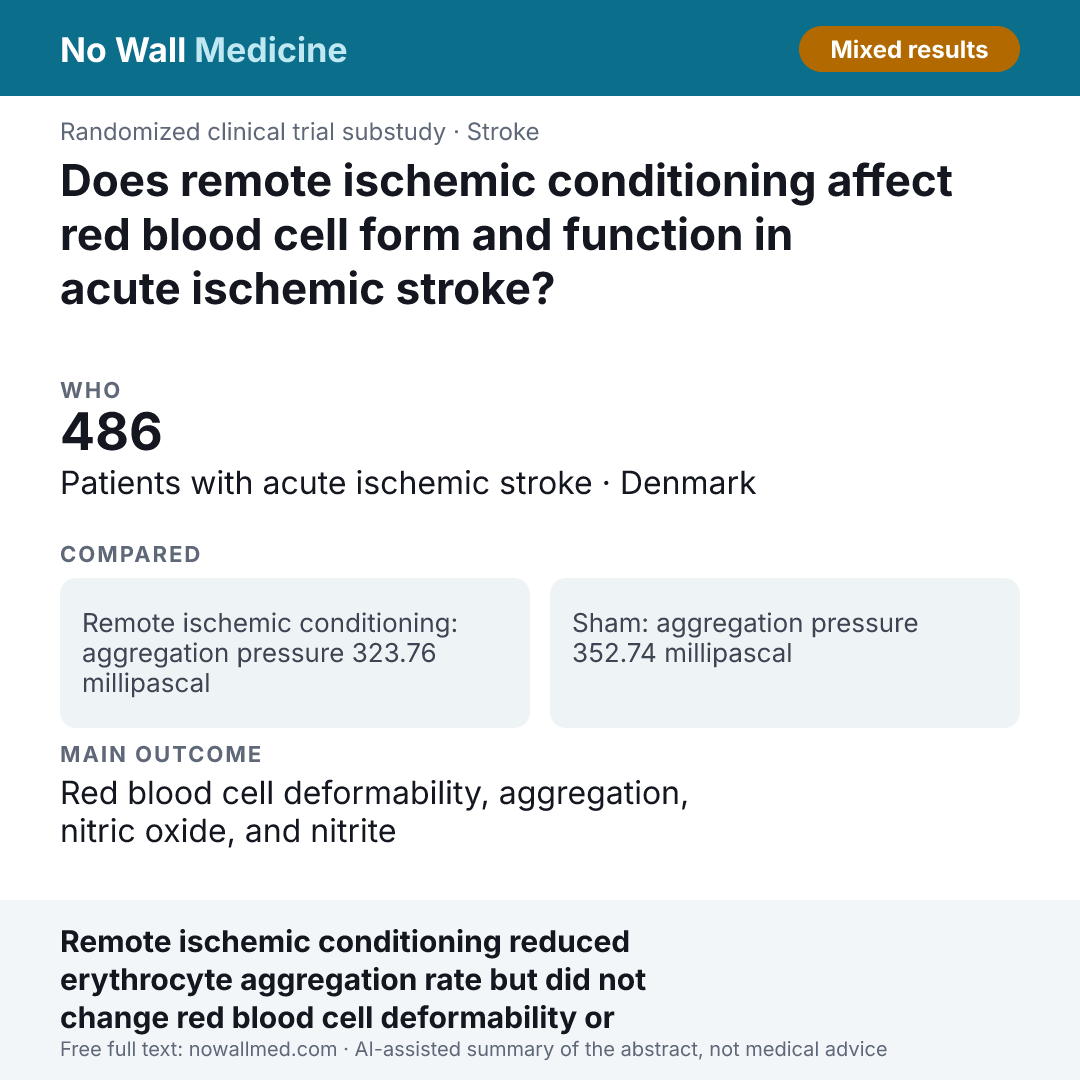
Does remote ischemic conditioning affect red blood cell form and function in acute ischemic stroke?
Who
486
Patients with acute ischemic stroke · Denmark
Compared
Remote ischemic conditioning: aggregation pressure 323.76 millipascal
Sham: aggregation pressure 352.74 millipascal
Main outcome
Red blood cell deformability, aggregation, nitric oxide, and nitrite
Bottom line: Remote ischemic conditioning reduced erythrocyte aggregation rate but did not change red blood cell deformability or nitric oxide levels.
Stroke · 2025-01-30 · Save PNG
Key points
- Researchers studied 486 patients from a randomized trial, including 249 patients with acute ischemic stroke, to measure red blood cell properties.
- Remote ischemic conditioning was associated with a slower erythrocyte aggregation rate and reduced aggregation pressure compared to a sham treatment.
- The treatment was not associated with changes in red blood cell maximal deformability, nitric oxide levels, or nitrite levels.
Discussion prompts
- Would these patients look like yours? Who was left out?
- Is the main outcome one that matters to patients?
- Is the difference large enough to change what you do?
Cite: Blauenfeldt RA, Waller J, Drasbek KR, et al. Effect of Remote Ischemic Conditioning on the Form and Function of Red Blood Cells in Patients With Acute Ischemic Stroke. Stroke. 2025;56(3):603-612. doi:10.1161/STROKEAHA.124.048976
Free full text: PubMed Central · Summary and visual abstract: nowallmed.com/a/effect-of-remote-ischemic-conditioning-on-the-form-and-function-of-10nx6aj/ (AI-assisted from the abstract; check the paper before relying on it).