Remote ischemic conditioning was associated with slower red blood cell aggregation in acute ischemic stroke patients
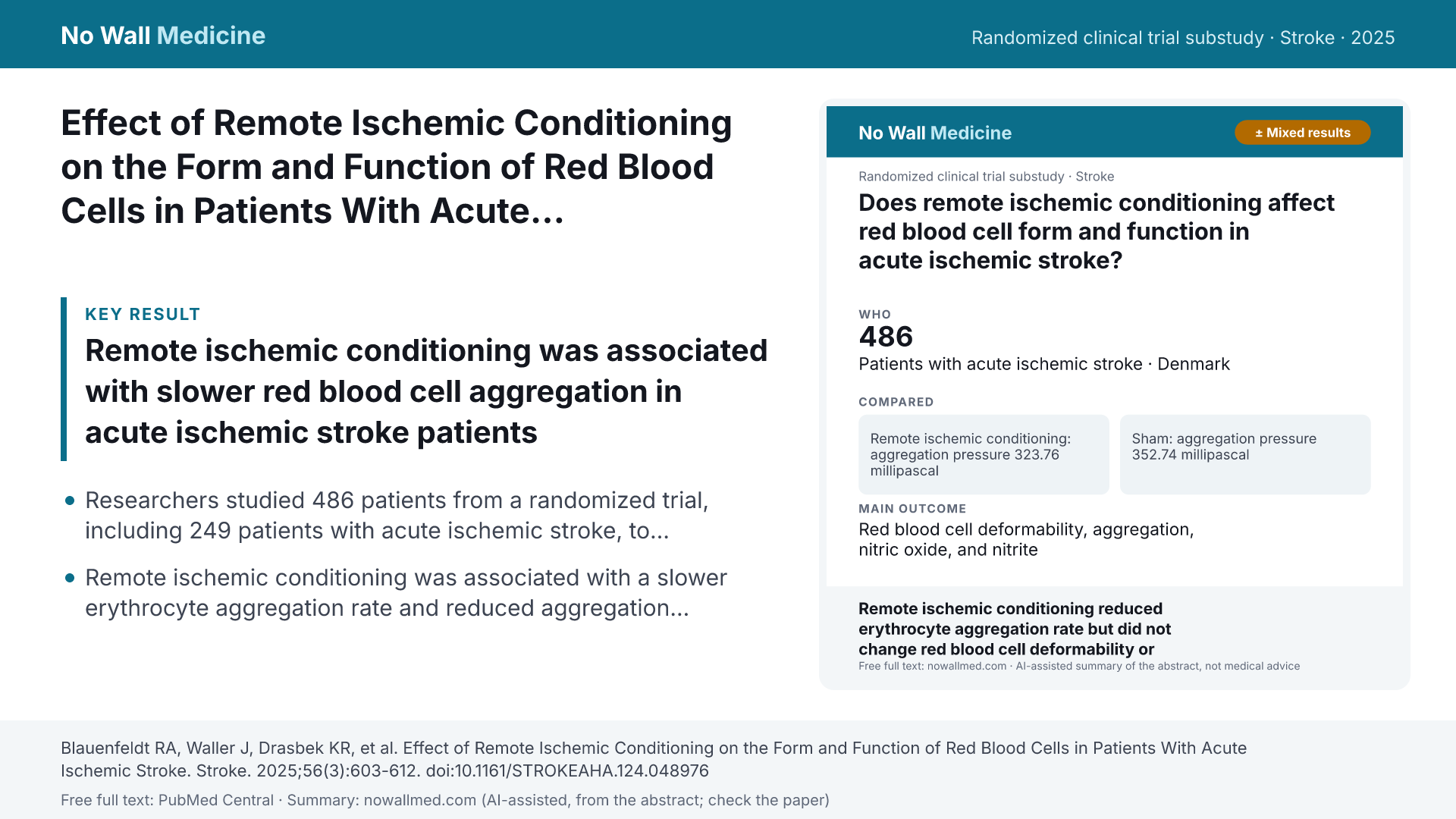
Effect of Remote Ischemic Conditioning on the Form and Function of Red Blood Cells in Patients With Acute Ischemic Stroke
Randomized clinical trial substudyMixed results
Does remote ischemic conditioning affect red blood cell form and function in acute ischemic stroke?
Who
486
Patients with acute ischemic stroke · Denmark
Compared
Remote ischemic conditioning: aggregation pressure 323.76 millipascal
Sham: aggregation pressure 352.74 millipascal
Main outcome
Red blood cell deformability, aggregation, nitric oxide, and nitrite
Bottom line: Remote ischemic conditioning reduced erythrocyte aggregation rate but did not change red blood cell deformability or nitric oxide levels.
Stroke · 2025-01-30Download image
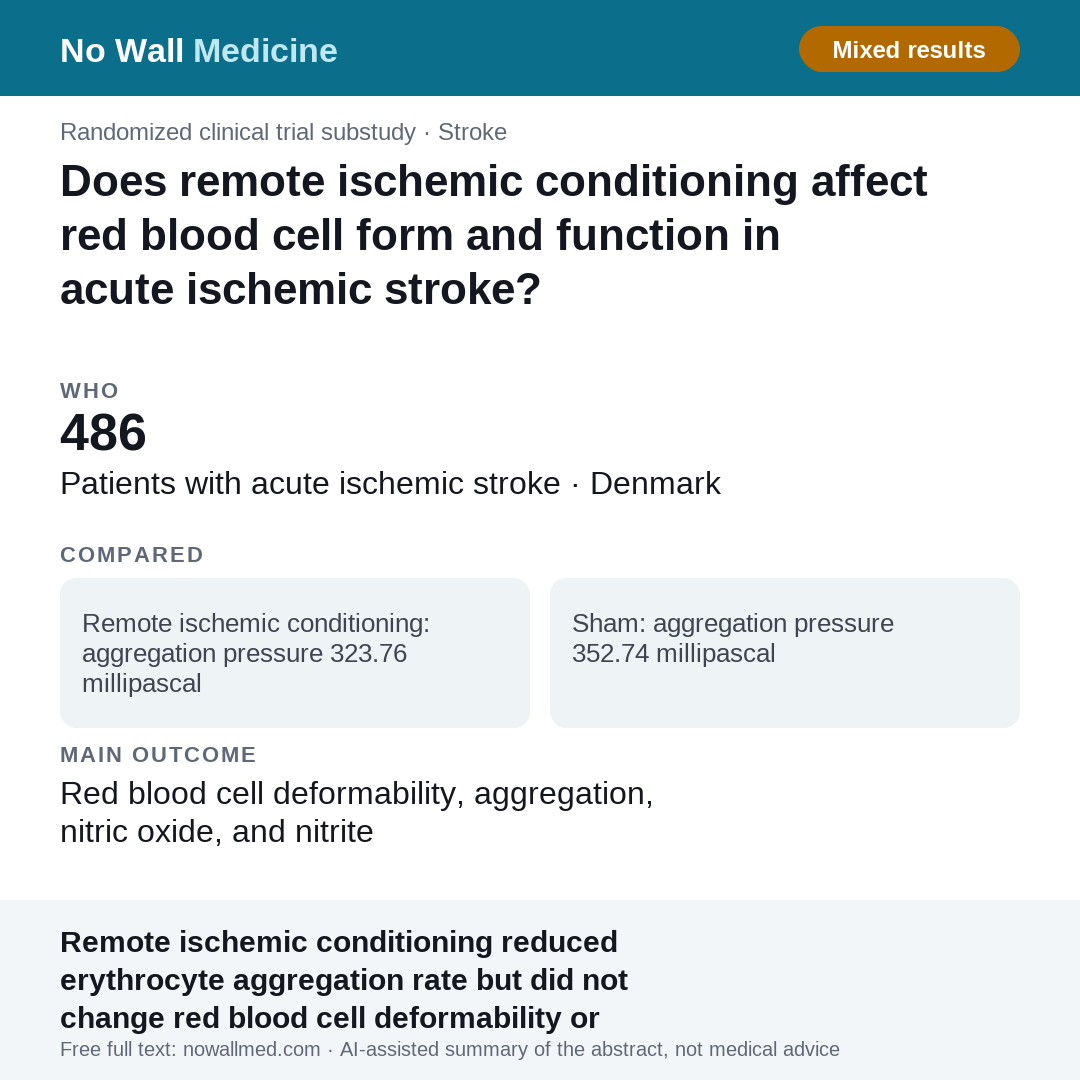
Clinical question: Does remote ischemic conditioning affect red blood cell form and function in acute ischemic stroke?
Why it matters: It was unknown if remote ischemic conditioning affects red blood cell deformability, nitric oxide, or nitrite levels in patients with acute ischemic stroke.
Key points
- Researchers studied 486 patients from a randomized trial, including 249 patients with acute ischemic stroke, to measure red blood cell properties.
- Remote ischemic conditioning was associated with a slower erythrocyte aggregation rate and reduced aggregation pressure compared to a sham treatment.
- The treatment was not associated with changes in red blood cell maximal deformability, nitric oxide levels, or nitrite levels.
Headline and key points written with AI from the paper’s abstract, with every number checked against it. Read the paper before relying on them.
Was this summary helpful?
Subject terms
Cite this article
Blauenfeldt RA, Waller J, Drasbek KR, Bech JN, Hvas AM, Larsen JB. Effect of Remote Ischemic Conditioning on the Form and Function of Red Blood Cells in Patients With Acute Ischemic Stroke. Stroke. 2025. doi:10.1161/STROKEAHA.124.048976
Spotted a mistake? Suggest a correction
Top studies every Monday
The week’s key trials and guidelines in your specialties, plus any topics you follow. By email, free.
Get the weekly digest