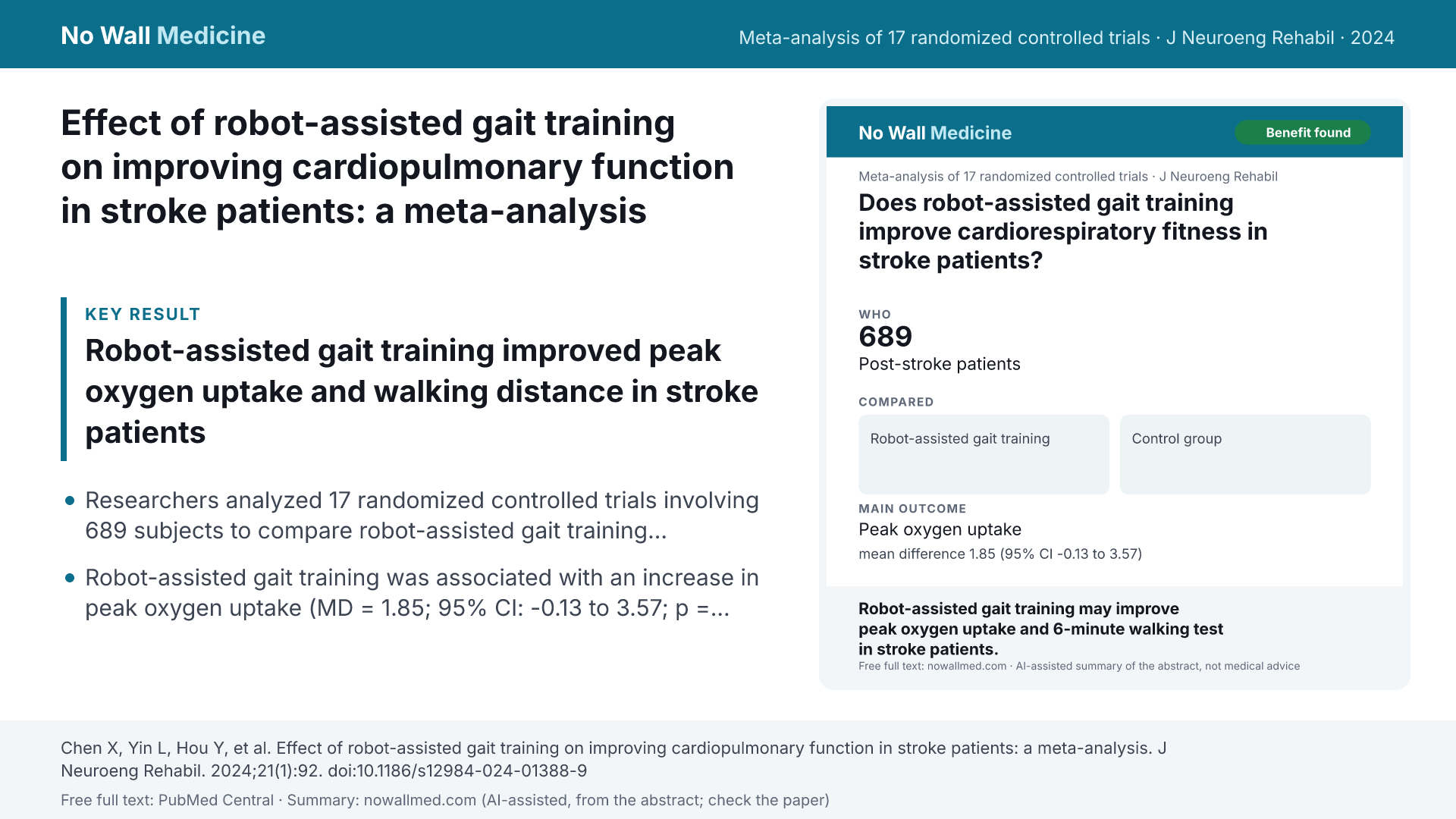
Effect of robot-assisted gait training on improving cardiopulmonary function in stroke patients: a meta-analysis
Key result: Robot-assisted gait training improved peak oxygen uptake and walking distance in stroke patients
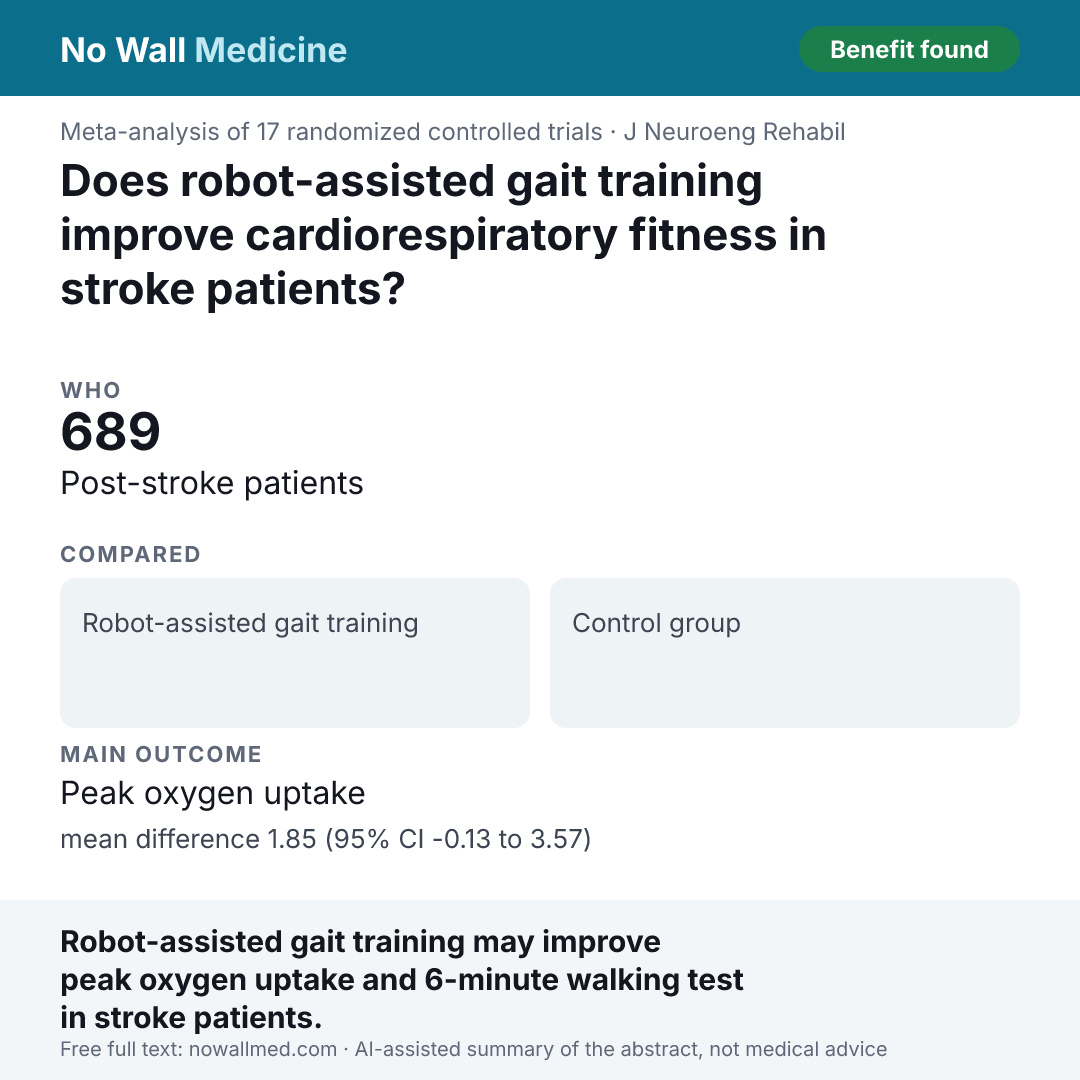
Meta-analysis of 17 randomized controlled trialsBenefit found
Does robot-assisted gait training improve cardiorespiratory fitness in stroke patients?
Who
689
Post-stroke patients
Compared
Robot-assisted gait training
Control group
Main outcome
Peak oxygen uptake
Result: mean difference 1.85 (95% CI -0.13 to 3.57)
Bottom line: Robot-assisted gait training may improve peak oxygen uptake and 6-minute walking test in stroke patients.
J Neuroeng Rehabil · 2024-05-30 · Save PNG
Key points
- Researchers analyzed 17 randomized controlled trials involving 689 subjects to compare robot-assisted gait training with conventional rehabilitation training.
- Robot-assisted gait training was associated with an increase in peak oxygen uptake (MD = 1.85; 95% CI: -0.13 to 3.57; p = 0.04) and 6-minute walking test distance (MD = 19.26; 95% CI: 10.43 to 28.08; p < 0.0001).
- No significant differences were found for peak heart rate (MD = 3.56; 95% CI: -1.90 to 9.02; p = 0.20) or peak inspiratory expiratory ratio (MD = -0.01; 95% CI: -0.04 to 0.01; p = 0.34).
Discussion prompts
- Would these patients look like yours? Who was left out?
- Is the main outcome one that matters to patients?
- Is the difference large enough to change what you do?
Cite: Chen X, Yin L, Hou Y, et al. Effect of robot-assisted gait training on improving cardiopulmonary function in stroke patients: a meta-analysis. J Neuroeng Rehabil. 2024;21(1):92. doi:10.1186/s12984-024-01388-9
Free full text: PubMed Central · Summary and visual abstract: nowallmed.com/a/effect-of-robot-assisted-gait-training-on-improving-cardiopulmonary-ec9rmu/ (AI-assisted from the abstract; check the paper before relying on it).