Routine genetic testing for drug metabolism enzymes did not affect antipsychotic drug persistence in schizophrenia
Effect of Routine Cytochrome P450 2D6 and 2C19 Genotyping on Antipsychotic Drug Persistence in Patients With Schizophrenia: A Randomized Clinical Trial
Single-masked, 3-group randomized clinical trialNo clear difference
Does routine cytochrome P450 2D6 and 2C19 genotyping affect antipsychotic drug persistence?
Who
311
Patients aged 18 years or older with schizophrenia spectrum diagnosis · 12 psychiatric outpatient clinics in Denmark
Compared
Cytochrome P450 test-guided
Structured clinical monitoring
Control
Main outcome
Antipsychotic drug persistence, days to first modification of initial treatment
Result: hazard ratio 1.02 (95% CI 0.71-1.45)
Bottom line: Routine cytochrome P450 genotyping does not improve antipsychotic drug persistence in patients with schizophrenia.
JAMA Netw Open · 2020-12-01Download image
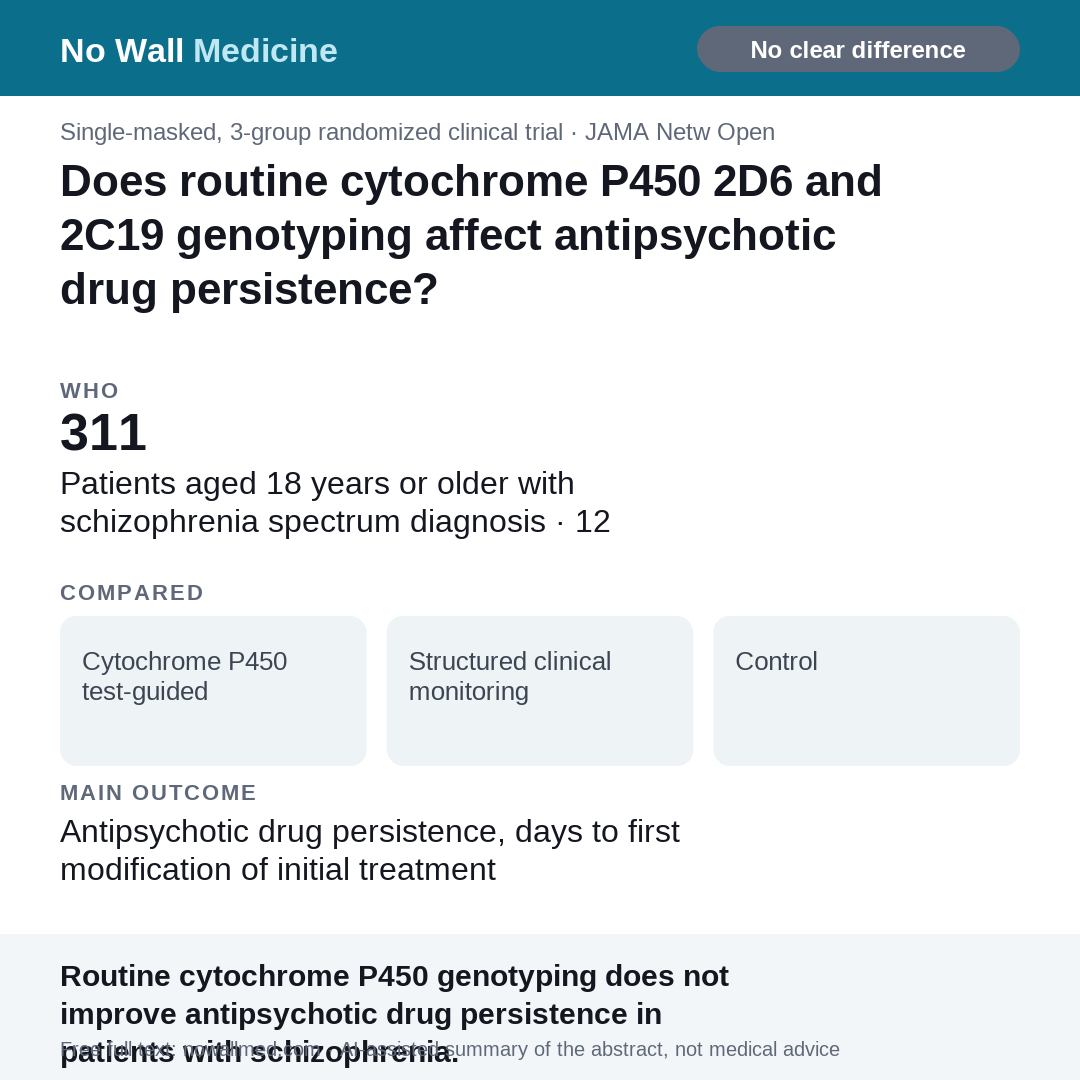
Clinical question: Does routine cytochrome P450 2D6 and 2C19 genotyping affect antipsychotic drug persistence?
Why it matters: The clinical utility of routine testing for cytochrome P450 2D6 and 2C19 genes to guide antipsychotic treatment is unclear.
Key points
- Researchers studied 311 patients with schizophrenia who were randomly assigned to receive test-guided treatment, structured clinical monitoring, or standard care.
- There was no difference in antipsychotic drug persistence between the test-guided group and the control group (hazard ratio, 1.02; 95% CI, 0.71-1.45).
- The structured clinical monitoring group also showed no difference in drug persistence compared to the control group (hazard ratio, 0.88; 95% CI, 0.61-1.26).
Headline and key points written with AI from the paper’s abstract, with every number checked against it. Read the paper before relying on them.
Was this summary helpful?
Subject terms
Cite this article
Jürgens G, Andersen SE, Rasmussen HB, Werge T, Jensen HD, Kaas-Hansen BS. Effect of Routine Cytochrome P450 2D6 and 2C19 Genotyping on Antipsychotic Drug Persistence in Patients With Schizophrenia: A Randomized Clinical Trial. JAMA Netw Open. 2020. doi:10.1001/jamanetworkopen.2020.27909
Spotted a mistake? Suggest a correction
Top studies every Monday
The week’s key trials and guidelines in your specialties, plus any topics you follow. By email, free.
Get the weekly digest