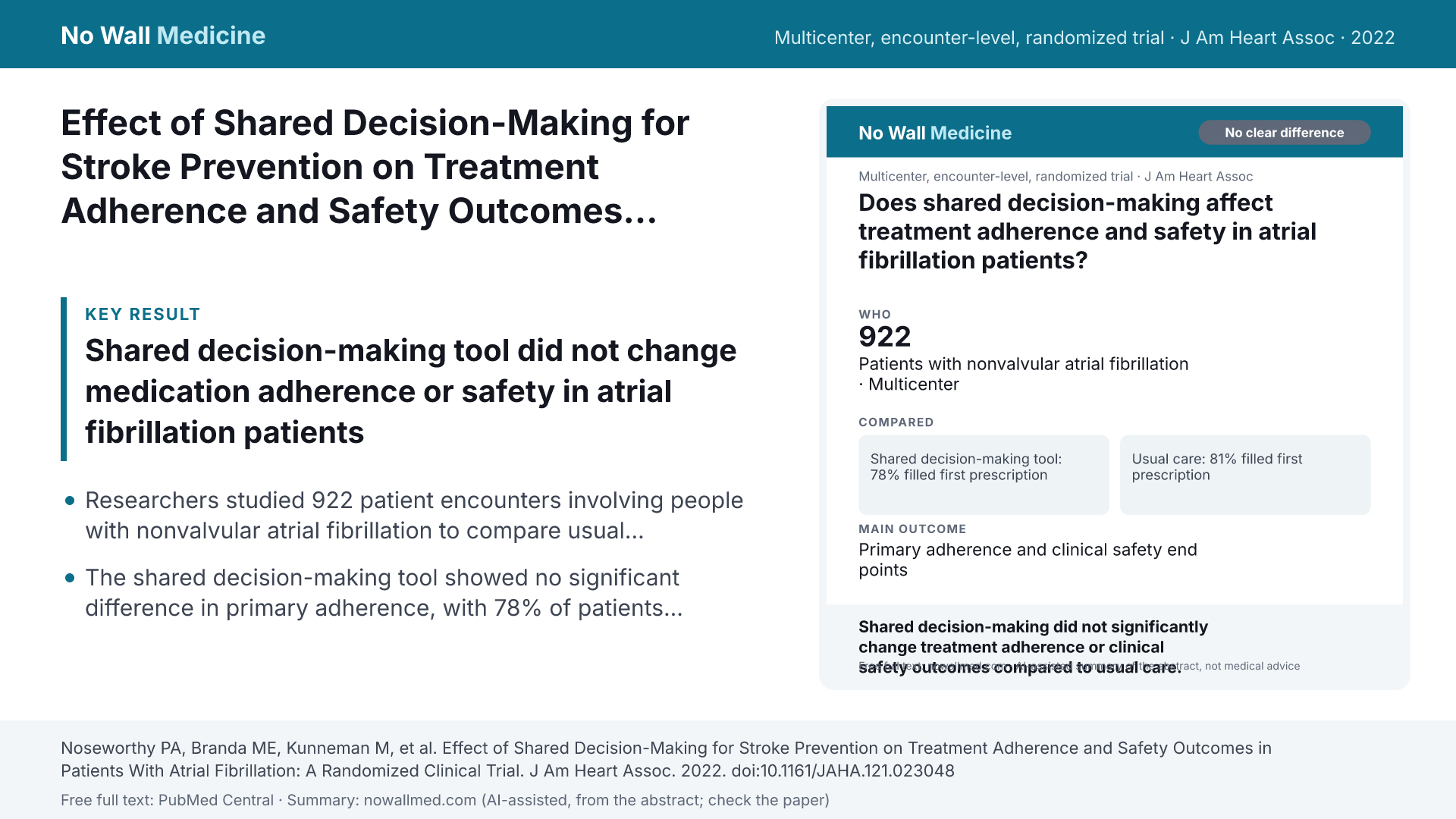
Shared decision-making tool did not change medication adherence or safety in atrial fibrillation patients
Effect of Shared Decision-Making for Stroke Prevention on Treatment Adherence and Safety Outcomes in Patients With Atrial Fibrillation: A Randomized Clinical Trial
Multicenter, encounter-level, randomized trialNo clear difference
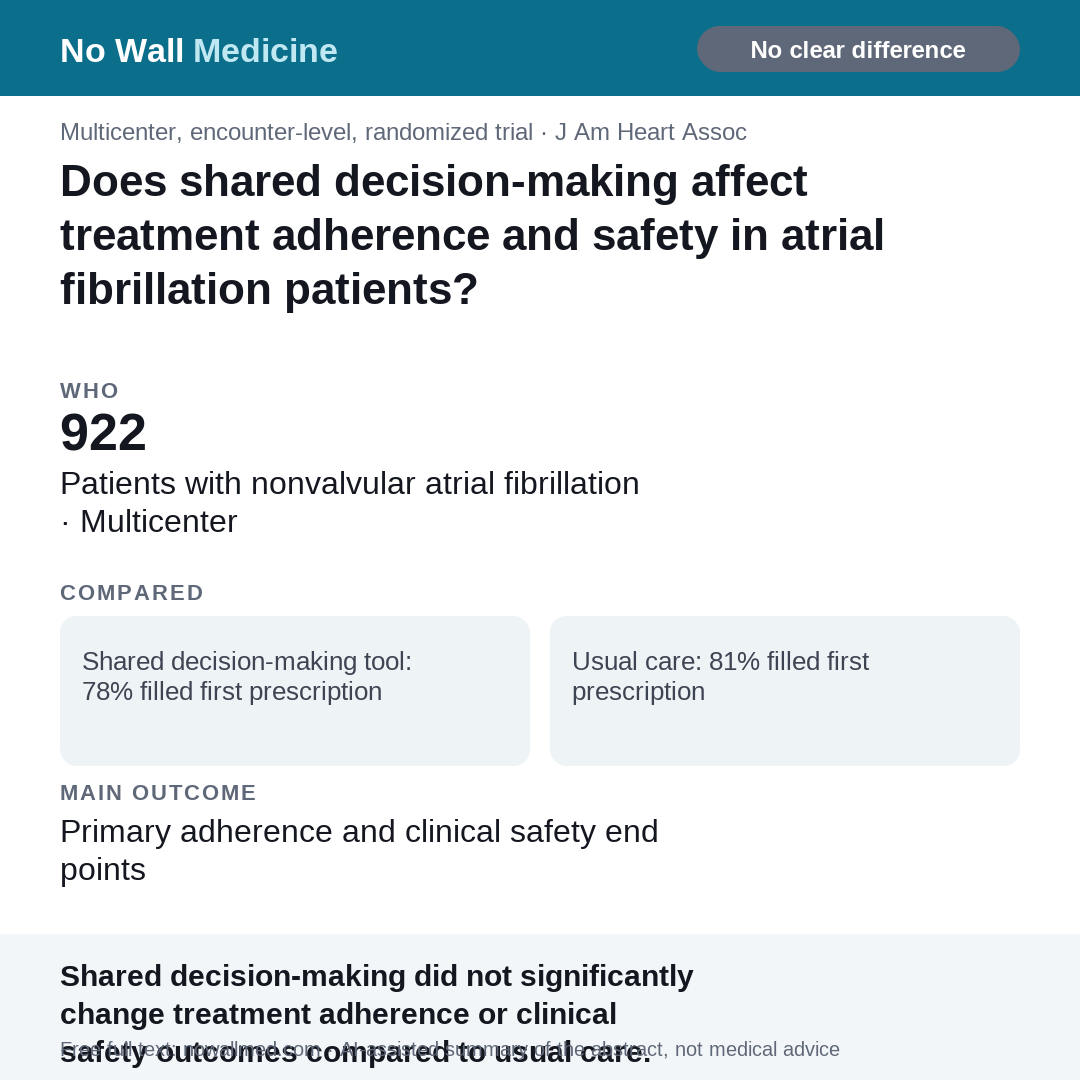
Does shared decision-making affect treatment adherence and safety in atrial fibrillation patients?
Who
922
Patients with nonvalvular atrial fibrillation · Multicenter
Compared
Shared decision-making tool: 78% filled first prescription
Usual care: 81% filled first prescription
Main outcome
Primary adherence and clinical safety end points
Bottom line: Shared decision-making did not significantly change treatment adherence or clinical safety outcomes compared to usual care.
J Am Heart Assoc · 2022-01-13Download image
Clinical question: Does shared decision-making affect treatment adherence and safety in atrial fibrillation patients?
Why it matters: It was unknown if using a shared decision-making tool during clinical encounters would change how well patients follow anticoagulation treatment plans or affect clinical safety.
Key points
- Researchers studied 922 patient encounters involving people with nonvalvular atrial fibrillation to compare usual care against usual care plus a shared decision-making tool.
- The shared decision-making tool showed no significant difference in primary adherence, with 78% of patients filling their first prescription compared to 81% in usual care.
- Safety outcomes, including strokes and major bleeding, occurred in 13% of the shared decision-making group and 14% of the usual care group.
Headline and key points written with AI from the paper’s abstract, with every number checked against it. Read the paper before relying on them.
Was this summary helpful?
Subject terms
Cite this article
Noseworthy PA, Branda ME, Kunneman M, et al. Effect of Shared Decision-Making for Stroke Prevention on Treatment Adherence and Safety Outcomes in Patients With Atrial Fibrillation: A Randomized Clinical Trial. J Am Heart Assoc. 2022. doi:10.1161/JAHA.121.023048
Spotted a mistake? Suggest a correction