Salt substitutes using less sodium and more potassium showed no effect on cancer risk
Effect of sodium-reduced potassium-enriched salt substitutes on stomach cancer: the Salt Substitute and Stroke Study (SSaSS)
Open-label, cluster randomised controlled trialNo clear difference
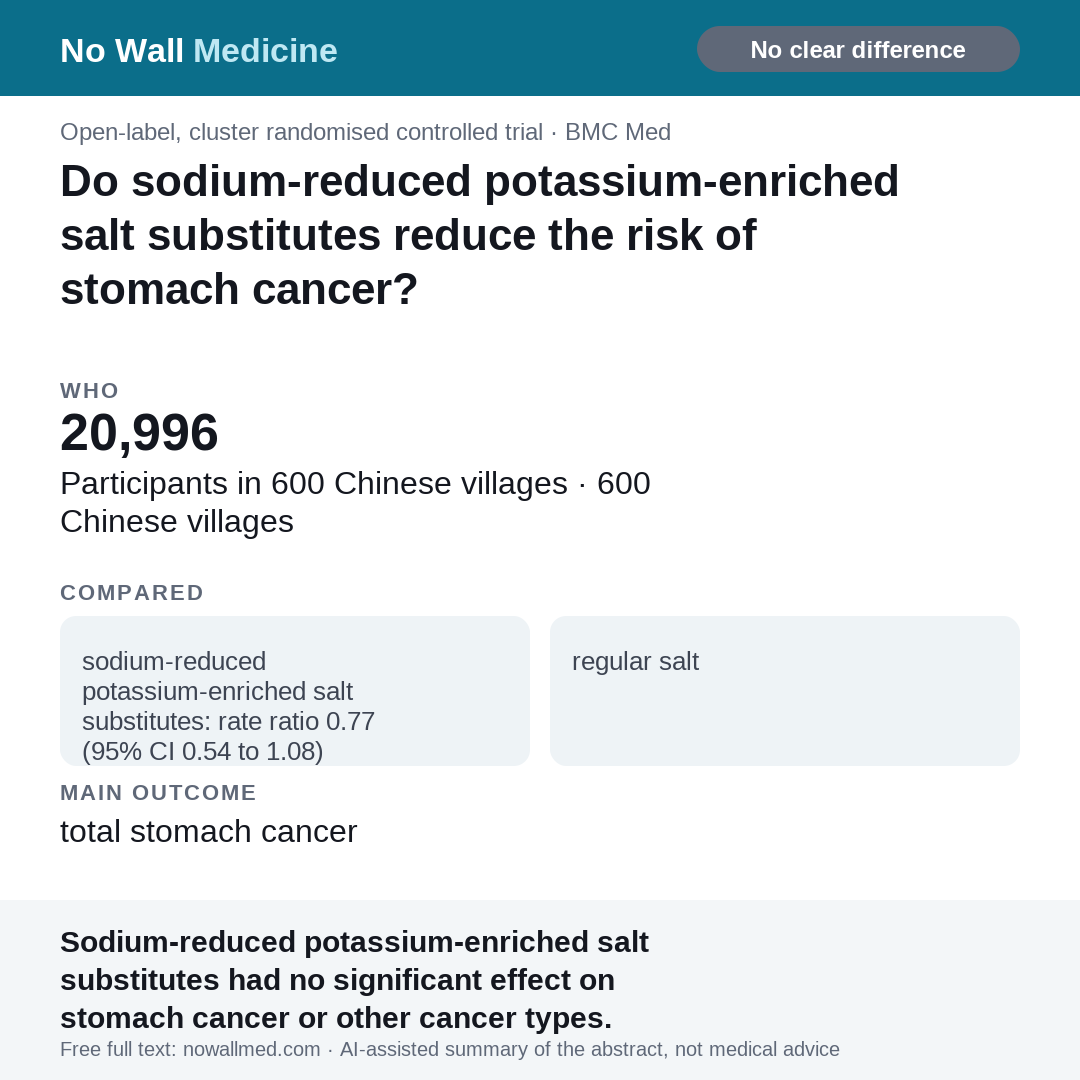
Do sodium-reduced potassium-enriched salt substitutes reduce the risk of stomach cancer?
Who
20,996
Participants in 600 Chinese villages · 600 Chinese villages
Compared
sodium-reduced potassium-enriched salt substitutes: rate ratio 0.77 (95% CI 0.54 to 1.08)
regular salt
Main outcome
total stomach cancer
Result: rate ratio 0.77 (95% CI 0.54 to 1.08)
Bottom line: Sodium-reduced potassium-enriched salt substitutes had no significant effect on stomach cancer or other cancer types.
BMC Med · 2025-04-23Download image
Clinical question: Do sodium-reduced potassium-enriched salt substitutes reduce the risk of stomach cancer?
Why it matters: It is unknown if replacing regular salt with sodium-reduced potassium-enriched salt substitutes can change the risk of stomach cancer and other cancers.
Key points
- Researchers conducted a cluster randomized controlled trial in 600 Chinese villages involving 20,996 participants to compare salt substitutes with regular salt.
- During a mean follow-up of 4.7 years, there was no detectable effect on total cancer at any site (rate ratio 0.94, 95% confidence interval 0.81 to 1.08).
- A trend toward but not a significant effect was seen for total stomach cancer (rate ratio 0.77, 95% confidence interval 0.54 to 1.08).
Headline and key points written with AI from the paper’s abstract, with every number checked against it. Read the paper before relying on them.
Was this summary helpful?
Subject terms
Cite this article
Zhang X, Yin X, Yap ML, Li Q, Huang L, Liu Y. Effect of sodium-reduced potassium-enriched salt substitutes on stomach cancer: the Salt Substitute and Stroke Study (SSaSS). BMC Med. 2025. doi:10.1186/s12916-025-04068-0
Spotted a mistake? Suggest a correction
Top studies every Monday
The week’s key trials and guidelines in your specialties, plus any topics you follow. By email, free.
Get the weekly digest