Salt substitute use was associated with lower rates of recurrent stroke and death in stroke patients
Salt Substitution and Recurrent Stroke and Death: A Randomized Clinical Trial
Open-label, cluster randomized clinical trialBenefit found
Does salt substitution reduce recurrent stroke and mortality among patients with stroke?
Who
15249
Patients with a self-reported hospital diagnosis of stroke · 600 northern Chinese villages
Compared
Salt substitute: rate ratio 0.86 (95% CI, 0.77-0.95)
Regular salt
Main outcome
Recurrent stroke
Result: rate ratio 0.86 (95% CI, 0.77-0.95)
Bottom line: Salt substitution reduced risks of recurrent stroke and death among patients with stroke.
JAMA Cardiol · 2025-02-05Download image
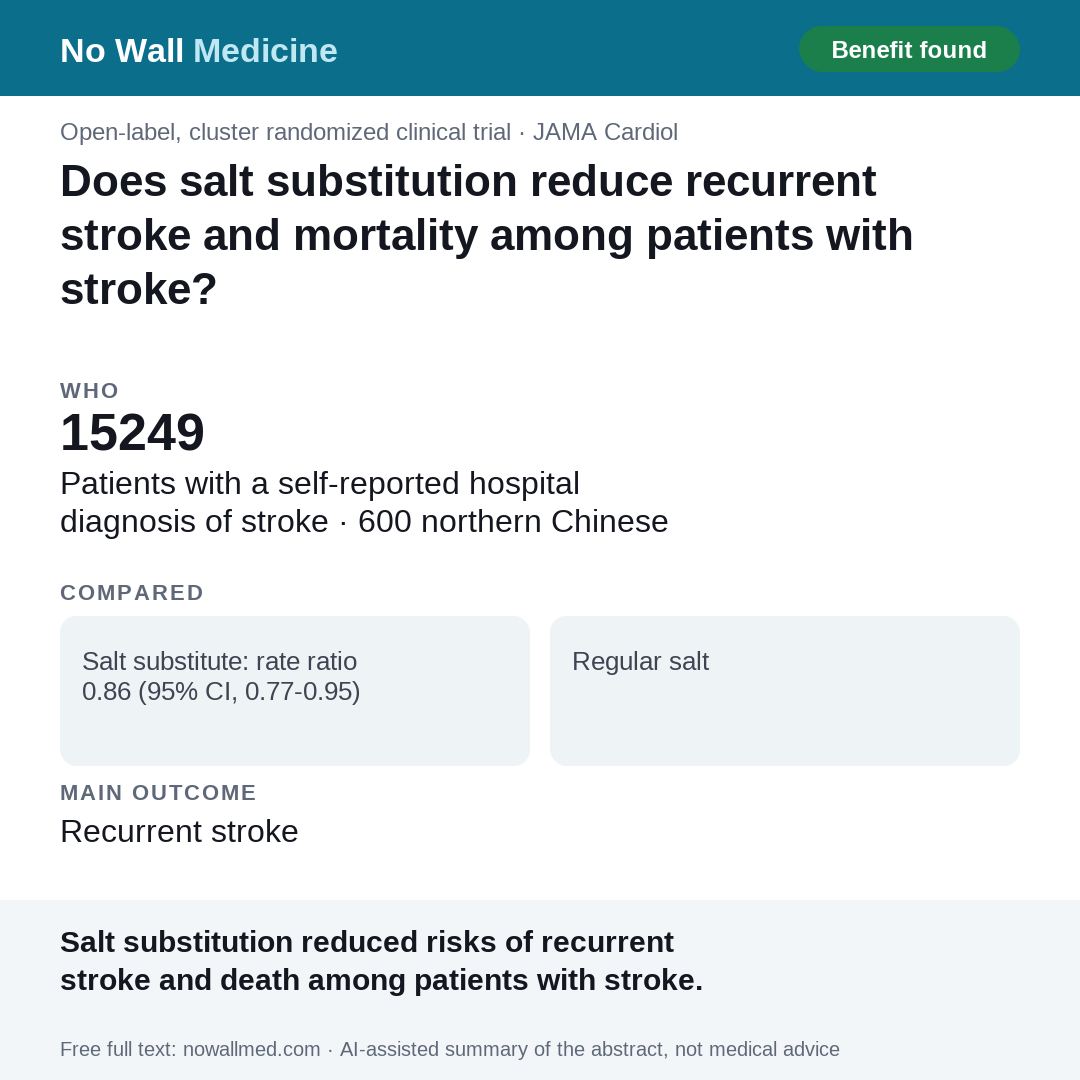
Clinical question: Does salt substitution reduce recurrent stroke and mortality among patients with stroke?
Why it matters: The direct effect of using salt substitutes versus regular salt on recurrent stroke and mortality among people who have already had a stroke is unclear.
Key points
- The study followed 15 249 patients with a history of stroke in 600 Chinese villages who used either regular salt or a salt substitute.
- Salt substitute use was associated with a lower rate of recurrent stroke (rate ratio, 0.86) and lower death rates (rate ratio, 0.88).
- The salt substitute, containing 75% sodium chloride and 25% potassium chloride, was not linked to a significant difference in hyperkalemia, or high blood potassium levels.
Headline and key points written with AI from the paper’s abstract, with every number checked against it. Read the paper before relying on them.
Was this summary helpful?
Subject terms
Cite this article
Ding X, Zhang X, Huang L, Xiong S, Li Z, Zhao Y. Salt Substitution and Recurrent Stroke and Death: A Randomized Clinical Trial. JAMA Cardiol. 2025. doi:10.1001/jamacardio.2024.5417
Spotted a mistake? Suggest a correction
Top studies every Monday
The week’s key trials and guidelines in your specialties, plus any topics you follow. By email, free.
Get the weekly digest