Spironolactone did not improve kidney function or reduce fibrosis in kidney transplant recipients
Effect of Spironolactone on Kidney Function in Kidney Transplant Recipients (the SPIREN trial): A Randomized Placebo-Controlled Clinical Trial
Randomized, placebo-controlled, double-blind clinical trialNo clear difference
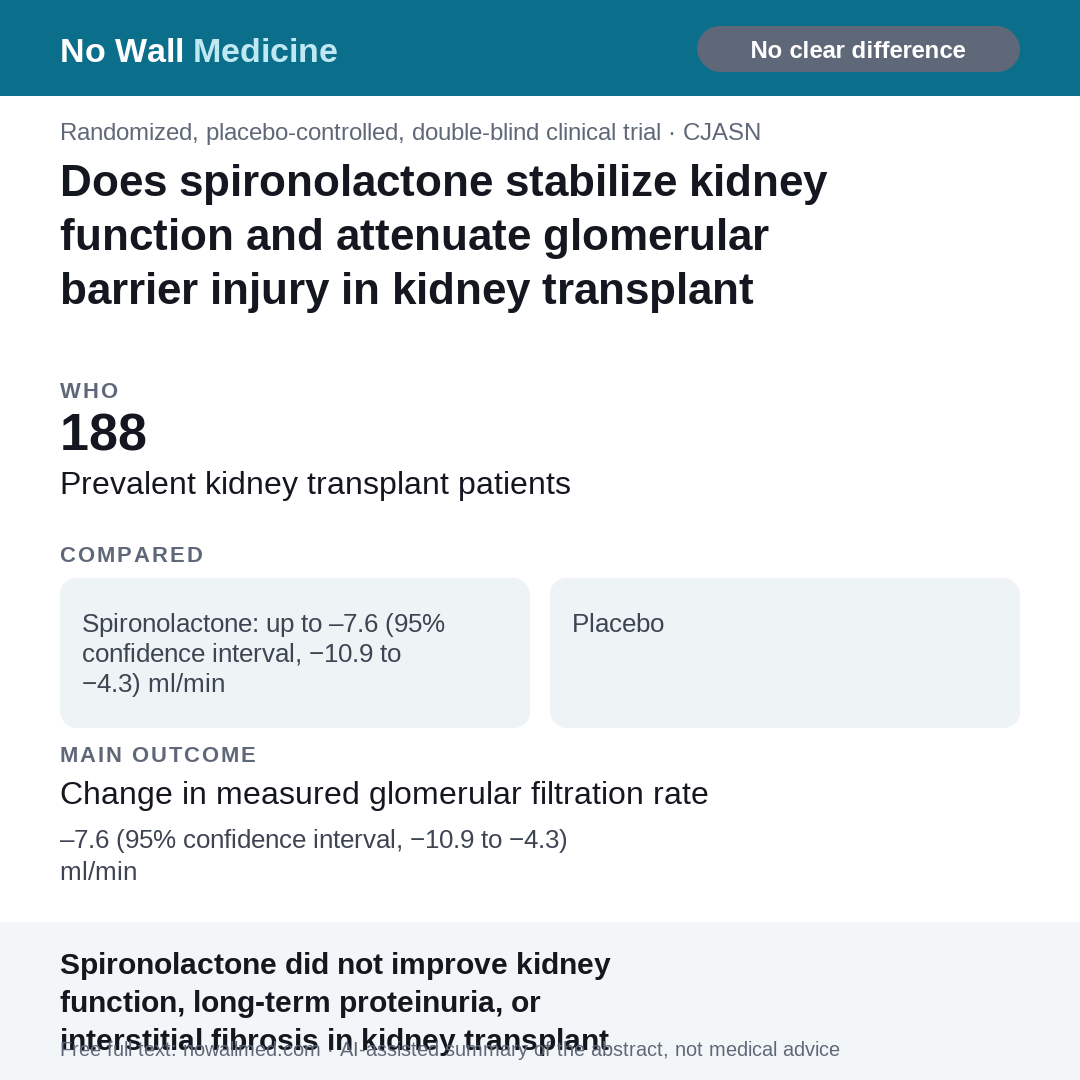
Does spironolactone stabilize kidney function and attenuate glomerular barrier injury in kidney transplant patients?
Who
188
Prevalent kidney transplant patients
Compared
Spironolactone: up to –7.6 (95% confidence interval, −10.9 to −4.3) ml/min
Placebo
Main outcome
Change in measured glomerular filtration rate
Result: –7.6 (95% confidence interval, −10.9 to −4.3) ml/min
Bottom line: Spironolactone did not improve kidney function, long-term proteinuria, or interstitial fibrosis in kidney transplant patients.
CJASN · 2024-02-27Download image
Clinical question: Does spironolactone stabilize kidney function and attenuate glomerular barrier injury in kidney transplant patients?
Why it matters: It was unknown if the mineralocorticoid receptor antagonist spironolactone could stabilize kidney function and reduce glomerular barrier injury in patients treated with calcineurin inhibitors.
Key points
- Researchers conducted a randomized, placebo-controlled trial with 188 kidney transplant patients over 3 years.
- Spironolactone was associated with a reduction in measured glomerular filtration rate (the rate at which kidneys filter blood) of up to –7.6 ml/min compared to placebo.
- The medication was associated with reduced 24-hour proteinuria after 1 year but had no significant effect on the development of interstitial fibrosis.
Headline and key points written with AI from the paper’s abstract, with every number checked against it. Read the paper before relying on them.
Was this summary helpful?
Subject terms
Cite this article
Mortensen LA, Jespersen B, Helligsoe ASL, Tougaard B, Cibulskyte-Ninkovic D, Egfjord M. Effect of Spironolactone on Kidney Function in Kidney Transplant Recipients (the SPIREN trial): A Randomized Placebo-Controlled Clinical Trial. CJASN. 2024. doi:10.2215/CJN.0000000000000439
Spotted a mistake? Suggest a correction
Top studies every Monday
The week’s key trials and guidelines in your specialties, plus any topics you follow. By email, free.
Get the weekly digest