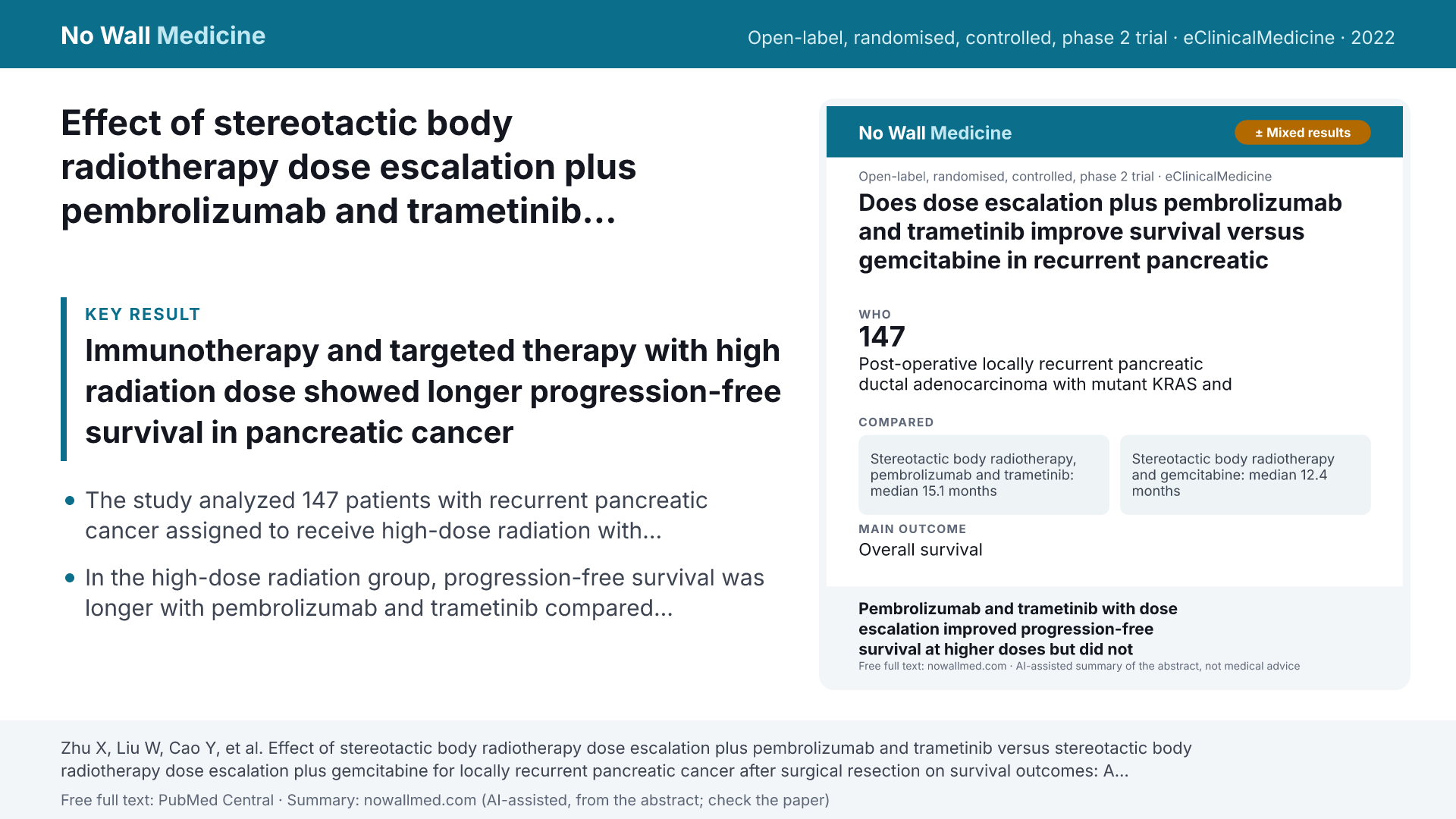
Immunotherapy and targeted therapy with high radiation dose showed longer progression-free survival in pancreatic cancer
Effect of stereotactic body radiotherapy dose escalation plus pembrolizumab and trametinib versus stereotactic body radiotherapy dose escalation plus gemcitabine for locally recurrent pancreatic cancer after surgical resection on survival outcomes: A secondary analysis of an open-label, randomised, controlled, phase 2 trial
Open-label, randomised, controlled, phase 2 trialMixed results
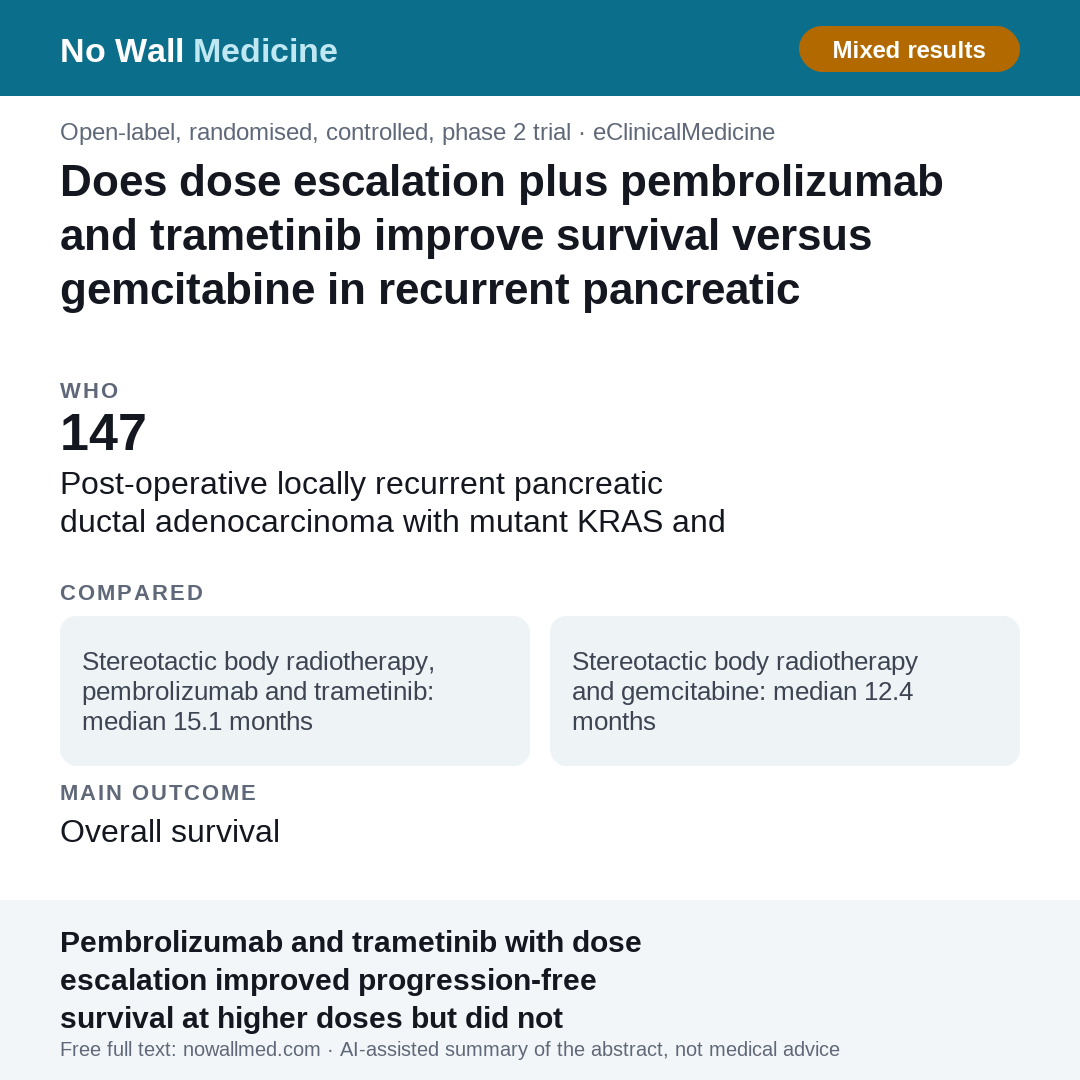
Does dose escalation plus pembrolizumab and trametinib improve survival versus gemcitabine in recurrent pancreatic cancer?
Who
147
Post-operative locally recurrent pancreatic ductal adenocarcinoma with mutant KRAS and PD-L1 · A hospital in China
Compared
Stereotactic body radiotherapy, pembrolizumab and trametinib: median 15.1 months
Stereotactic body radiotherapy and gemcitabine: median 12.4 months
Main outcome
Overall survival
Result: hazard ratio 0.67 (95%CI 0.43-1.04)
Bottom line: Pembrolizumab and trametinib with dose escalation improved progression-free survival at higher doses but did not significantly improve overall survival.
Limitation: Small sample size and post-hoc analysis not powered to determine significance.
Funded by: Shanghai Shenkang Centre and Changhai Hospital
eClinicalMedicine · 2022-12-01Download image
Clinical question: Does dose escalation plus pembrolizumab and trametinib improve survival versus gemcitabine in recurrent pancreatic cancer?
Why it matters: It is unknown if increasing radiation doses works together with immunotherapy and targeted therapy to improve survival for patients with recurrent pancreatic cancer.
Key points
- The study analyzed 147 patients with recurrent pancreatic cancer assigned to receive high-dose radiation with either pembrolizumab and trametinib or gemcitabine.
- In the high-dose radiation group, progression-free survival was longer with pembrolizumab and trametinib compared to gemcitabine, with a median of 8.6 vs. 5.0 months.
- Overall survival did not reach statistical significance between the two groups, with a median of 15.1 vs. 12.4 months.
Limitation the authors note: The authors noted the small sample size and that this was a post-hoc analysis not powered to determine significance.
Headline and key points written with AI from the paper’s abstract, with every number checked against it. Read the paper before relying on them.
Was this summary helpful?
Cite this article
Zhu X, Liu W, Cao Y, Ju X, Zhao X, Jiang L. Effect of stereotactic body radiotherapy dose escalation plus pembrolizumab and trametinib versus stereotactic body radiotherapy dose escalation plus gemcitabine for locally recurrent pancreatic cancer after surgical resection on survival outcomes: A secondary analysis of an open-label, randomised, controlled, phase 2 trial. eClinicalMedicine. 2022. doi:10.1016/j.eclinm.2022.101764
Spotted a mistake? Suggest a correction
Top studies every Monday
The week’s key trials and guidelines in your specialties, plus any topics you follow. By email, free.
Get the weekly digest