Text messaging and behavioral content did not increase COVID-19 vaccine uptake in an urban population
Effect of Text Messaging and Behavioral Interventions on COVID-19 Vaccination Uptake: A Randomized Clinical Trial
Randomized clinical trial with a factorial designNo clear difference
Do text messaging and behavioral interventions increase COVID-19 vaccine uptake?
Who
16045
Patients at least 18 years old in Philadelphia, Pennsylvania · Urban academic health system
Compared
3.6%Outbound telephone call only (14/390)
3.1%Text message and outbound telephone call (243/7890)
3.3%Text message and inbound telephone call (253/7765)
Main outcome
Proportion of patients who completed the first vaccine dose within 1 month
Result: absolute difference, -0.5% (95% CI, -2.4% to 1.4%)
Bottom line: Text messaging and behaviorally informed content did not increase COVID-19 vaccine uptake compared to telephone calls alone.
JAMA Netw Open · 2022-06-01Download image
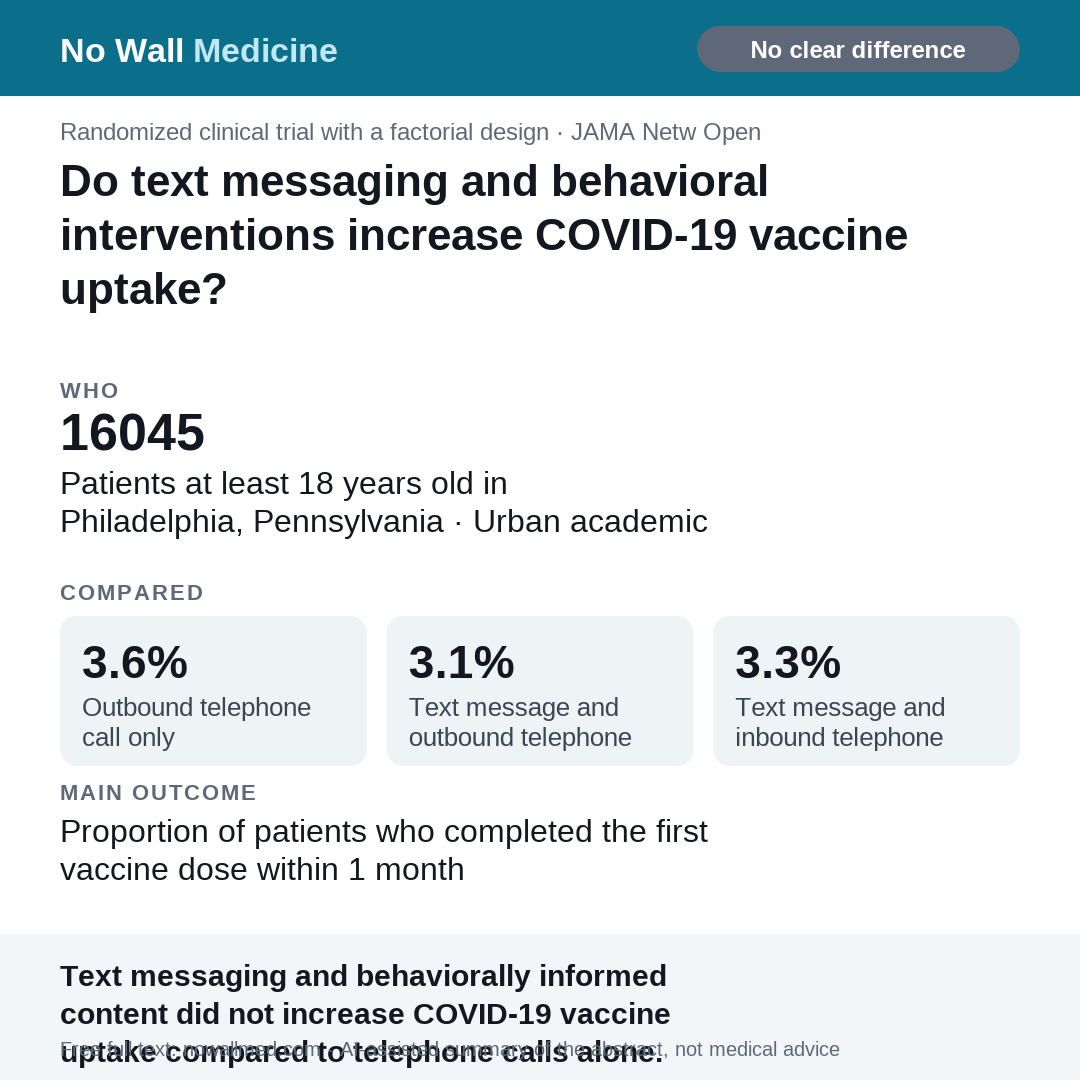
Clinical question: Do text messaging and behavioral interventions increase COVID-19 vaccine uptake?
Why it matters: It was unknown if text messaging with different scheduling methods or behavioral messaging content could increase COVID-19 vaccine uptake in urban populations.
Key points
- Researchers studied 16,045 patients in Philadelphia to compare outbound telephone calls, text messages with outbound calls, and text messages with inbound calls.
- At 1 month, 3.6% of the telephone-only group, 3.1% of the text plus outbound call group, and 3.3% of the text plus inbound call group received a vaccine dose.
- Among those receiving text messages, vaccination rates were 3.0% for standard messaging, 3.4% for clinician endorsement, 2.6% for scarcity, and 3.6% for endowment framing.
Headline and key points written with AI from the paper’s abstract, with every number checked against it. Read the paper before relying on them.
Was this summary helpful?
Subject terms
Cite this article
Mehta SJ, Mallozzi C, Shaw PA, Reitz C, McDonald C, Vandertuyn M. Effect of Text Messaging and Behavioral Interventions on COVID-19 Vaccination Uptake: A Randomized Clinical Trial. JAMA Netw Open. 2022. doi:10.1001/jamanetworkopen.2022.16649
Spotted a mistake? Suggest a correction
Top studies every Monday
The week’s key trials and guidelines in your specialties, plus any topics you follow. By email, free.
Get the weekly digest