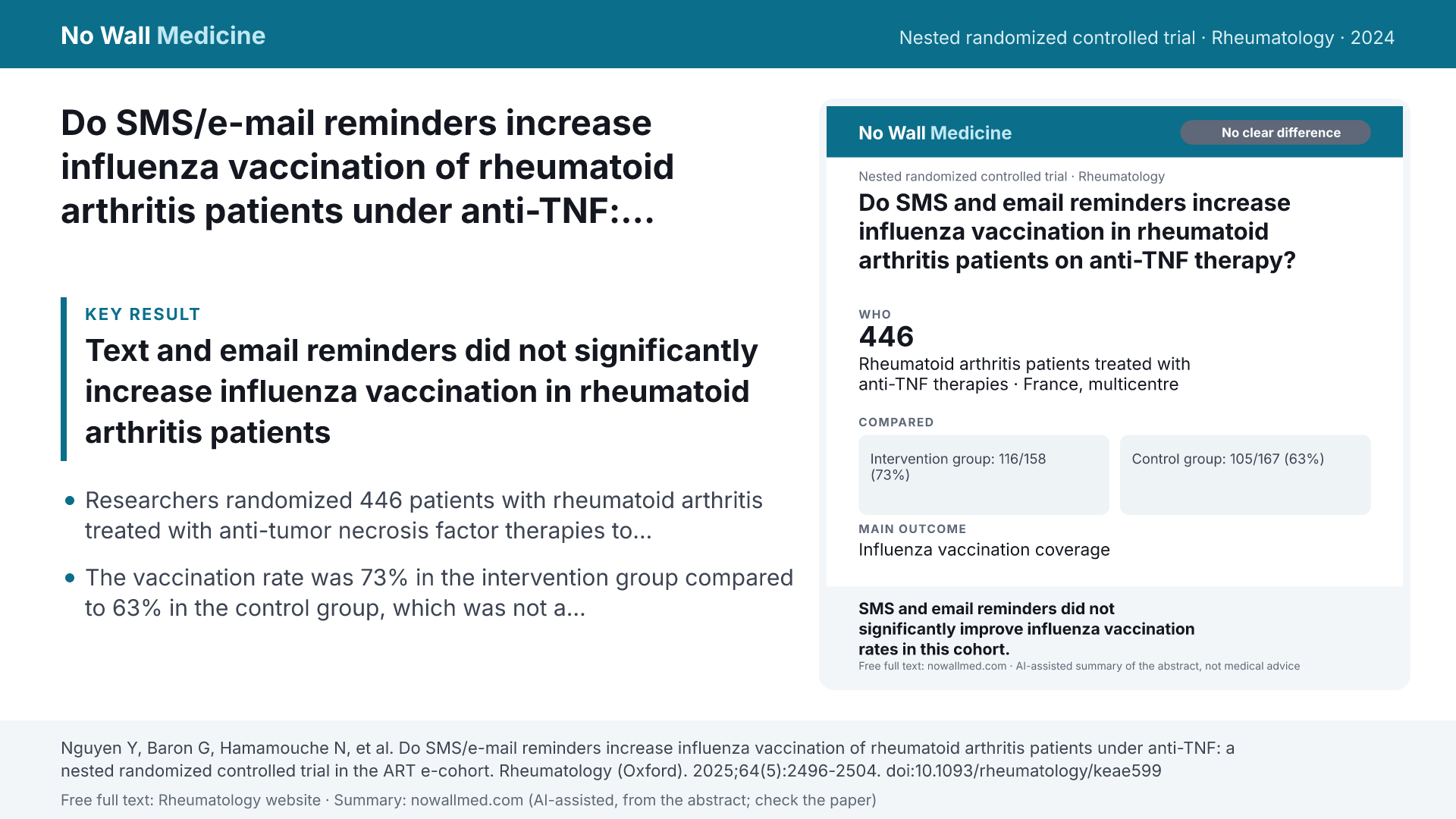
Text and email reminders did not significantly increase influenza vaccination in rheumatoid arthritis patients
Do SMS/e-mail reminders increase influenza vaccination of rheumatoid arthritis patients under anti-TNF: a nested randomized controlled trial in the ART e-cohort
Nested randomized controlled trialNo clear difference
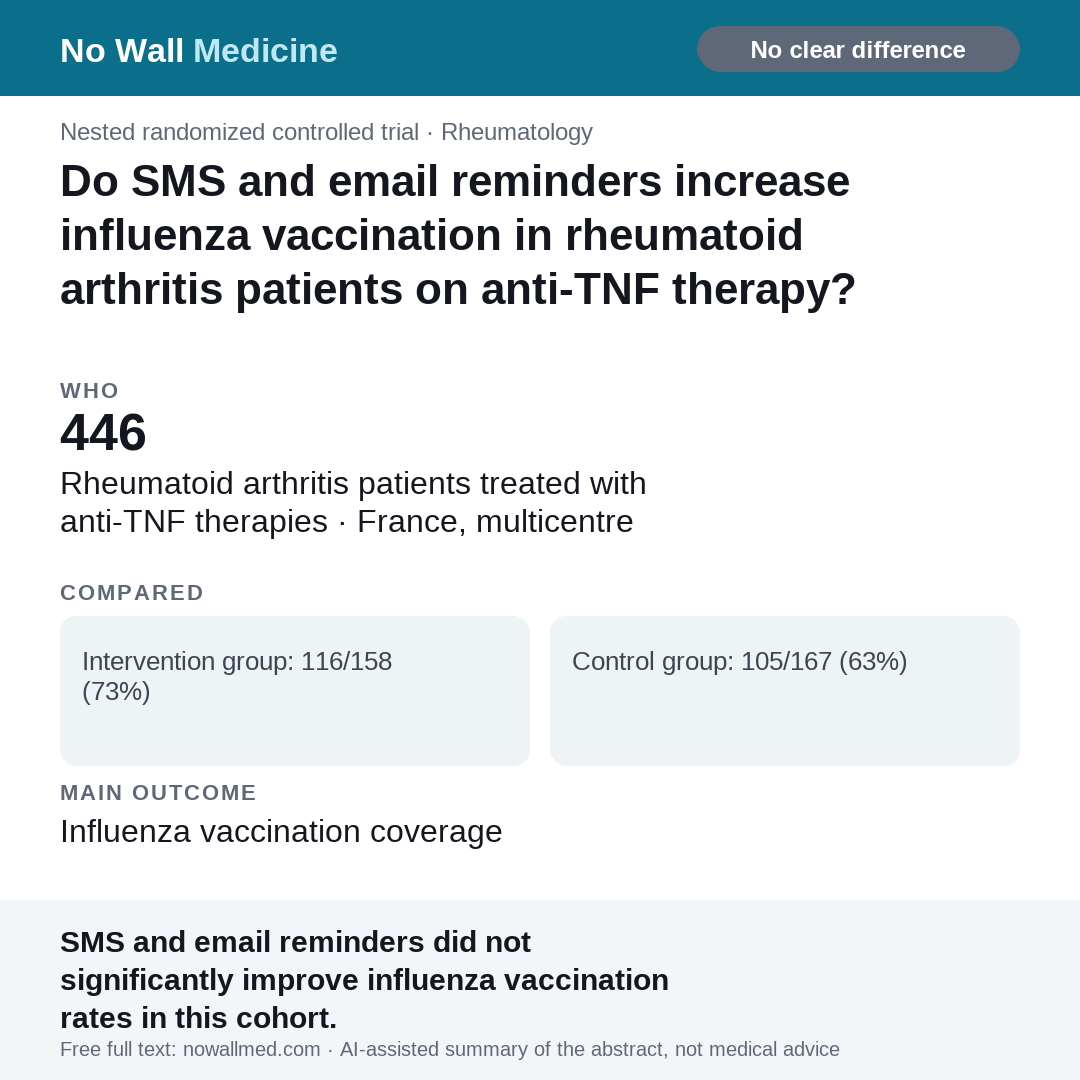
Do SMS and email reminders increase influenza vaccination in rheumatoid arthritis patients on anti-TNF therapy?
Who
446
Rheumatoid arthritis patients treated with anti-TNF therapies · France, multicentre prospective cohort
Compared
Intervention group: 116/158 (73%)
Control group: 105/167 (63%)
Main outcome
Influenza vaccination coverage
Result: relative risk 1.08 (95% CI 0.95-1.23)
Bottom line: SMS and email reminders did not significantly improve influenza vaccination rates in this cohort.
Rheumatology · 2024-11-22Download image
Clinical question: Do SMS and email reminders increase influenza vaccination in rheumatoid arthritis patients on anti-TNF therapy?
Why it matters: It was unknown if sending short message service or email reminders could improve influenza vaccination coverage among patients with rheumatoid arthritis receiving anti-tumor necrosis factor therapy.
Key points
- Researchers randomized 446 patients with rheumatoid arthritis treated with anti-tumor necrosis factor therapies to receive either regular SMS and email reminders or no reminders.
- The vaccination rate was 73% in the intervention group compared to 63% in the control group, which was not a statistically significant difference (relative risk 1.08; 95% CI 0.95-1.23).
- Being age 65 years or older and having received a previous influenza vaccination were associated with higher vaccination rates.
Limitation the authors note: The authors stated that the results might be counterbalanced by an already high vaccination coverage.
Headline and key points written with AI from the paper’s abstract, with every number checked against it. Read the paper before relying on them.
Was this summary helpful?
Subject terms
Cite this article
Nguyen Y, Baron G, Hamamouche N, Belkhir R, Miconnet S, Soubrier M. Do SMS/e-mail reminders increase influenza vaccination of rheumatoid arthritis patients under anti-TNF: a nested randomized controlled trial in the ART e-cohort. Rheumatology. 2024. doi:10.1093/rheumatology/keae599
Spotted a mistake? Suggest a correction