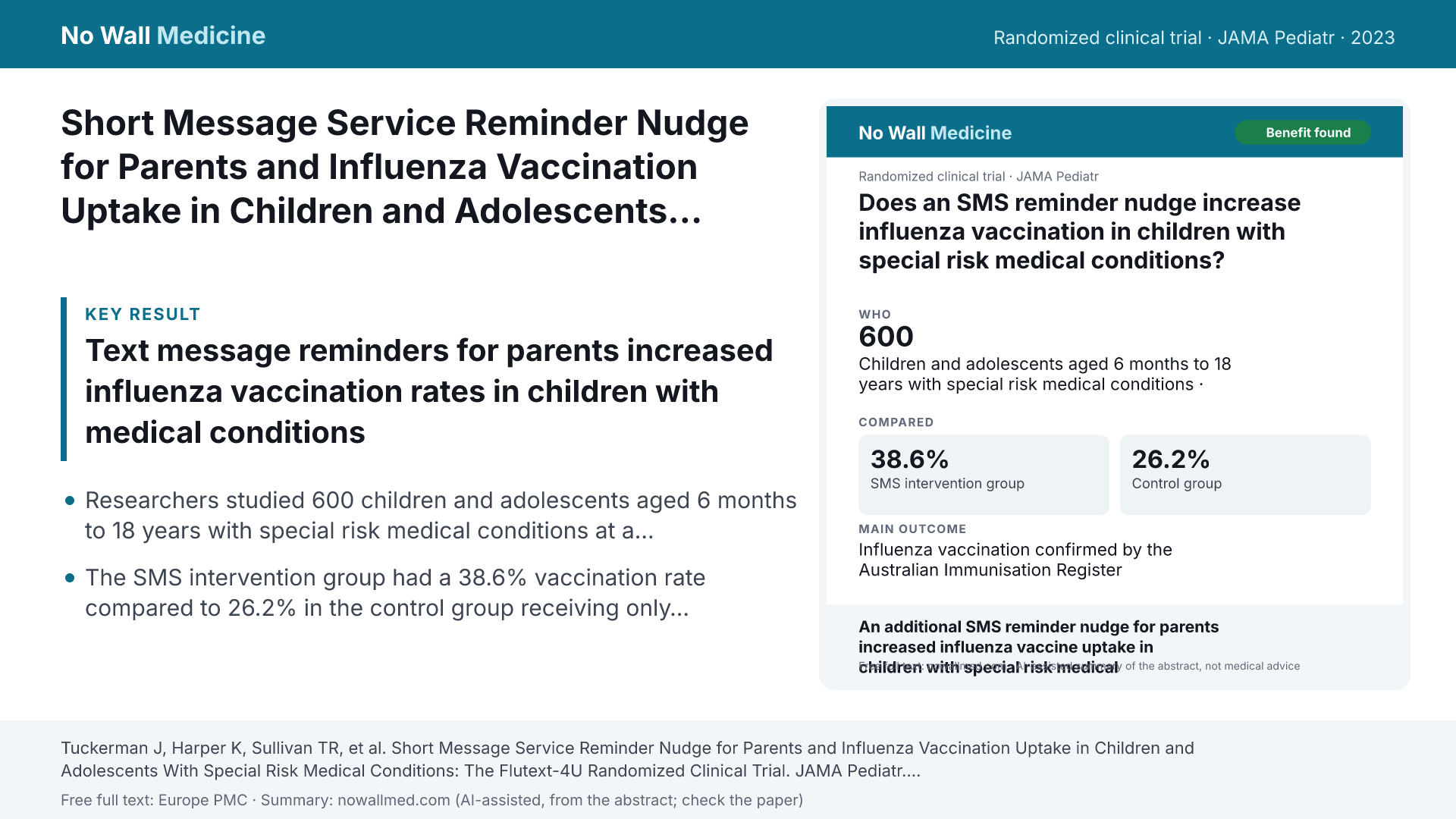
Text message reminders for parents increased influenza vaccination rates in children with medical conditions
Short Message Service Reminder Nudge for Parents and Influenza Vaccination Uptake in Children and Adolescents With Special Risk Medical Conditions: The Flutext-4U Randomized Clinical Trial
Randomized clinical trialBenefit found
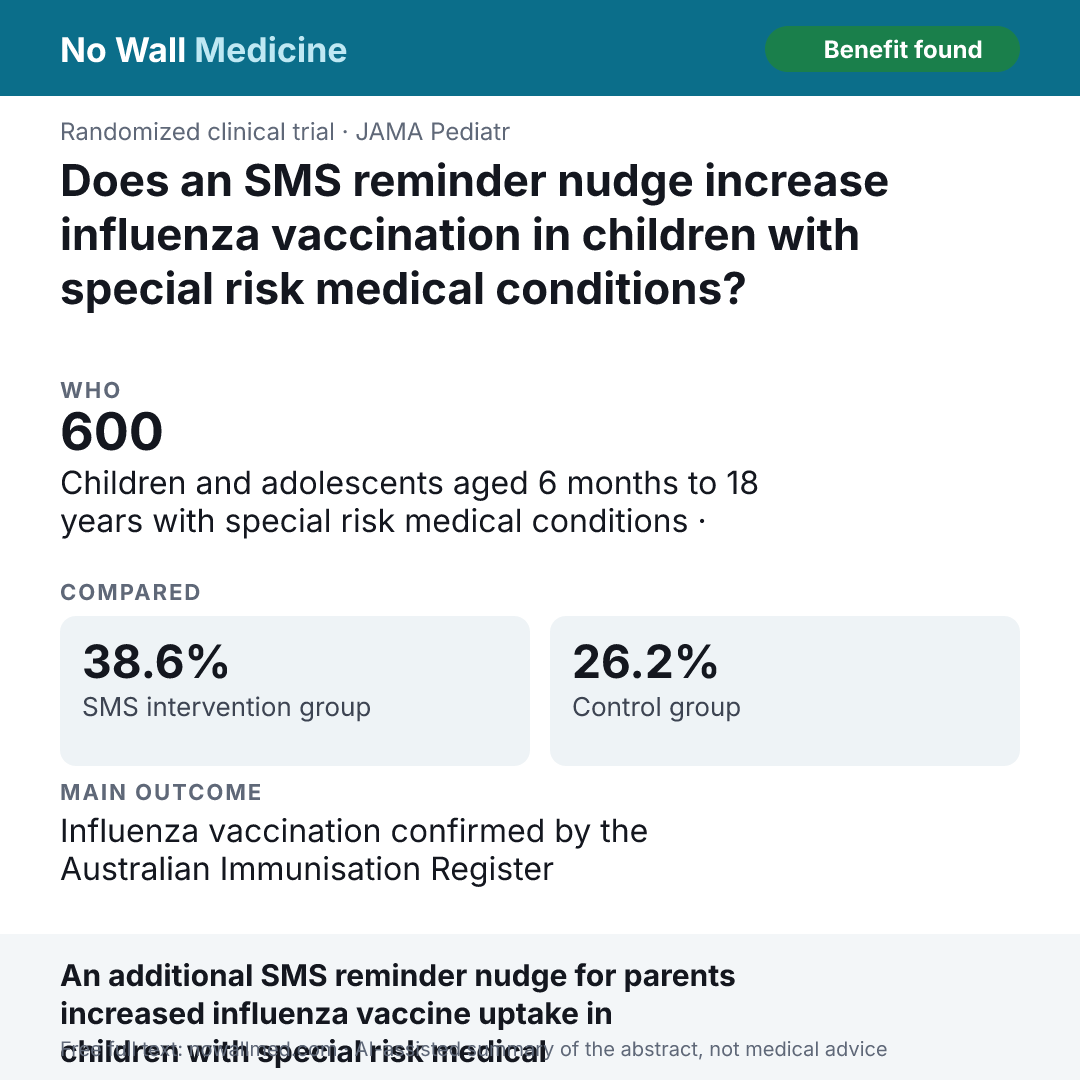
Does an SMS reminder nudge increase influenza vaccination in children with special risk medical conditions?
Who
600
Children and adolescents aged 6 months to 18 years with special risk medical conditions · Tertiary pediatric hospital in Adelaide, South Australia
Compared
38.6%SMS intervention group (113 of 293)
26.2%Control group (79 of 302)
Main outcome
Influenza vaccination confirmed by the Australian Immunisation Register
Result: adjusted odds ratio 1.79 (95% CI 1.27-2.55)
Bottom line: An additional SMS reminder nudge for parents increased influenza vaccine uptake in children with special risk medical conditions.
JAMA Pediatr · 2023-02-23 · ACTRN12621000463875
Why it matters: Influenza vaccination rates are suboptimal among children and adolescents living with chronic medical conditions that increase their risk of severe illness.
Headline and visual abstract written with AI from the paper’s abstract, with every number checked against it. Read the paper before relying on them.
Was this summary helpful?
Abstract
Importance
Children with chronic medical conditions are at increased risk of severe influenza. Uptake of influenza vaccination in children and adolescents with these identified special risk medical conditions (SRMCs) is suboptimal.Objective
To assess the effectiveness of Flutext-4U, a parent short message service (SMS) reminder nudge intervention, in increasing influenza immunization in children and adolescents with SRMCs.Design, setting, and participants
This randomized clinical trial was conducted at a tertiary pediatric hospital in Adelaide, South Australia, from April 15 to September 30, 2021. Children and adolescents aged 6 months to younger than 18 years with SRMCs and a subspecialist outpatient appointment over a 5-month period during the Australian seasonal influenza vaccination season (April-August 2021) were eligible to participate. Follow-up was until September 30, 2021.Interventions
Participants were randomly assigned (1:1 ratio) to control: clinician nudges (hospital vaccine availability, ease of access, and recommendation from hospital subspecialists) or SMS intervention (control conditions plus an additional SMS reminder nudge to parents), with randomization stratified by age group (14 to Main outcomes and measures
The primary outcome was influenza vaccination, as confirmed by the Australian Immunisation Register.Results
A total of 600 participants (intervention group: 298 [49.7%]; mean [SD] age, 11.5 [4.6] years; 162 female participants [54.4%]; control group: 302 [50.3%]; mean [SD] age, 11.4 [4.7] years; 155 female participants [51.3%]) were included. Influenza vaccination was 38.6% (113 of 293) in the SMS intervention group compared with 26.2% (79 of 302) in the control group (adjusted odds ratio [aOR], 1.79; 95% CI, 1.27-2.55; P = .001). Time to vaccine receipt was significantly lower among SMS participants (adjusted hazard ratio, 1.67; 95% CI, 1.25-2.22; P Conclusions and relevance
Results of this randomized clinical trial suggest that an additional SMS reminder nudge for parents delivered in the tertiary care hospital setting to children and adolescents with SMRCs resulted in higher influenza vaccine uptake compared with clinician nudges alone.Trial registration
ANZCTR Identifier: ACTRN12621000463875.
Abstract reproduced under the article’s CC BY licence.
Subject terms
Cite this article
Tuckerman J, Harper K, Sullivan TR, et al. Short Message Service Reminder Nudge for Parents and Influenza Vaccination Uptake in Children and Adolescents With Special Risk Medical Conditions: The Flutext-4U Randomized Clinical Trial. JAMA Pediatr. 2023;177(4):337-344. doi:10.1001/jamapediatrics.2022.6145
Spotted a mistake? Suggest a correction