Occupational therapy group programme did not improve quality of life or activity participation in patients with multiple chronic conditions
Effect of the OPTIMAL programme on self-management of multimorbidity in primary care: a randomised controlled trial
Pragmatic parallel randomised controlled trialNo clear difference
Does the OPTIMAL programme improve self-management in patients with multimorbidity?
Who
149
Patients with multimorbidity · Eight primary care teams in Eastern Ireland
Compared
OPTIMAL programme: aMD = 7.86 (95% CI 0.92 to 14.80) for EQ-VAS
Usual care
Main outcome
Health-related quality of life and frequency of activity participation
Result: aMD = 0.04 (95% CI -0.06 to 0.13) for EQ-5D-3L index score
Bottom line: The OPTIMAL programme was ineffective in improving health-related quality of life or activity participation at 6-month follow-up.
Br J Gen Pract · 2021-03-26Download image
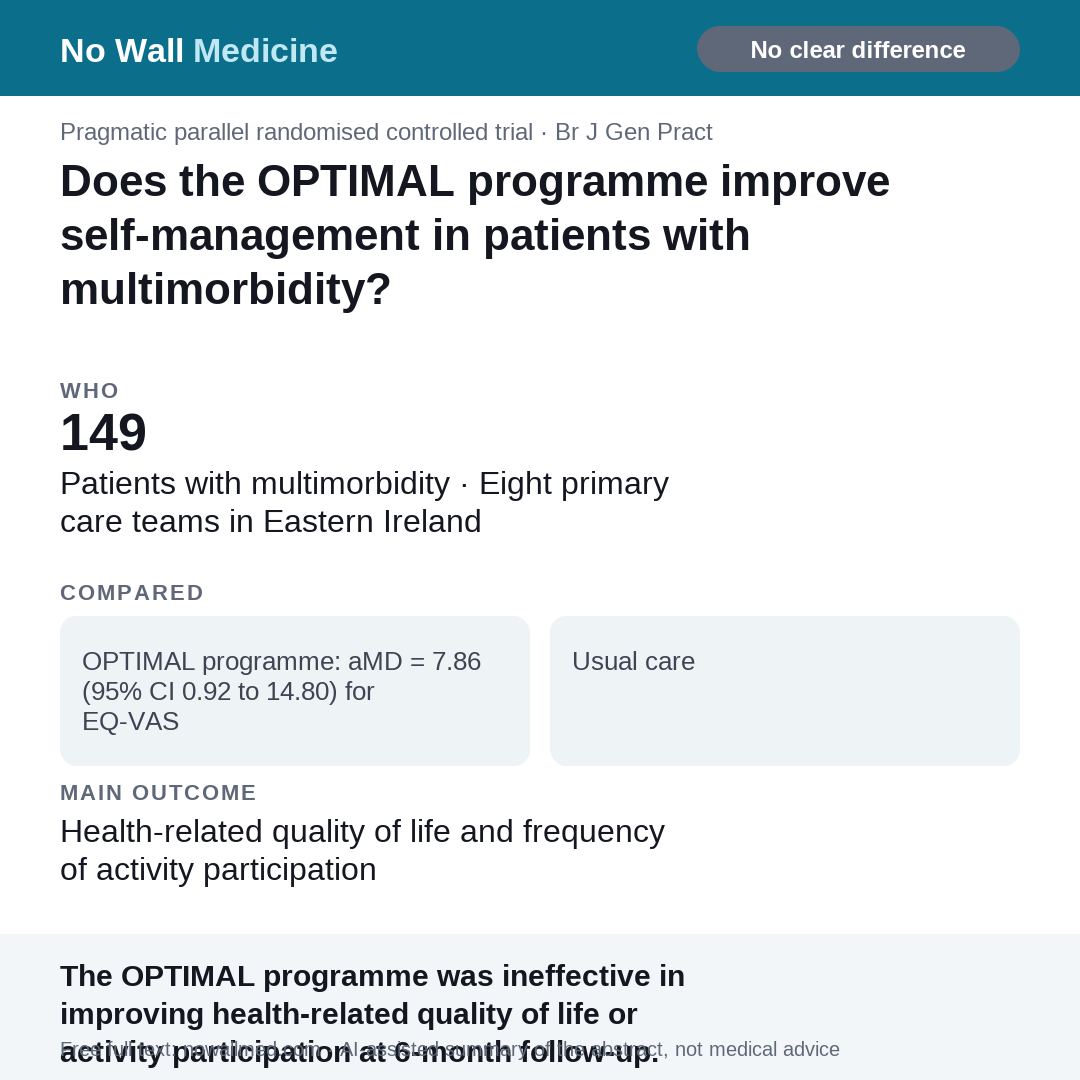
Clinical question: Does the OPTIMAL programme improve self-management in patients with multimorbidity?
Why it matters: It is unknown if a group-based, occupational therapy-led self-management programme can effectively improve health outcomes for patients living with multiple chronic conditions.
Key points
- Researchers conducted a randomized controlled trial with 149 patients with multimorbidity across eight primary care teams in Eastern Ireland.
- The 6-week OPTIMAL programme showed significant improvement in visual analogue scale health scores at immediate follow-up (aMD = 7.86; 95% CI = 0.92 to 14.80).
- At 6-month follow-up, there were no differences in primary outcomes of health-related quality of life or frequency of activity participation.
Headline and key points written with AI from the paper’s abstract, with every number checked against it. Read the paper before relying on them.
Was this summary helpful?
Subject terms
Cite this article
O'Toole L, Connolly D, Boland F, Smith SM. Effect of the OPTIMAL programme on self-management of multimorbidity in primary care: a randomised controlled trial. Br J Gen Pract. 2021. doi:10.3399/bjgp20X714185
Spotted a mistake? Suggest a correction
Top studies every Monday
The week’s key trials and guidelines in your specialties, plus any topics you follow. By email, free.
Get the weekly digest