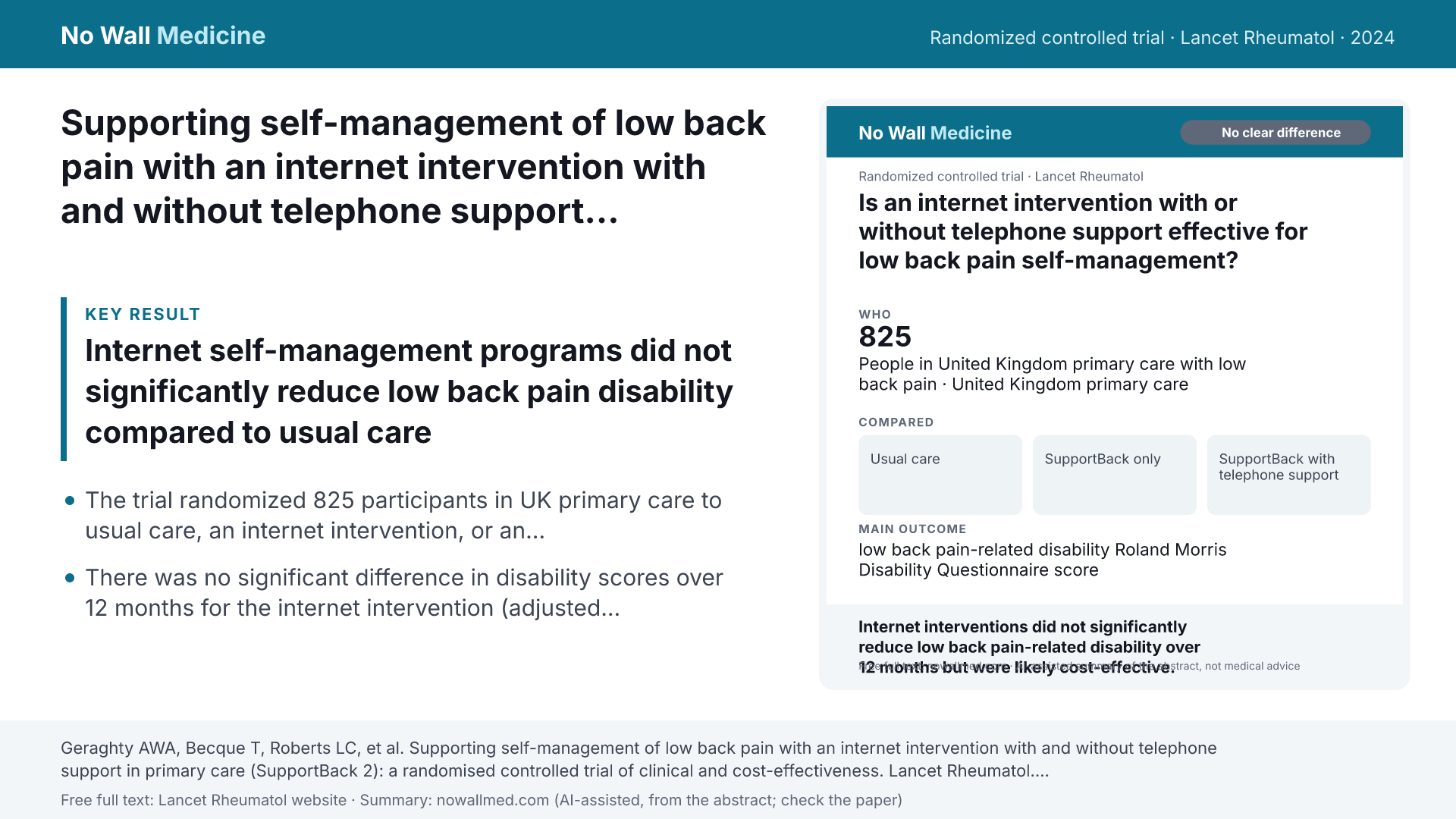
Internet self-management programs did not significantly reduce low back pain disability compared to usual care
Supporting self-management of low back pain with an internet intervention with and without telephone support in primary care (SupportBack 2): a randomised controlled trial of clinical and cost-effectiveness
Randomized controlled trialNo clear difference
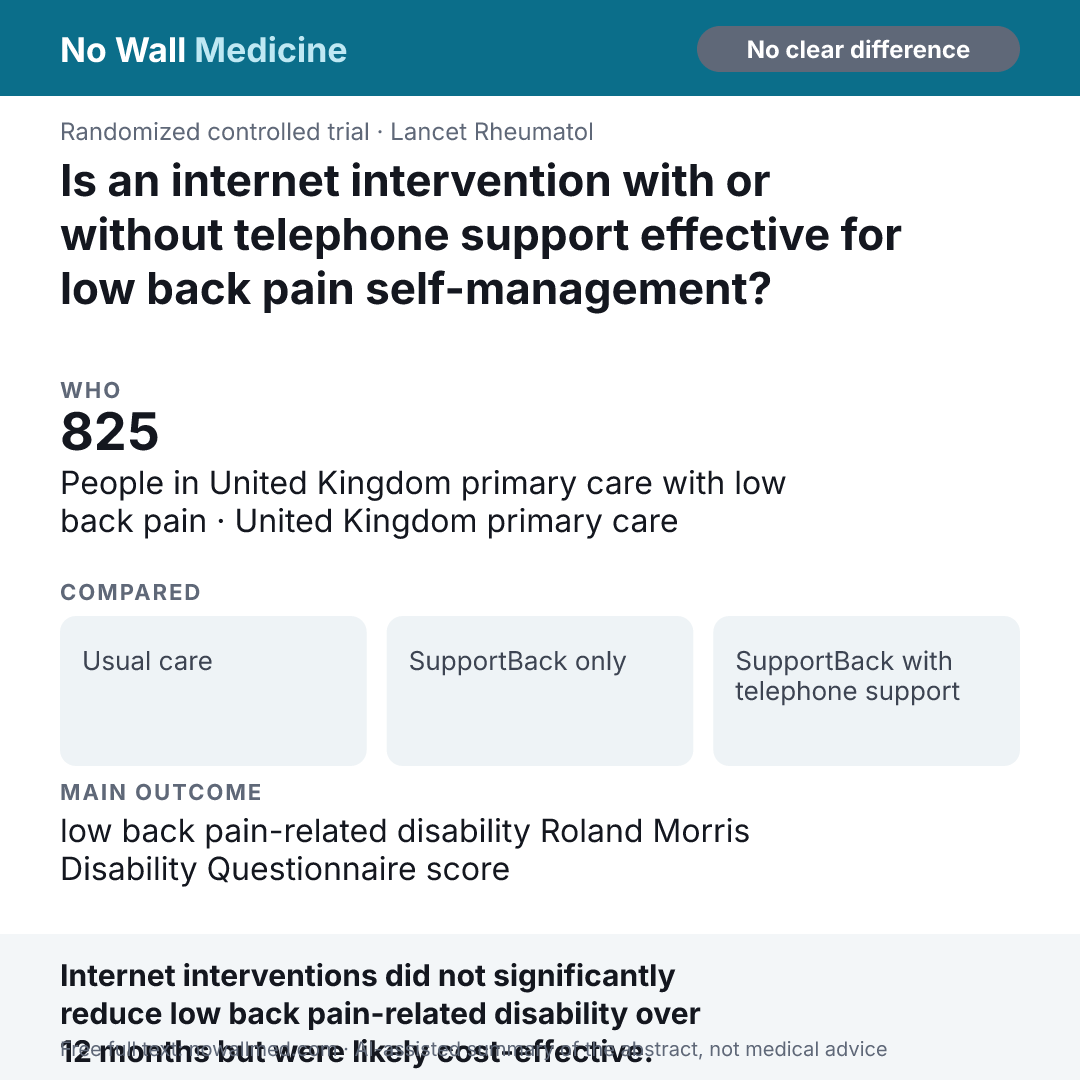
Is an internet intervention with or without telephone support effective for low back pain self-management?
Who
825
People in United Kingdom primary care with low back pain · United Kingdom primary care
Compared
Usual care
SupportBack only
SupportBack with telephone support
Main outcome
low back pain-related disability Roland Morris Disability Questionnaire score
Result: adjusted mean difference -0·5 (97·5% CI -1·2 to 0·2)
Bottom line: Internet interventions did not significantly reduce low back pain-related disability over 12 months but were likely cost-effective.
Funded by: National Institute for Health and Care Research
Lancet Rheumatol · 2024-05-30 · Save PNG
Clinical question: Is an internet intervention with or without telephone support effective for low back pain self-management?
Key points
- The trial randomized 825 participants in UK primary care to usual care, an internet intervention, or an internet intervention with three physiotherapist telephone calls.
- There was no significant difference in disability scores over 12 months for the internet intervention (adjusted mean difference -0.5; 97.5% CI -1.2 to 0.2) or the telephone-supported version (-0.6; 97.5% CI -1.2 to 0.1).
- The internet interventions were likely to be cost-effective at a threshold of £20,000 per quality adjusted life year and showed no treatment-related serious adverse events.
Headline and key points written with AI from the paper’s abstract, with every number checked against it. Read the paper before relying on them.
Was this summary helpful?
Abstract
Background
Low back pain is prevalent and a leading cause of disability. We aimed to determine the clinical and cost-effectiveness of an accessible, scalable internet intervention for supporting behavioural self-management (SupportBack). Methods
Participants in UK primary care with low back pain without serious spinal pathology were randomly assigned 1:1:1 using computer algorithms stratified by disability level and telephone-support centre to usual care, usual care and SupportBack, or usual care and SupportBack with physiotherapist telephone-support (three brief calls). The primary outcome was low back pain-related disability (Roland Morris Disability Questionnaire [RMDQ] score) at 6 weeks, 3 months, 6 months, and 12 months using a repeated measures model, analysed by intention to treat using 97·5% CIs. A parallel economic evaluation from a health services perspective was used to estimate cost-effectiveness. People with lived experience of low back pain were involved in this trial from the outset. This completed trial was registered with ISRCTN, ISRCTN14736486. Findings
Between Nov 29, 2018, and Jan 12, 2021, 825 participants were randomly assigned (274 to usual care, 275 to SupportBack only, 276 to SupportBack with telephone-support). Participants had a mean age of 54 (SD 15), 479 (58%) of 821 were women and 342 (42%) were men, and 591 (92%) of 641 were White. Follow-up rates were 687 (83%) at 6 weeks, 598 (73%) at 3 months, 589 (72%) at 6 months, and 652 (79%) at 12 months. For the primary analysis, 736 participants were analysed (249 usual care, 245 SupportBack, and 242 SupportBack with telephone support). At a significance level of 0·025, there was no difference in RMDQ over 12 months with SupportBack versus usual care (adjusted mean difference -0·5 [97·5% CI -1·2 to 0·2]; p=0·085) or SupportBack with telephone-support versus usual care (-0·6 [-1·2 to 0·1]; p=0·048). There were no treatment-related serious adverse events. The economic evaluation showed that the SupportBack group dominated usual care, being both more effective and less costly. Both interventions were likely to be cost-effective at a threshold of £20 000 per quality adjusted life year compared with usual care. Interpretation
The SupportBack internet interventions did not significantly reduce low back pain-related disability over 12 months compared with usual care. They were likely to be cost-effective and safe. Clinical effectiveness, cost-effectiveness, and safety should be considered together when determining whether to apply these interventions in clinical practice. Funding
National Institute for Health and Care Research Health Technology Assessment (16/111/78).
Abstract reproduced under the article’s CC BY licence.
Subject terms
Headline, design, result, key points, caveat and citation as plain text.
Cite this article
Geraghty AWA, Becque T, Roberts LC, et al. Supporting self-management of low back pain with an internet intervention with and without telephone support in primary care (SupportBack 2): a randomised controlled trial of clinical and cost-effectiveness. Lancet Rheumatol. 2024;6(7):e424-e437. doi:10.1016/S2665-9913(24)00086-9
Spotted a mistake? Suggest a correction