Artificial intelligence app did not improve musculoskeletal health for patients with neck or low back pain
Effect of an Artificial Intelligence-Based Self-Management App on Musculoskeletal Health in Patients With Neck and/or Low Back Pain Referred to Specialist Care: A Randomized Clinical Trial
Randomized clinical trialNo clear difference
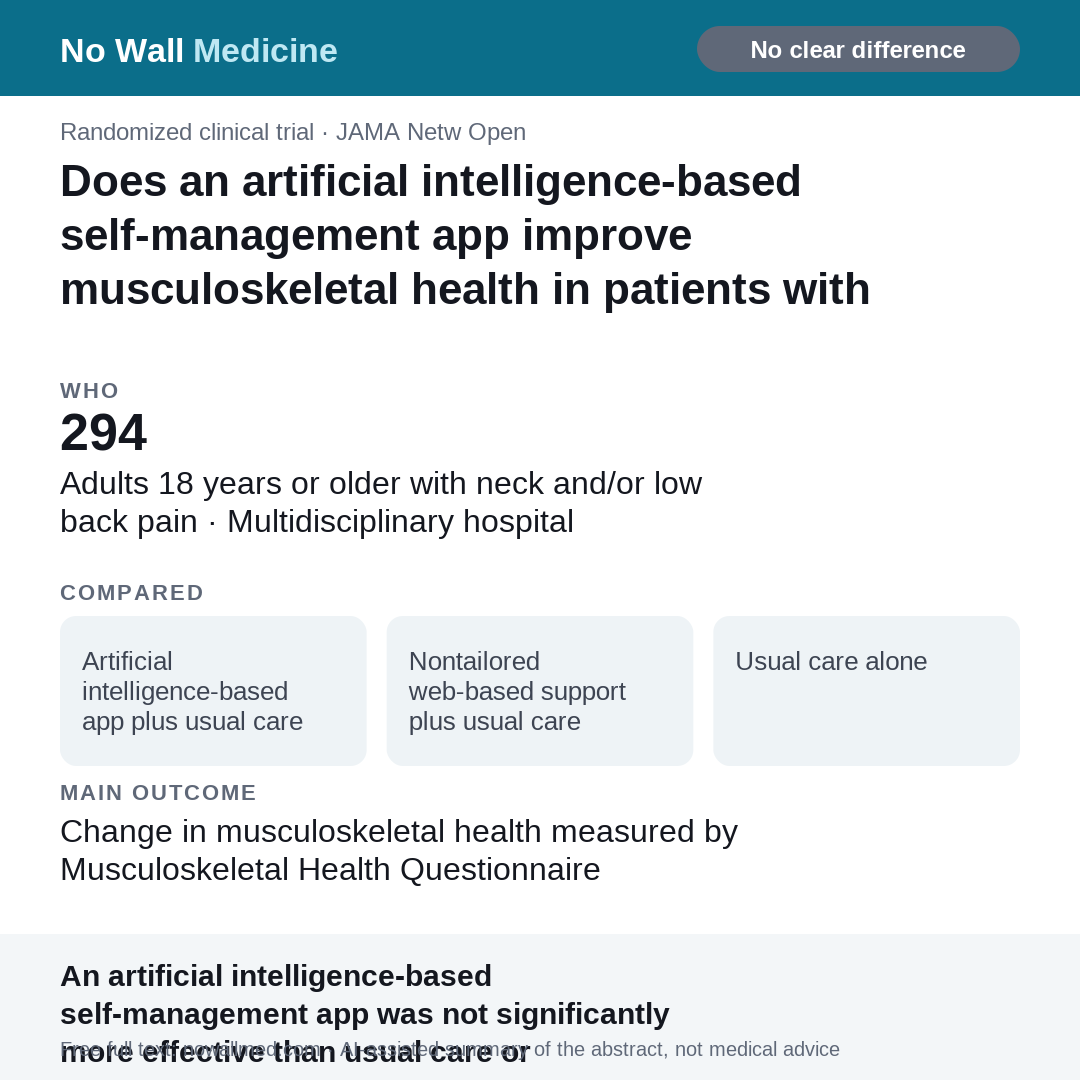
Does an artificial intelligence-based self-management app improve musculoskeletal health in patients with neck or low back pain?
Who
294
Adults 18 years or older with neck and/or low back pain · Multidisciplinary hospital outpatient clinic
Compared
Artificial intelligence-based app plus usual care
Nontailored web-based support plus usual care
Usual care alone
Main outcome
Change in musculoskeletal health measured by Musculoskeletal Health Questionnaire
Result: adjusted mean difference 0.62 points (95% CI, -1.66 to 2.90 points)
Bottom line: An artificial intelligence-based self-management app was not significantly more effective than usual care or nontailored web-based support.
JAMA Netw Open · 2023-06-01Download image
Clinical question: Does an artificial intelligence-based self-management app improve musculoskeletal health in patients with neck or low back pain?
Why it matters: It was unknown if individually tailored self-management support delivered via an artificial intelligence-based smartphone app provides benefits for patients referred to specialist care for neck and low back pain.
Key points
- The trial included 294 adults with neck and/or low back pain randomized to an artificial intelligence app, nontailored web support, or usual care.
- At 3 months, the app group showed no significant difference in musculoskeletal health scores compared to usual care (0.62 point difference) or nontailored web support (1.08 point difference).
- The study followed participants for up to 6 months to measure musculoskeletal health, pain intensity, and health-related quality of life.
Headline and key points written with AI from the paper’s abstract, with every number checked against it. Read the paper before relying on them.
Was this summary helpful?
Subject terms
Cite this article
Marcuzzi A, Nordstoga AL, Bach K, Aasdahl L, Nilsen TIL, Bardal EM. Effect of an Artificial Intelligence-Based Self-Management App on Musculoskeletal Health in Patients With Neck and/or Low Back Pain Referred to Specialist Care: A Randomized Clinical Trial. JAMA Netw Open. 2023. doi:10.1001/jamanetworkopen.2023.20400
Spotted a mistake? Suggest a correction
Top studies every Monday
The week’s key trials and guidelines in your specialties, plus any topics you follow. By email, free.
Get the weekly digest