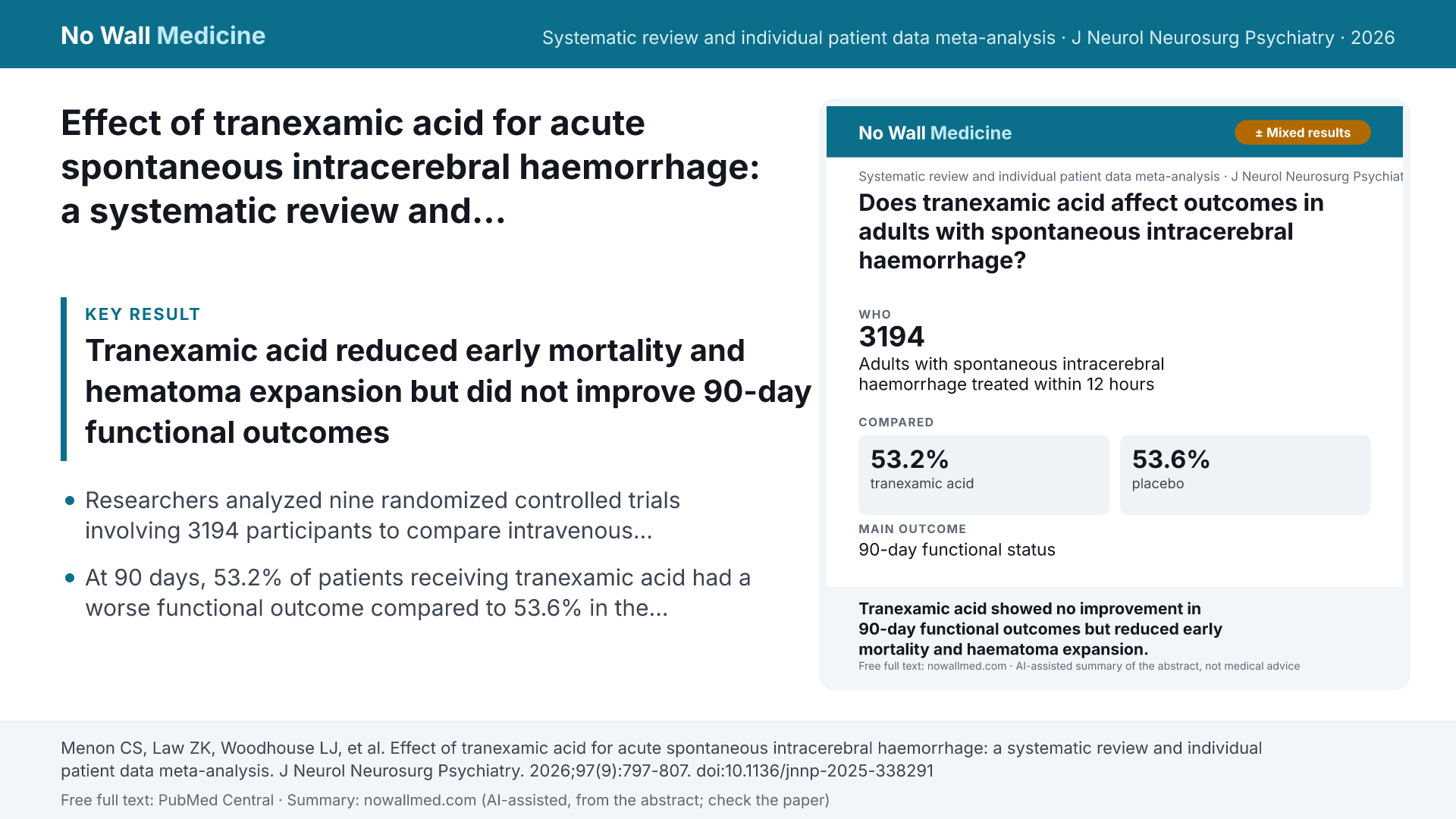
Tranexamic acid reduced early mortality and hematoma expansion but did not improve 90-day functional outcomes
Effect of tranexamic acid for acute spontaneous intracerebral haemorrhage: a systematic review and individual patient data meta-analysis
Systematic review and individual patient data meta-analysisMixed results
Does tranexamic acid affect outcomes in adults with spontaneous intracerebral haemorrhage?
Who
3194
Adults with spontaneous intracerebral haemorrhage treated within 12 hours
Compared
53.2%tranexamic acid
53.6%placebo
Main outcome
90-day functional status
Result: adjusted common OR 0.93 (95% CI 0.81 to 1.07)
Bottom line: Tranexamic acid showed no improvement in 90-day functional outcomes but reduced early mortality and haematoma expansion.
J Neurol Neurosurg Psychiatry · 2026-08-13 · Save PNG
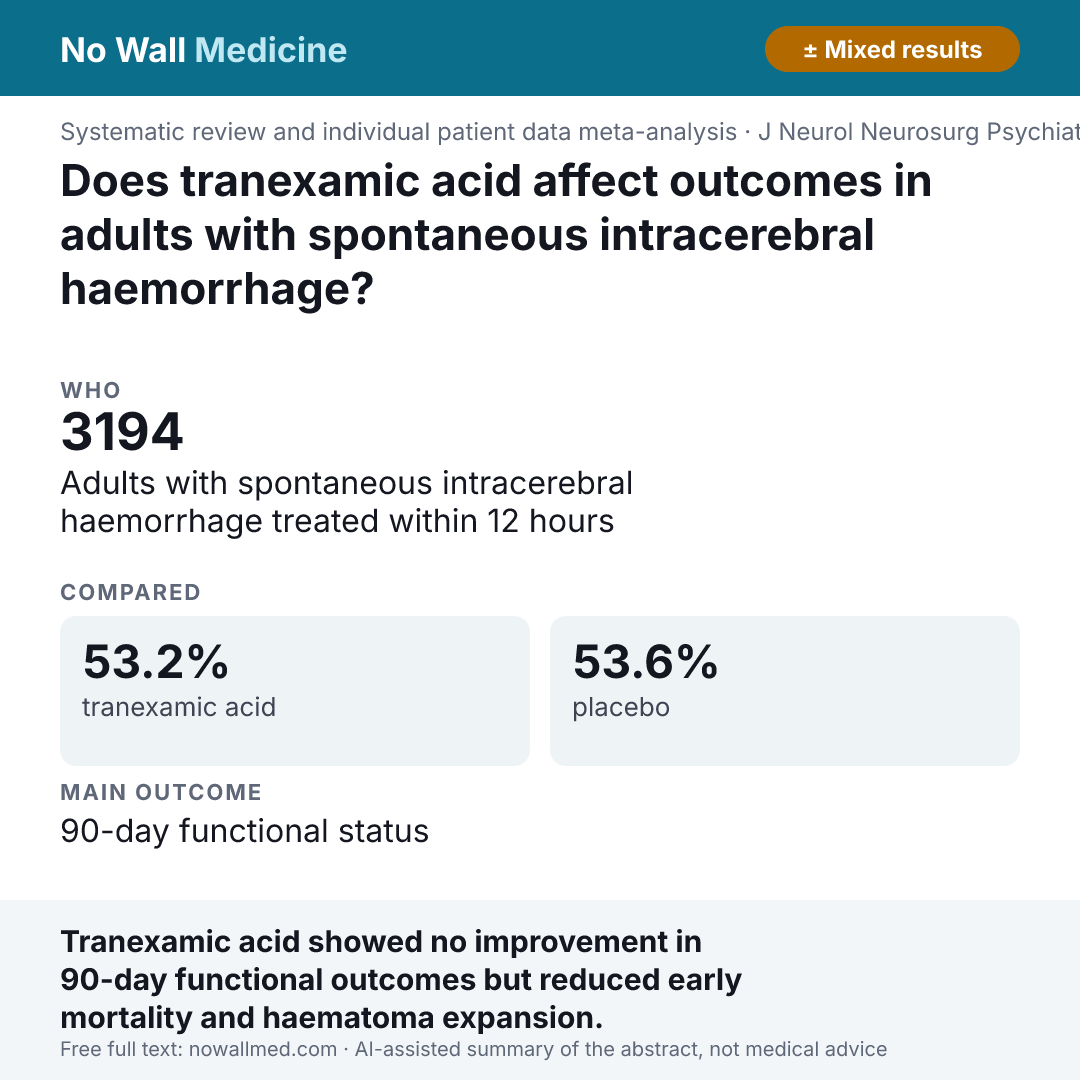
Clinical question: Does tranexamic acid affect outcomes in adults with spontaneous intracerebral haemorrhage?
Why it matters: Spontaneous intracerebral hemorrhage has high mortality rates and there is currently no proven treatment to stop bleeding.
Key points
- Researchers analyzed nine randomized controlled trials involving 3194 participants to compare intravenous tranexamic acid against a placebo for spontaneous intracerebral hemorrhage.
- At 90 days, 53.2% of patients receiving tranexamic acid had a worse functional outcome compared to 53.6% in the placebo group.
- Tranexamic acid significantly reduced mortality at day 7 and reduced hematoma expansion, which is the increase in the size of a brain bleed.
Headline and key points written with AI from the paper’s abstract, with every number checked against it. Read the paper before relying on them.
Was this summary helpful?
Abstract
Background
Spontaneous intracerebral haemorrhage (ICH) has high rates of mortality with no proven haemostatic treatment. We conducted the first systematic review and individual patient data meta-analysis (IPDMA) to assess the effect of tranexamic acid on outcomes in spontaneous ICH. Methods
We searched databases such as MEDLINE, EMBASE and CENTRAL for randomised controlled trials comparing intravenous tranexamic acid to placebo in adults with spontaneous ICH treated within 12 hours. The primary outcome was 90-day functional status (modified Rankin scale). Secondary outcomes included early mortality and haematoma expansion. One-stage random-effects analysis used generalised linear mixed models. Risk of bias was assessed using the Cochrane Risk of Bias (RoB) 2 tool. Results
We screened 1131 records; nine trials (3194 participants) met inclusion and five trials (2860 participants; 90%) provided individual patient data. ROB was low in all trials. At 90 days, 53.2% of patients receiving tranexamic acid had a worse functional outcome compared with 53.6% in the placebo (adjusted common OR 0.93, 95% CI 0.81 to 1.07). Mortality at day 7 and haematoma expansion were significantly reduced with tranexamic acid (adjusted OR 0.70, 95% CI 0.51 to 0.95; and OR 0.81, 95% CI 0.68 to 0.97). No between-trial heterogeneity was observed. Conclusions
This systematic review and IPDMA of tranexamic acid for spontaneous ICH found no improvement in 90-day functional outcomes. However, small yet significant reductions in early mortality and haematoma expansion were observed. The early mortality benefit and favourable safety profile support further research into ultra-early treatment and as part of ICH care bundles for selected patient populations. Prospero registration number
CRD42017054978.
Abstract reproduced under the article’s CC BY NC licence.
Subject terms
Headline, design, result, key points, caveat and citation as plain text.
Cite this article
Menon CS, Law ZK, Woodhouse LJ, et al. Effect of tranexamic acid for acute spontaneous intracerebral haemorrhage: a systematic review and individual patient data meta-analysis. J Neurol Neurosurg Psychiatry. 2026;97(9):797-807. doi:10.1136/jnnp-2025-338291
Spotted a mistake? Suggest a correction