Effect of Vasoactive Intestinal Polypeptide on Development of Migraine Headaches: A Randomized Clinical Trial
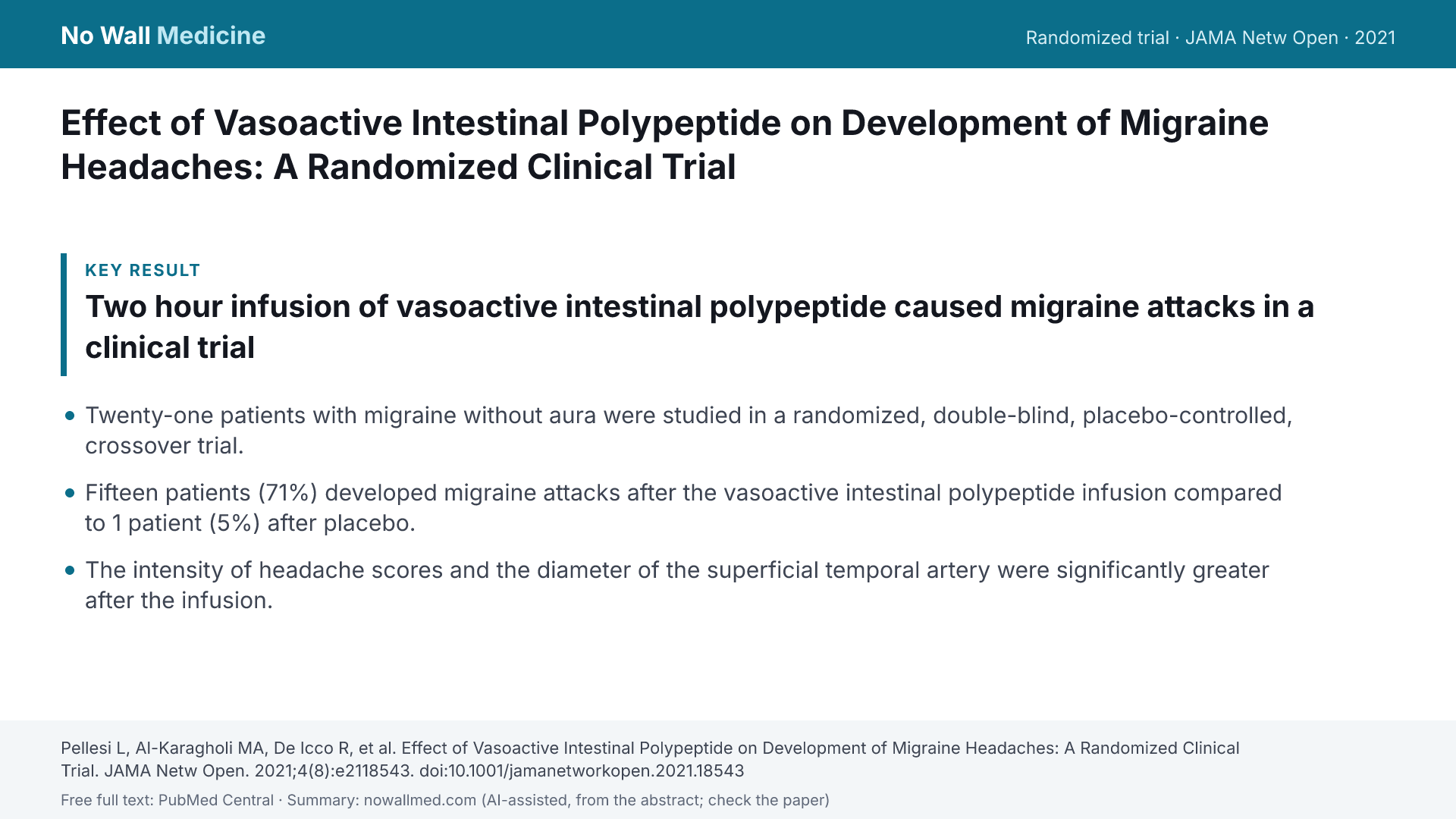
Key result: Two hour infusion of vasoactive intestinal polypeptide caused migraine attacks in a clinical trial
Key points
- Twenty-one patients with migraine without aura were studied in a randomized, double-blind, placebo-controlled, crossover trial.
- Fifteen patients (71%) developed migraine attacks after the vasoactive intestinal polypeptide infusion compared to 1 patient (5%) after placebo.
- The intensity of headache scores and the diameter of the superficial temporal artery were significantly greater after the infusion.
Why it matters: It was unclear if the lack of migraine induction by vasoactive intestinal polypeptide was due to only a transient widening of blood vessels.
Discussion prompts
- Would these patients look like yours? Who was left out?
- Is the main outcome one that matters to patients?
- Is the difference large enough to change what you do?
Cite: Pellesi L, Al-Karagholi MA, De Icco R, et al. Effect of Vasoactive Intestinal Polypeptide on Development of Migraine Headaches: A Randomized Clinical Trial. JAMA Netw Open. 2021. doi:10.1001/jamanetworkopen.2021.18543
Free full text: PubMed Central · Summary and visual abstract: nowallmed.com/a/effect-of-vasoactive-intestinal-polypeptide-on-development-of-xnz15i/ (AI-assisted from the abstract; check the paper before relying on it).