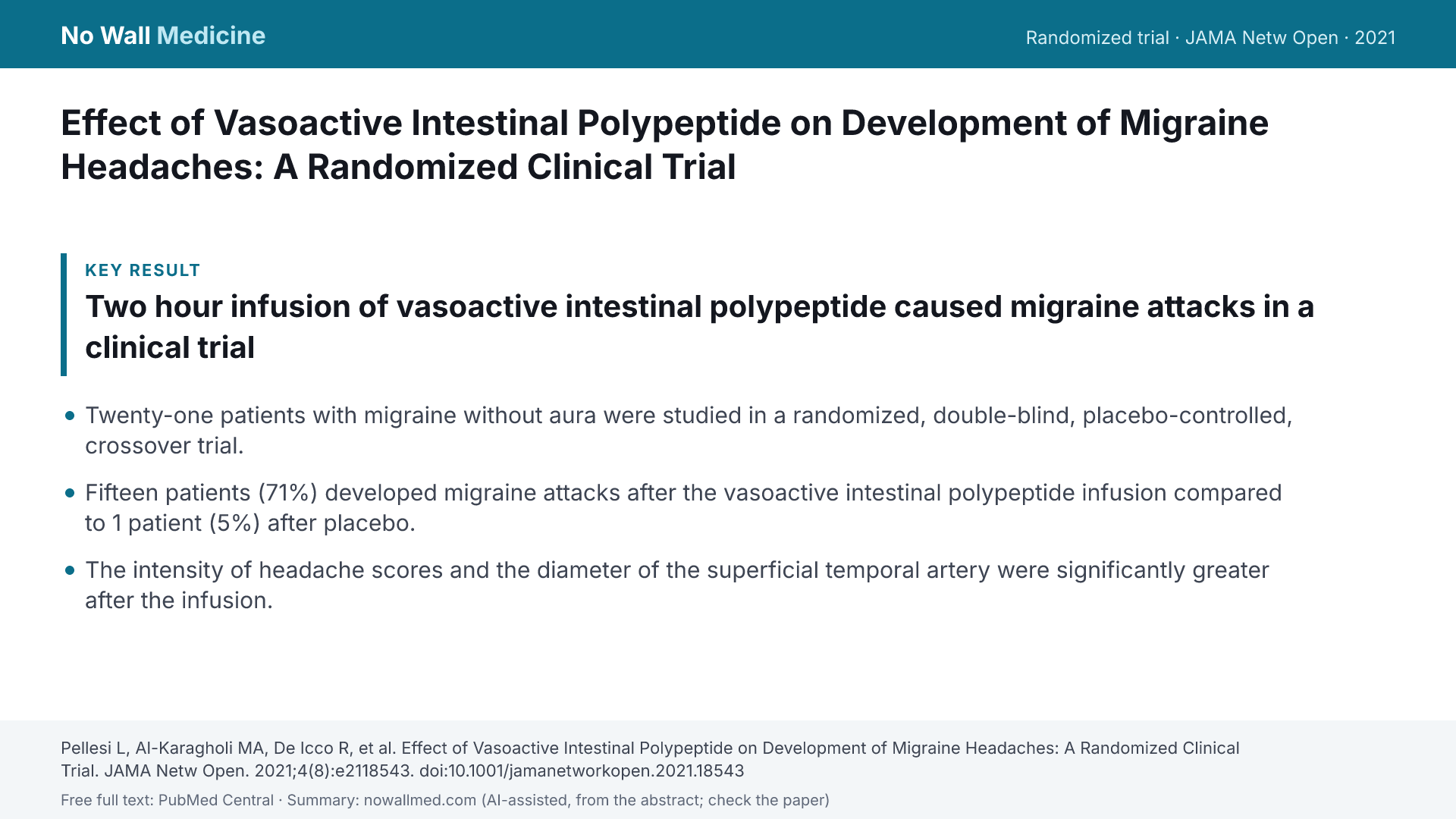
Two hour infusion of vasoactive intestinal polypeptide caused migraine attacks in a clinical trial
Effect of Vasoactive Intestinal Polypeptide on Development of Migraine Headaches: A Randomized Clinical Trial
Why it matters: It was unclear if the lack of migraine induction by vasoactive intestinal polypeptide was due to only a transient widening of blood vessels.
Key points
- Twenty-one patients with migraine without aura were studied in a randomized, double-blind, placebo-controlled, crossover trial.
- Fifteen patients (71%) developed migraine attacks after the vasoactive intestinal polypeptide infusion compared to 1 patient (5%) after placebo.
- The intensity of headache scores and the diameter of the superficial temporal artery were significantly greater after the infusion.
Headline and key points written with AI from the paper’s abstract, with every number checked against it. Read the paper before relying on them.
Was this summary helpful?
Subject terms
Cite this article
Pellesi L, Al-Karagholi MA, De Icco R, Coskun H, Elbahi FA, Lopez-Lopez C. Effect of Vasoactive Intestinal Polypeptide on Development of Migraine Headaches: A Randomized Clinical Trial. JAMA Netw Open. 2021. doi:10.1001/jamanetworkopen.2021.18543
Spotted a mistake? Suggest a correction