A 24-hour interval between medications was less effective than a 48-hour interval for medical abortion
Effectiveness and acceptability of a 24-h interval versus a 48-h interval between mifepristone intake and misoprostol administration for in-hospital abortion at 9-20 gestational weeks: an international, open-label, randomised, controlled, non-inferiority trial
Open-label, randomised, controlled, non-inferiority trialHarm found
Is a 24-hour versus 48-hour interval between mifepristone and misoprostol effective for medical abortion?
Who
531
Adults undergoing medical abortion for singleton viable pregnancy at 9-20 weeks · Nine hospitals in India, Sweden, Thailand, and Viet Nam
Compared
89%24-h interval (236 of 266 participants)
94%48-h interval (248 of 265 participants)
Main outcome
Complete fetal expulsion within 12 hours of initial misoprostol dose
Result: odds ratio 0·54, 95% CI 0·29-1·00
Bottom line: A 24-hour interval resulted in a lower successful abortion rate than a 48-hour interval and was not non-inferior.
Funded by: Ministry of Foreign Affairs of the Netherlands
Lancet Glob Health · 2024-12-21Download image
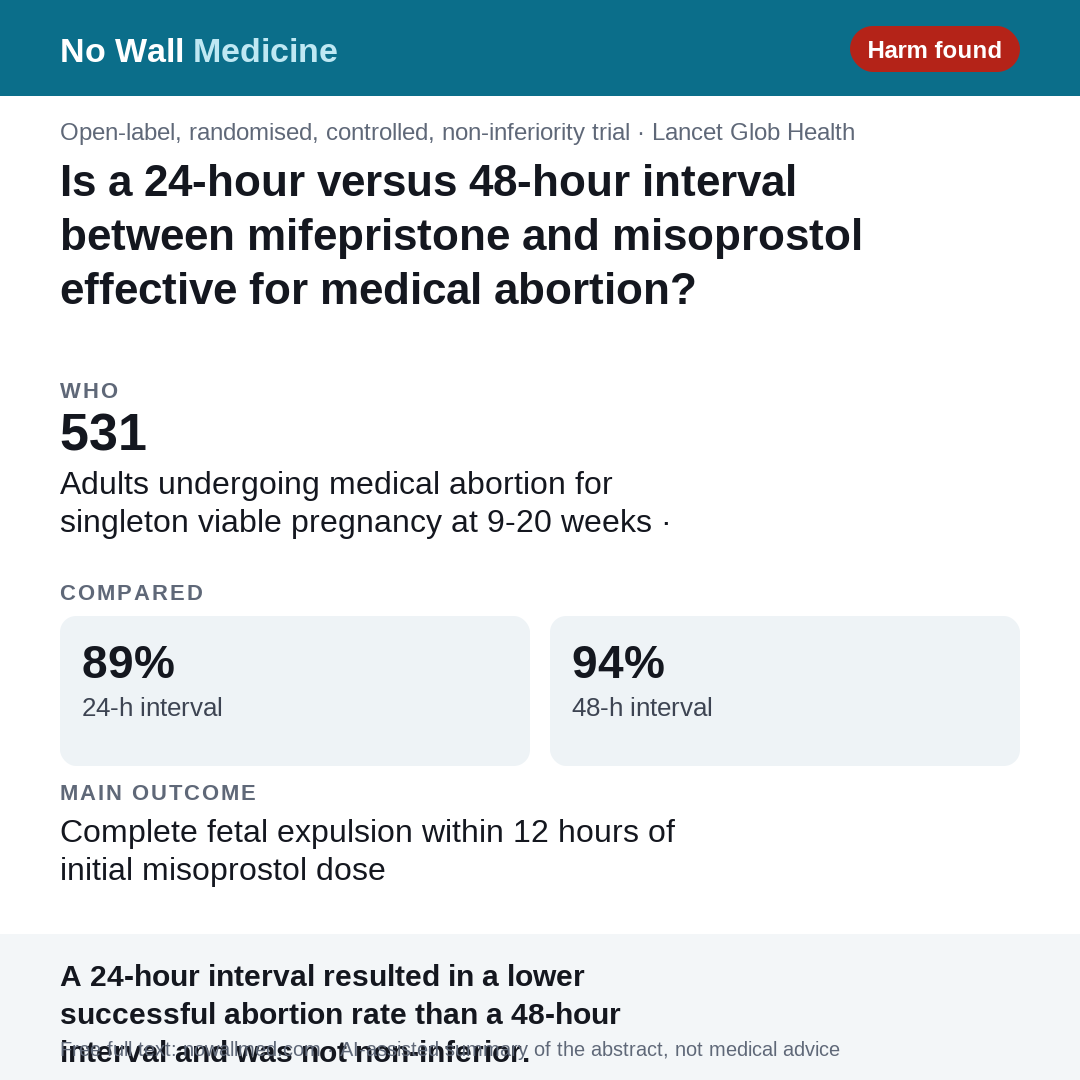
Clinical question: Is a 24-hour versus 48-hour interval between mifepristone and misoprostol effective for medical abortion?
Why it matters: It was unknown whether a shorter 24-hour interval between mifepristone and misoprostol administration is as effective as a 48-hour interval for second-trimester medical abortion.
Key points
- Researchers studied 531 participants across nine hospitals in India, Sweden, Thailand, and Viet Nam undergoing medical abortion between 9 and 20 weeks of pregnancy.
- The successful abortion rate within 12 hours was 89% for the 24-hour interval group and 94% for the 48-hour interval group.
- The risk difference of -4.86% exceeded the pre-set non-inferiority margin of 5%.
Headline and key points written with AI from the paper’s abstract, with every number checked against it. Read the paper before relying on them.
Was this summary helpful?
Abstract
Background
Optimising management of second-trimester medical abortion is important, as complications increase with gestational age. We aimed to compare a 24-h interval with a 48-h interval between mifepristone intake and misoprostol administration in in-hospital, second-trimester medical abortion for effectiveness and acceptability. Methods
This open-label, randomised, controlled, non-inferiority trial was conducted at nine hospitals in India, Sweden, Thailand, and Viet Nam among adults undergoing medical abortion for a singleton viable pregnancy at a gestation of between 9 weeks and 20 weeks. Participants were randomly assigned (1:1) via central computer-generated sequence stratified by study site to receive 200 mg mifepristone orally and (after being admitted to hospital) 800 μg misoprostol vaginally either 24 h (the intervention) or 48 h (the control) later followed by 400 μg misoprostol sublingually every 3 h. If no abortion occurred after five doses, the 200 mg mifepristone was repeated, followed by the same misoprostol regimen the following day. The participants, researchers, and clinic staff were not masked to the allocation group. The primary outcome was complete fetal expulsion (herein defined as successful abortion) within 12 h of the initial misoprostol dose. The non-inferiority margin was set at 5%. Outcomes were compared in the modified intention-to-treat (mITT) population, from which randomly assigned participants who discontinued before receiving mifepristone or misoprostol were excluded. This trial is registered as an International Standard Randomised Controlled Trial, number ISRCTN49711891, and is completed. Findings
Between Feb 18, 2015, and Oct 15, 2016, we screened 724 individuals and 540 participants were enrolled in the study (271 in the 24-h interval group and 269 in the 48-h interval group). Nine participants were excluded from analysis because they did not return for either mifepristone intake or misoprostol administration. The mITT population therefore consisted of 531 participants, of whom 266 were allocated to the 24-h interval group and 265 to the 48-h interval group. By mITT, the succsessful abortion rate within 12 h was 89% (236 of 266 participants) in the 24-h interval group and 94% (248 of 265 participants) in the 48-h interval group (odds ratio 0·54, 95% CI 0·29-1·00). The risk difference was -4·86% (95% CI -0·05 to -9·67), which exceeded our non-inferiority margin of 5%. One participant in the 24-h interval group died following an otherwise uncomplicated abortion from what was assessed as being an amniotic fluid embolism unrelated to their participation in the trial. The most common adverse events in both groups were heavy bleeding, shivering, fever, and nausea. Interpretation
A 24-h interval between mifepristone intake and misoprostol administration has a lower rate of successful abortion within 12 h than a 48-h interval and cannot be defined as non-inferior. Individuals should be able to choose whether to initiate abortion sooner with a 24-h interval or delay administration of misoprostol to 48 h and potentially optimise the rate of successful abortion. Funding
Ministry of Foreign Affairs of the Netherlands. Translations
For the Thai and Hindi translations of the abstract see Supplementary Materials section.
Abstract reproduced under the article’s CC BY licence.
Subject terms
Cite this article
Endler M, Jaisamrarn U, Mittal S, Phanupong P, Du DV, Ngo TA. Effectiveness and acceptability of a 24-h interval versus a 48-h interval between mifepristone intake and misoprostol administration for in-hospital abortion at 9-20 gestational weeks: an international, open-label, randomised, controlled, non-inferiority trial. Lancet Glob Health. 2024. doi:10.1016/S2214-109X(24)00416-9
Spotted a mistake? Suggest a correction
Top studies every Monday
The week’s key trials and guidelines in your specialties, plus any topics you follow. By email, free.
Get the weekly digest