Different formats of cognitive-behavioural therapy show similar effectiveness for treating obsessive-compulsive disorder
Effectiveness and acceptability of cognitive-behavioural therapy delivery formats for obsessive-compulsive disorder: network meta-analysis
Network meta-analysis of 61 randomized controlled trialsBenefit found
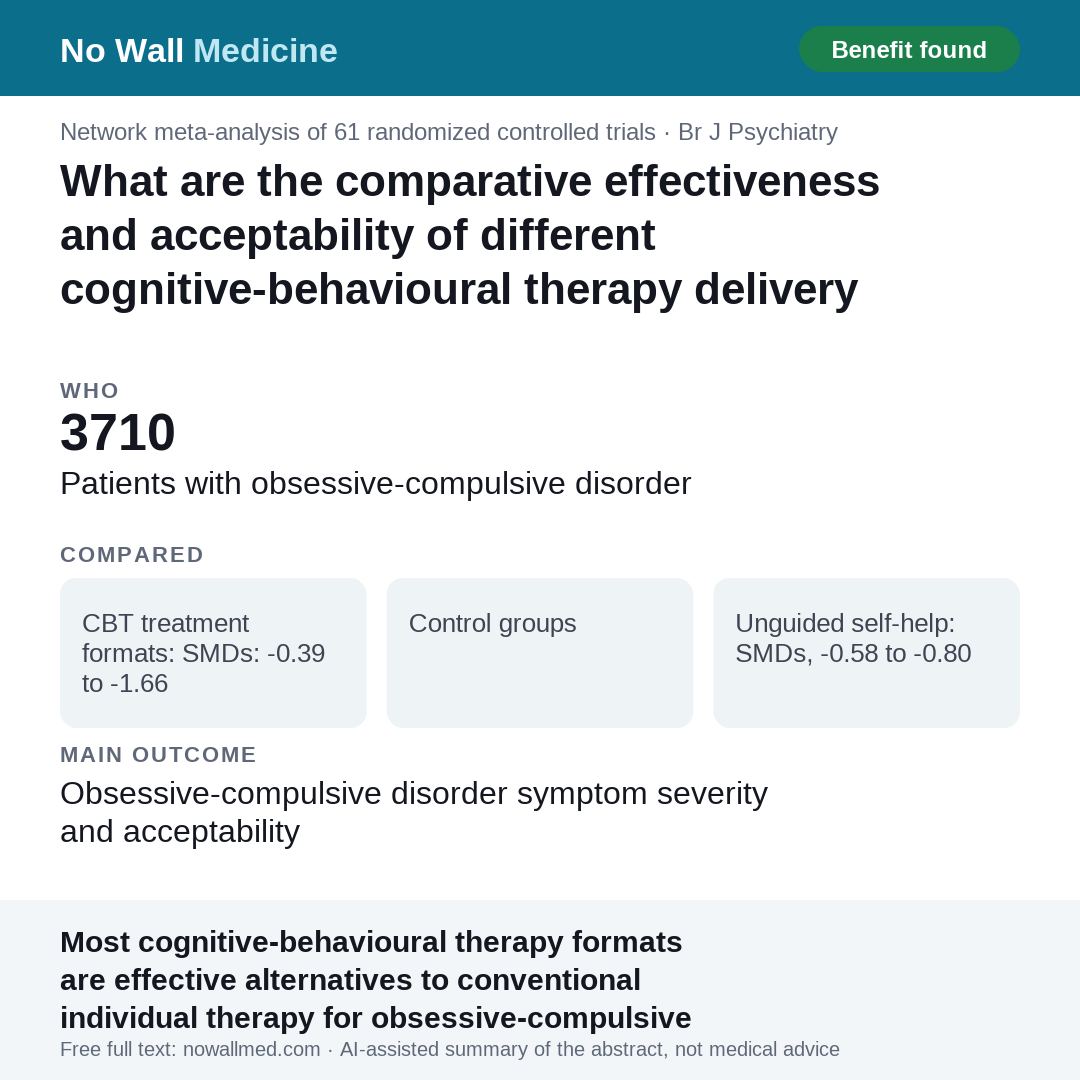
What are the comparative effectiveness and acceptability of different cognitive-behavioural therapy delivery formats for obsessive-compulsive disorder?
Who
3710
Patients with obsessive-compulsive disorder
Compared
CBT treatment formats: SMDs: -0.39 to -1.66
Control groups
Unguided self-help: SMDs, -0.58 to -0.80
Main outcome
Obsessive-compulsive disorder symptom severity and acceptability
Bottom line: Most cognitive-behavioural therapy formats are effective alternatives to conventional individual therapy for obsessive-compulsive disorder.
Br J Psychiatry · 2025-11-05Download image
Clinical question: What are the comparative effectiveness and acceptability of different cognitive-behavioural therapy delivery formats for obsessive-compulsive disorder?
Why it matters: Comprehensive evidence was lacking regarding how different delivery formats of cognitive-behavioural therapy compare in effectiveness and acceptability for obsessive-compulsive disorder.
Key points
- Researchers analyzed 61 randomized controlled trials involving 3710 patients with obsessive-compulsive disorder to compare various delivery formats of cognitive-behavioural therapy.
- All cognitive-behavioural therapy formats were more effective than control groups, with standard mean differences ranging from -0.39 to -1.66.
- Individual, remote-delivery, and family-involved formats were more effective than group therapy, while most formats were more effective than unguided self-help.
Headline and key points written with AI from the paper’s abstract, with every number checked against it. Read the paper before relying on them.
Topics
Cite this article
Wang Y, Miguel C, Ciharova M, Amarnath A, Lin J, Zhao R. Effectiveness and acceptability of cognitive-behavioural therapy delivery formats for obsessive-compulsive disorder: network meta-analysis. Br J Psychiatry. 2025. doi:10.1192/bjp.2024.197
Spotted a mistake? Suggest a correction