Targeted indoor residual spraying was as effective as standard spraying for malaria control
Effectiveness and cost-effectiveness of reactive, targeted indoor residual spraying for malaria control in low-transmission settings: a cluster-randomised, non-inferiority trial in South Africa
Cluster-randomised, open-label, non-inferiority trialBenefit found
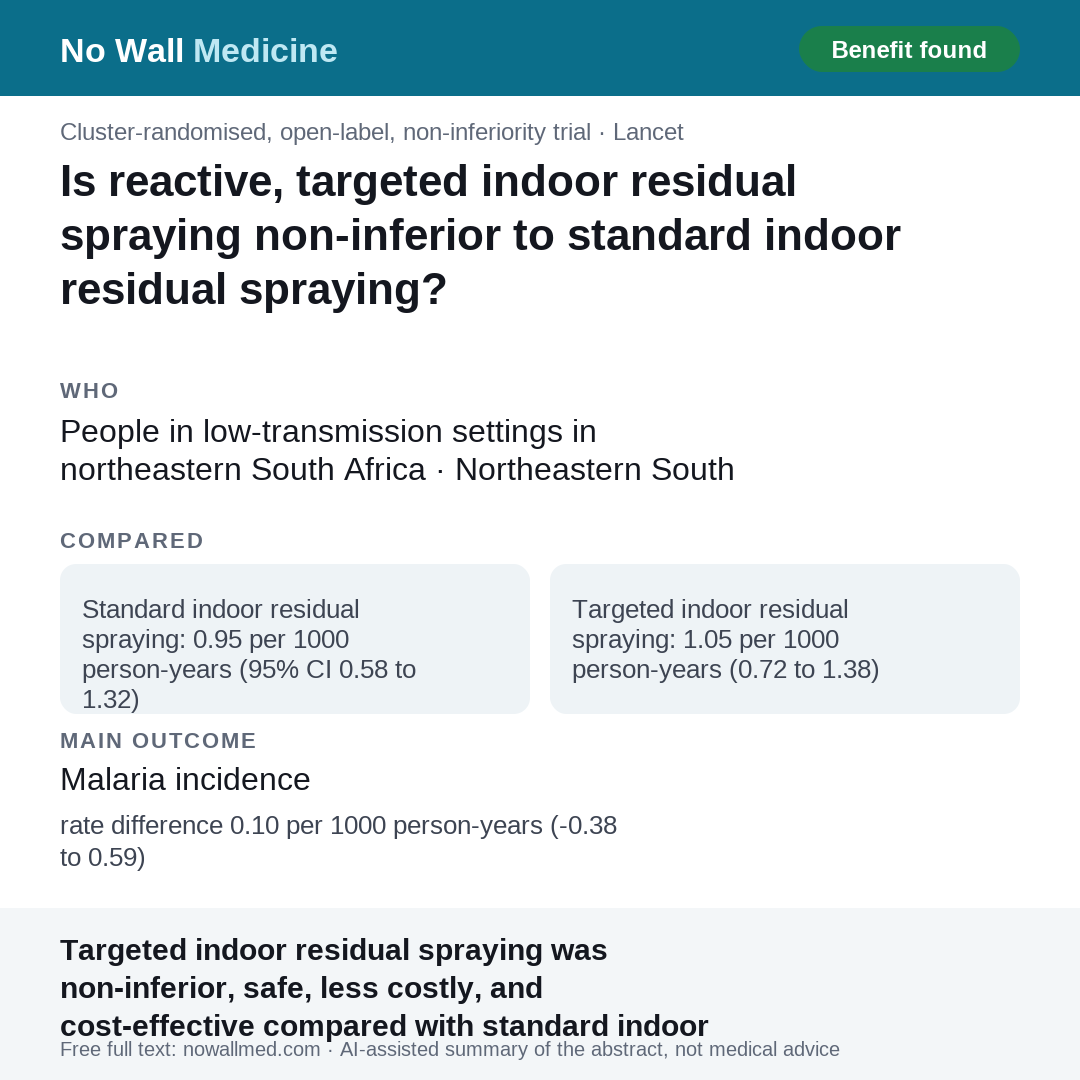
Is reactive, targeted indoor residual spraying non-inferior to standard indoor residual spraying?
Who
People in low-transmission settings in northeastern South Africa · Northeastern South Africa
Compared
Standard indoor residual spraying: 0.95 per 1000 person-years (95% CI 0.58 to 1.32)
Targeted indoor residual spraying: 1.05 per 1000 person-years (0.72 to 1.38)
Main outcome
Malaria incidence
Result: rate difference 0.10 per 1000 person-years (-0.38 to 0.59)
Bottom line: Targeted indoor residual spraying was non-inferior, safe, less costly, and cost-effective compared with standard indoor residual spraying.
Funded by: Joint Global Health Trials
Lancet · 2021-02-28Download image
Clinical question: Is reactive, targeted indoor residual spraying non-inferior to standard indoor residual spraying?
Why it matters: Rising insecticide costs and limited budgets make it uncertain if universal indoor residual spraying is sustainable in areas with low malaria transmission.
Key points
- Researchers conducted a cluster-randomised trial in northeastern South Africa comparing standard annual mass spraying to spraying only the homes of identified malaria patients and their neighbors.
- Malaria incidence was 0.95 per 1000 person-years in the standard group and 1.05 per 1000 person-years in the targeted group, meeting the non-inferiority margin.
- The targeted spraying strategy was estimated to save US$7845 per additional disability-adjusted life-year, which is a measure of the overall disease burden.
Headline and key points written with AI from the paper’s abstract, with every number checked against it. Read the paper before relying on them.
Was this summary helpful?
Abstract
Background
Increasing insecticide costs and constrained malaria budgets could make universal vector control strategies, such as indoor residual spraying (IRS), unsustainable in low-transmission settings. We investigated the effectiveness and cost-effectiveness of a reactive, targeted IRS strategy. Methods
This cluster-randomised, open-label, non-inferiority trial compared reactive, targeted IRS with standard IRS practice in northeastern South Africa over two malaria seasons (2015-17). In standard IRS clusters, programme managers conducted annual mass spray campaigns prioritising areas using historical data, expert opinion, and other factors. In targeted IRS clusters, only houses of index cases (identified through passive surveillance) and their immediate neighbours were sprayed. The non-inferiority margin was 1 case per 1000 person-years. Health service costs of real-world implementation were modelled from primary and secondary data. Incremental costs per disability-adjusted life-year (DALY) were estimated and deterministic and probabilistic sensitivity analyses conducted. This study is registered with ClinicalTrials.gov, NCT02556242. Findings
Malaria incidence was 0·95 per 1000 person-years (95% CI 0·58 to 1·32) in the standard IRS group and 1·05 per 1000 person-years (0·72 to 1·38) in the targeted IRS group, corresponding to a rate difference of 0·10 per 1000 person-years (-0·38 to 0·59), demonstrating non-inferiority for targeted IRS (p<0·0001). Per additional DALY incurred, targeted IRS saved US$7845 (2902 to 64 907), giving a 94-98% probability that switching to targeted IRS would be cost-effective relative to plausible cost-effectiveness thresholds for South Africa ($2637 to $3557 per DALY averted). Depending on the threshold used, targeted IRS would remain cost-effective at incidences of less than 2·0-2·7 per 1000 person-years. Findings were robust to plausible variation in other parameters. Interpretation
Targeted IRS was non-inferior, safe, less costly, and cost-effective compared with standard IRS in this very-low-transmission setting. Saved resources could be reallocated to other malaria control and elimination activities. Funding
Joint Global Health Trials.
Abstract reproduced under the article’s CC BY licence.
Subject terms
Cite this article
Bath D, Cook J, Govere J, Mathebula P, Morris N, Hlongwana K. Effectiveness and cost-effectiveness of reactive, targeted indoor residual spraying for malaria control in low-transmission settings: a cluster-randomised, non-inferiority trial in South Africa. Lancet. 2021. doi:10.1016/S0140-6736(21)00251-8
Spotted a mistake? Suggest a correction
Top studies every Monday
The week’s key trials and guidelines in your specialties, plus any topics you follow. By email, free.
Get the weekly digest