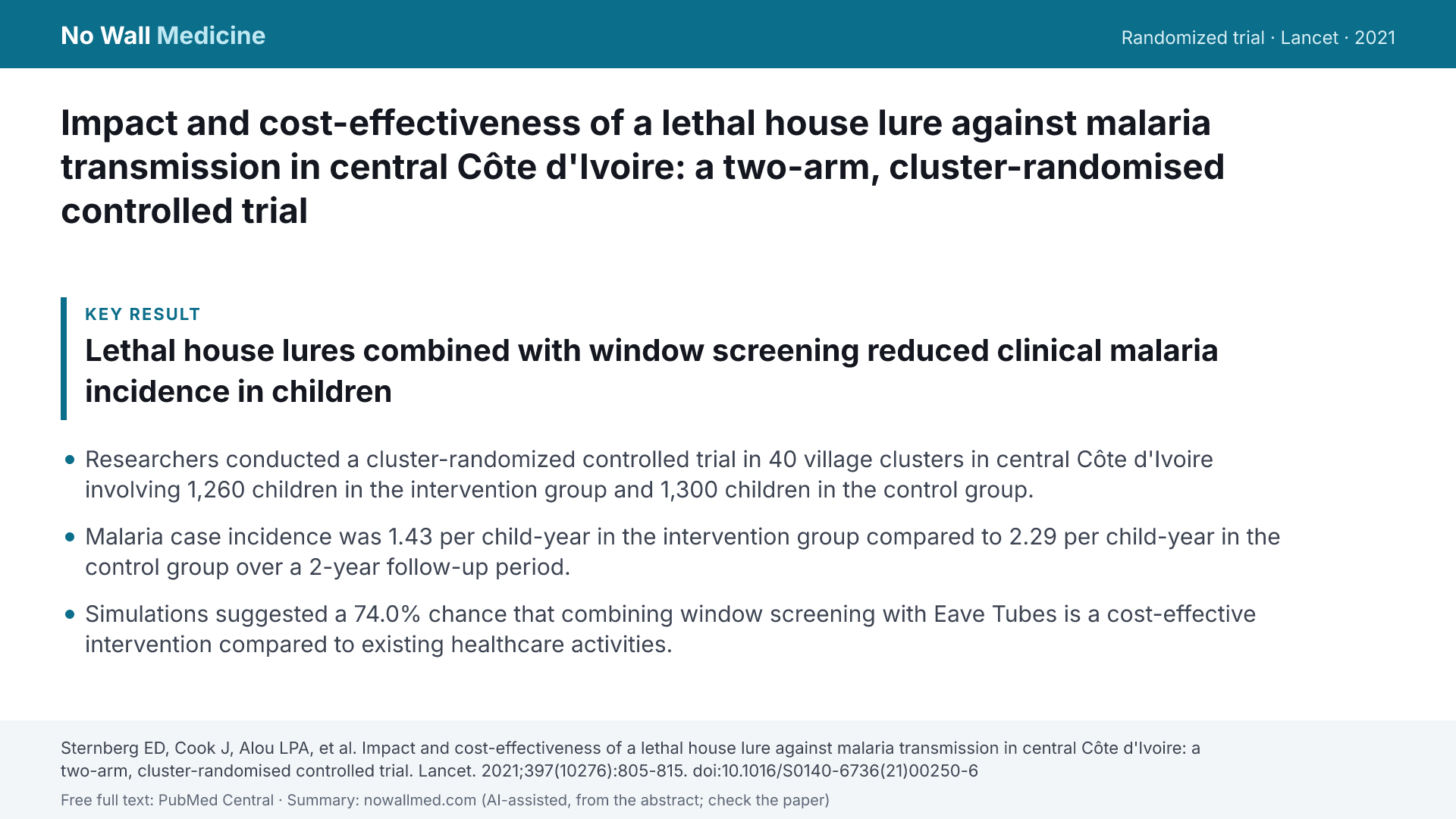
Lethal house lures combined with window screening reduced clinical malaria incidence in children
Impact and cost-effectiveness of a lethal house lure against malaria transmission in central Côte d'Ivoire: a two-arm, cluster-randomised controlled trial
Same trial (ISRCTN18145556)
Papers we list that report this registered trial, oldest first. Read a secondary analysis alongside the main results.
- Main results
This paper Lancet 2021-02 - Related analysis Benefit found
House screening and EaveTubes lowered malaria infection prevalence in Côte d'Ivoire BMC Med 2023-05
Why it matters: New vector control tools are required to sustain the fight against malaria as existing methods may need supplementation.
Key points
- Researchers conducted a cluster-randomized controlled trial in 40 village clusters in central Côte d'Ivoire involving 1,260 children in the intervention group and 1,300 children in the control group.
- Malaria case incidence was 1.43 per child-year in the intervention group compared to 2.29 per child-year in the control group over a 2-year follow-up period.
- Simulations suggested a 74.0% chance that combining window screening with Eave Tubes is a cost-effective intervention compared to existing healthcare activities.
Headline and key points written with AI from the paper’s abstract, with every number checked against it. Read the paper before relying on them.
Was this summary helpful?
Abstract
Background
New vector control tools are required to sustain the fight against malaria. Lethal house lures, which target mosquitoes as they attempt to enter houses to blood feed, are one approach. Here we evaluated lethal house lures consisting of In2Care (Wageningen, Netherlands) Eave Tubes, which provide point-source insecticide treatments against host-seeking mosquitoes, in combination with house screening, which aims to reduce mosquito entry. Methods
We did a two-arm, cluster-randomised controlled trial with 40 village-level clusters in central Côte d'Ivoire between Sept 26, 2016, and April 10, 2019. All households received new insecticide-treated nets at universal coverage (one bednet per two people). Suitable households within the clusters assigned to the treatment group were offered screening plus Eave Tubes, with Eave Tubes treated using a 10% wettable powder formulation of the pyrethroid β-cyfluthrin. Because of the nature of the intervention, treatment could not be masked for households and field teams, but all analyses were blinded. The primary endpoint was clinical malaria incidence recorded by active case detection over 2 years in cohorts of children aged 6 months to 10 years. This trial is registered with ISRCTN, ISRCTN18145556. Findings
3022 houses received screening plus Eave Tubes, with an average coverage of 70% across the intervention clusters. 1300 eligible children were recruited for active case detection in the control group and 1260 in the intervention group. During the 2-year follow-up period, malaria case incidence was 2·29 per child-year (95% CI 1·97-2·61) in the control group and 1·43 per child-year (1·21-1·65) in the intervention group (hazard ratio 0·62, 95% CI 0·51-0·76; p<0·0001). Cost-effectiveness simulations suggested that screening plus Eave Tubes has a 74·0% chance of representing a cost-effective intervention, compared with existing healthcare activities in Côte d'Ivoire, and is similarly cost-effective to other core vector control interventions across sub-Saharan Africa. No serious adverse events associated with the intervention were reported during follow-up. Interpretation
Screening plus Eave Tubes can provide protection against malaria in addition to the effects of insecticide-treated nets, offering potential for a new, cost-effective strategy to supplement existing vector control tools. Additional trials are needed to confirm these initial results and further optimise Eave Tubes and the lethal house lure concept to facilitate adoption. Funding
The Bill & Melinda Gates Foundation.
Abstract reproduced under the article’s CC BY licence.
Subject terms
Headline, design, result, key points, caveat and citation as plain text.
Cite this article
Sternberg ED, Cook J, Alou LPA, et al. Impact and cost-effectiveness of a lethal house lure against malaria transmission in central Côte d'Ivoire: a two-arm, cluster-randomised controlled trial. Lancet. 2021;397(10276):805-815. doi:10.1016/S0140-6736(21)00250-6
Spotted a mistake? Suggest a correction