Lay counselor problem-solving intervention shows sustained mental health benefits for adolescents after 12 months
Effectiveness and costs associated with a lay counselor-delivered, brief problem-solving mental health intervention for adolescents in urban, low-income schools in India: 12-month outcomes of a randomized controlled trial
Randomized controlled trialBenefit found
Is a lay counselor-delivered problem-solving intervention effective for adolescents in low-income schools?
Who
250
250 school-going adolescents with elevated mental health symptoms · 6 government schools in New Delhi, India
Compared
Lay counselor intervention
Printed booklets alone
Main outcome
Psychosocial problems and mental health symptoms
Result: YTP: adjusted mean difference -0.75 (95% CI -1.47, -0.03); SDQ Total Difficulties: adjusted mean difference -1.73 (95% CI -3.47, 0.02)
Bottom line: A brief lay counselor-delivered problem-solving intervention provides sustained mental health benefits for adolescents over 12 months.
Limitation: Lack of sample size calculations for 12-month follow-up and absence of cost-effectiveness analyses.
PLOS Med · 2021-09-28Download image
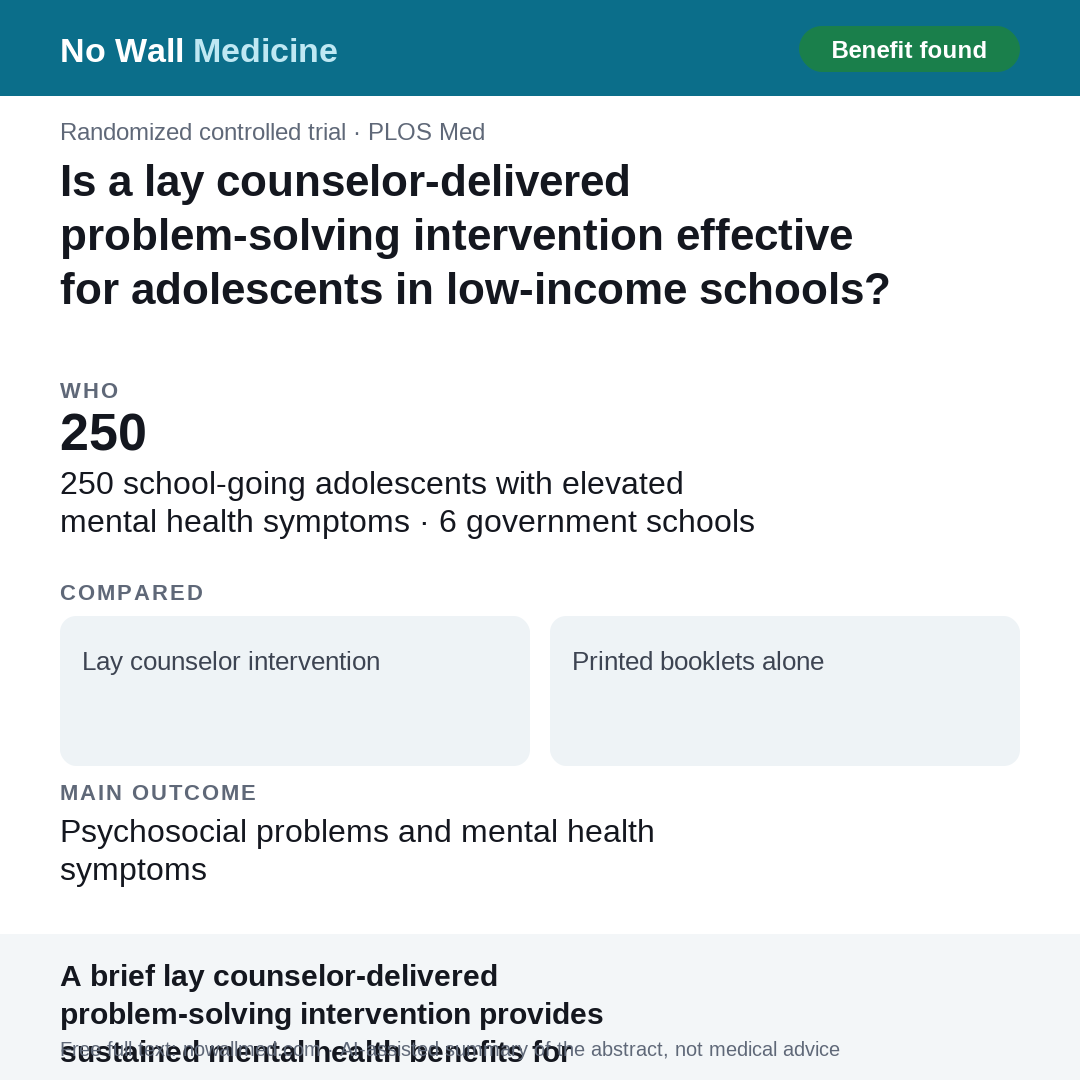
Clinical question: Is a lay counselor-delivered problem-solving intervention effective for adolescents in low-income schools?
Why it matters: Evidence regarding the long-term effectiveness of lay counselor-delivered mental health interventions in low-resource settings is scarce.
Key points
- The study randomized 250 school-going adolescents in New Delhi, India, to receive either a lay counselor-delivered problem-solving intervention or printed booklets alone.
- At 12 months, the intervention group showed significant differences in Youth Top Problems (AMD = -0.75) and Strengths and Difficulties Questionnaire Total Difficulties (AMD = -1.73).
- The modeled cost to scale up the intervention was $4 USD per student, representing 0.4% of the per-student school budget in New Delhi.
Limitation the authors note: The authors noted a lack of sample size calculations powered for the 12-month follow-up and the absence of cost-effectiveness analyses using primary outcomes.
Headline and key points written with AI from the paper’s abstract, with every number checked against it. Read the paper before relying on them.
Was this summary helpful?
Subject terms
Cite this article
Malik K, Michelson D, Doyle AM, Weiss HA, Greco G, Sahu R. Effectiveness and costs associated with a lay counselor-delivered, brief problem-solving mental health intervention for adolescents in urban, low-income schools in India: 12-month outcomes of a randomized controlled trial. PLOS Med. 2021. doi:10.1371/journal.pmed.1003778
Spotted a mistake? Suggest a correction
Top studies every Monday
The week’s key trials and guidelines in your specialties, plus any topics you follow. By email, free.
Get the weekly digest