Community-based rehabilitation effects on pain and physical function after leg amputation are inconsistent
Effectiveness and Equity in Community-Based Rehabilitation on Pain, Physical Function, and Quality of Life After Unilateral Lower Limb Amputation: A Systematic Review
Systematic review of randomized controlled trialsMixed results
Are community or home exercise-based rehabilitation interventions effective after lower limb amputation?
Who
351
Adults with transfemoral or transtibial amputation
Compared
Exercise-based rehabilitation
Control
Main outcome
Pain, physical function, and quality of life
Bottom line: Intervention effects on pain, physical function, and quality of life were inconsistent across the included trials.
Limitation: Inequitable exclusion of 423 potential participants limits generalizability to the underlying population.
Arch Phys Med Rehabil · 2023-03-07Download image
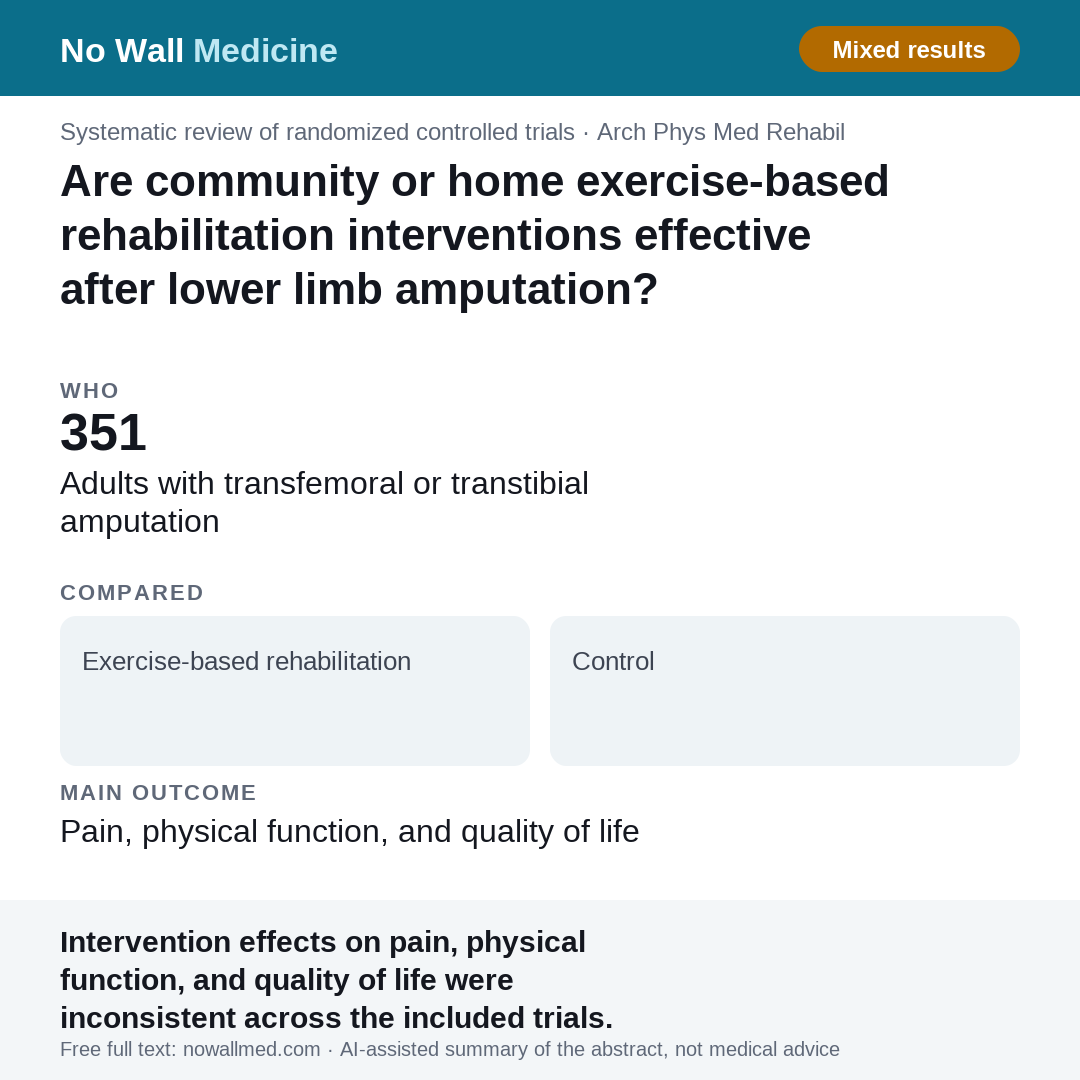
Clinical question: Are community or home exercise-based rehabilitation interventions effective after lower limb amputation?
Why it matters: It is unknown how effective community or home-based exercise programs are for improving pain, physical function, and quality of life after lower limb amputation.
Key points
- Researchers reviewed eight randomized controlled trials involving 351 participants receiving exercise-based rehabilitation at home or in the community after leg amputation.
- The effects of these interventions on pain, physical function, and quality of life were inconsistent across the studies.
- A total of 423 potential participants, representing 65% of the population, were excluded from the identified trials due to inequity.
Limitation the authors note: The included trials were of low to moderate quality and showed heterogeneity in exercise modes and outcome measures.
Headline and key points written with AI from the paper’s abstract, with every number checked against it. Read the paper before relying on them.
Was this summary helpful?
Subject terms
Cite this article
Wijekoon A, Jayawardana S, Milton-Cole R, Chandrathilaka M, Jones A, Cook S. Effectiveness and Equity in Community-Based Rehabilitation on Pain, Physical Function, and Quality of Life After Unilateral Lower Limb Amputation: A Systematic Review. Arch Phys Med Rehabil. 2023. doi:10.1016/j.apmr.2023.02.009
Spotted a mistake? Suggest a correction
Top studies every Monday
The week’s key trials and guidelines in your specialties, plus any topics you follow. By email, free.
Get the weekly digest