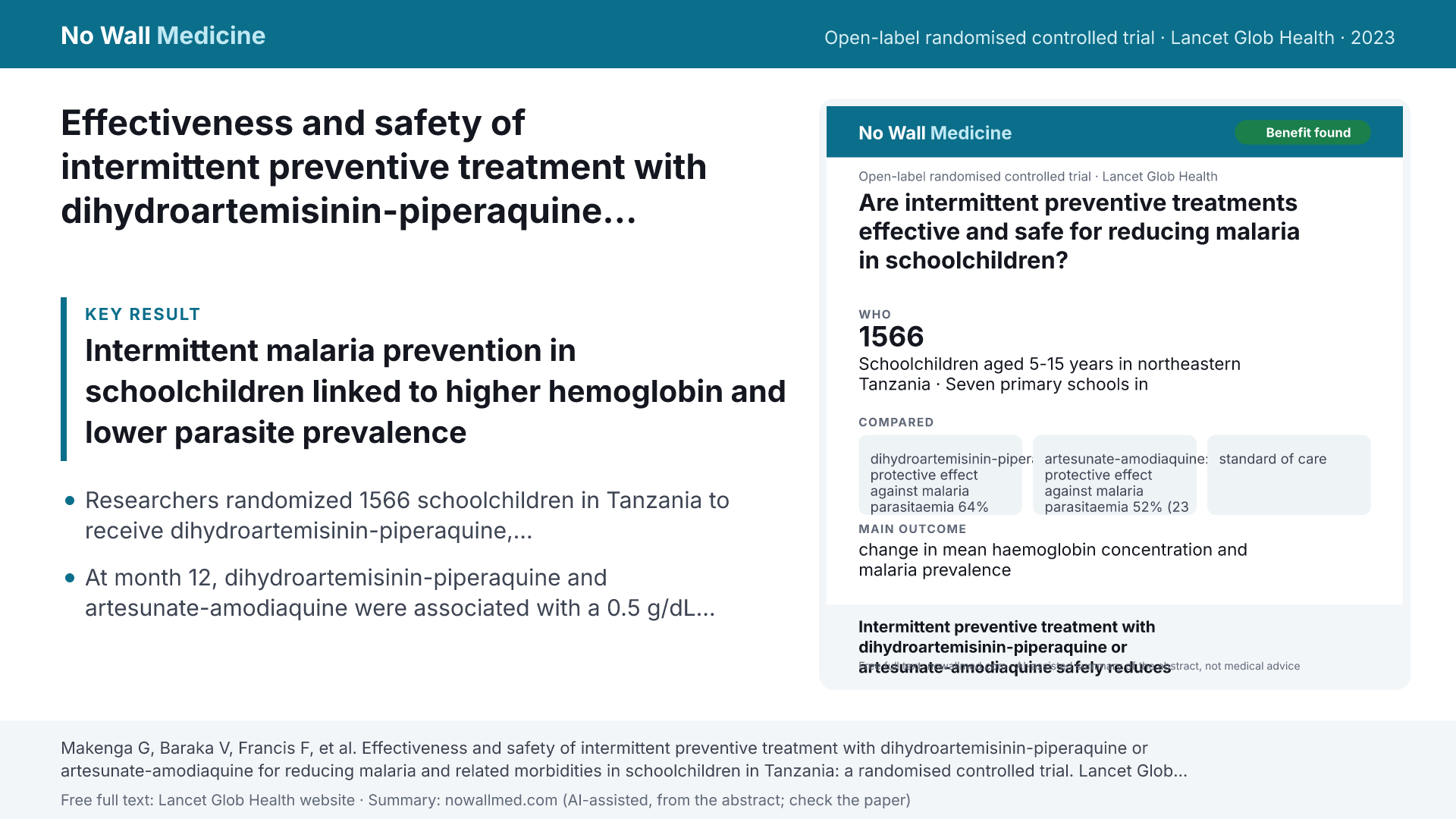
Effectiveness and safety of intermittent preventive treatment with dihydroartemisinin-piperaquine or artesunate-amodiaquine for reducing malaria and related morbidities in schoolchildren in Tanzania: a randomised controlled trial
Key result: Intermittent malaria prevention in schoolchildren linked to higher hemoglobin and lower parasite prevalence
Key points
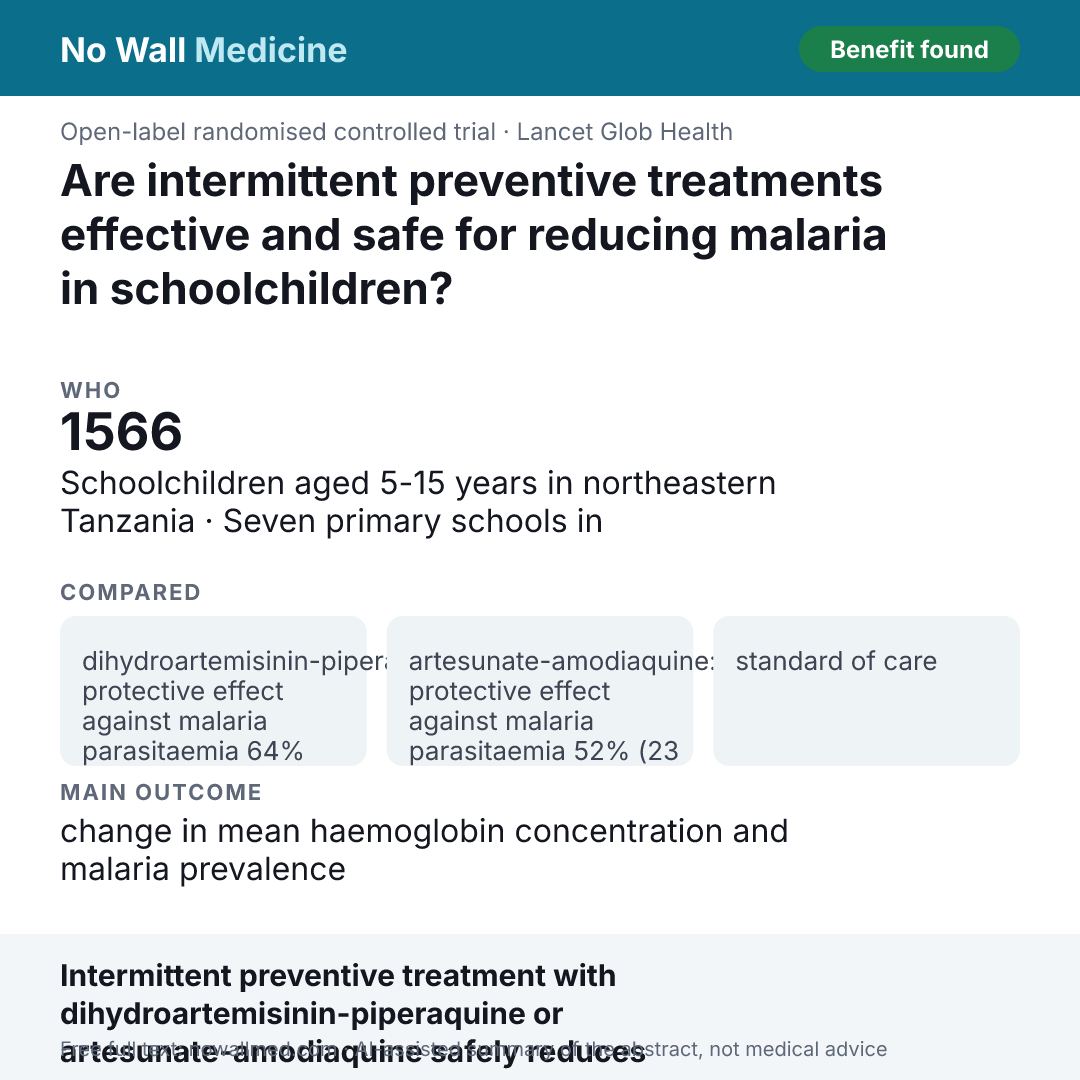
- Researchers randomized 1566 schoolchildren in Tanzania to receive dihydroartemisinin-piperaquine, artesunate-amodiaquine, or standard care.
- At month 12, dihydroartemisinin-piperaquine and artesunate-amodiaquine were associated with a 0.5 g/dL increase in mean hemoglobin concentration compared to the control group.
- The protective effect against malaria parasites was 64% for dihydroartemisinin-piperaquine and 52% for artesunate-amodiaquine at month 12, though no significant differences were noted at month 20.
Limitation the authors note: Due to COVID-19-related school closures, only two schools were visited at month 12.
Discussion prompts
- Would these patients look like yours? Who was left out?
- Is the main outcome one that matters to patients?
- Is the difference large enough to change what you do?
Cite: Makenga G, Baraka V, Francis F, et al. Effectiveness and safety of intermittent preventive treatment with dihydroartemisinin-piperaquine or artesunate-amodiaquine for reducing malaria and related morbidities in schoolchildren in Tanzania: a randomised controlled trial. Lancet Glob Health. 2023;11(8):e1277-e1289. doi:10.1016/S2214-109X(23)00204-8
Free full text: Lancet Glob Health website · Summary and visual abstract: nowallmed.com/a/effectiveness-and-safety-of-intermittent-preventive-treatment-with-14hanrb/ (AI-assisted from the abstract; check the paper before relying on it).