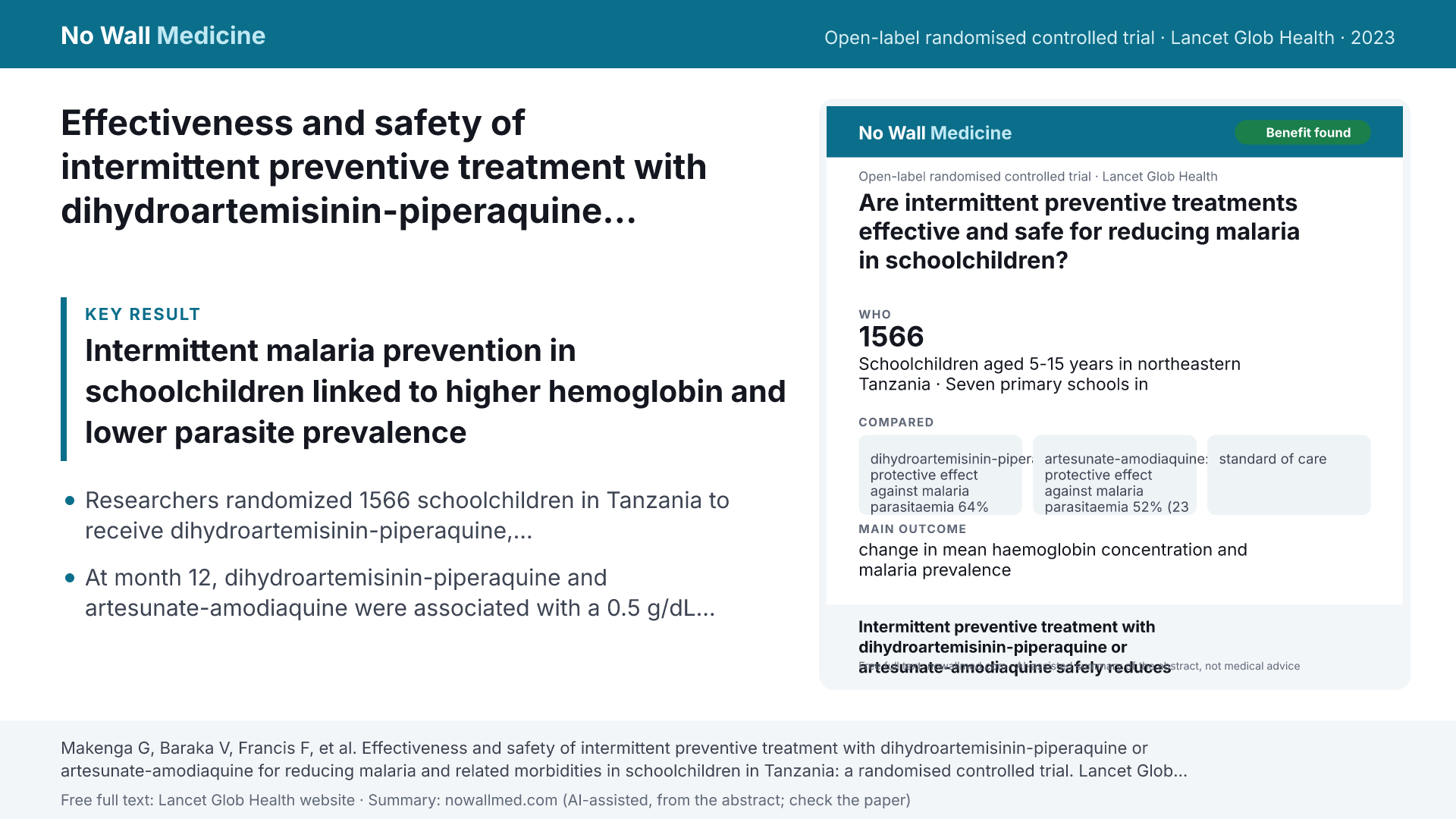
Intermittent malaria prevention in schoolchildren linked to higher hemoglobin and lower parasite prevalence
Effectiveness and safety of intermittent preventive treatment with dihydroartemisinin-piperaquine or artesunate-amodiaquine for reducing malaria and related morbidities in schoolchildren in Tanzania: a randomised controlled trial
Open-label randomised controlled trialBenefit found
Are intermittent preventive treatments effective and safe for reducing malaria in schoolchildren?
Who
1566
Schoolchildren aged 5-15 years in northeastern Tanzania · Seven primary schools in northeastern Tanzania
Compared
dihydroartemisinin-piperaquine: protective effect against malaria parasitaemia 64% (95% CI 39 to 79)
artesunate-amodiaquine: protective effect against malaria parasitaemia 52% (23 to 70)
standard of care
Main outcome
change in mean haemoglobin concentration and malaria prevalence
Result: protective effect against malaria parasitaemia 64% (95% CI 39 to 79)
Bottom line: Intermittent preventive treatment with dihydroartemisinin-piperaquine or artesunate-amodiaquine safely reduces malaria parasitaemia and clinical malaria in schoolchildren.
Lancet Glob Health · 2023-07-21Download image
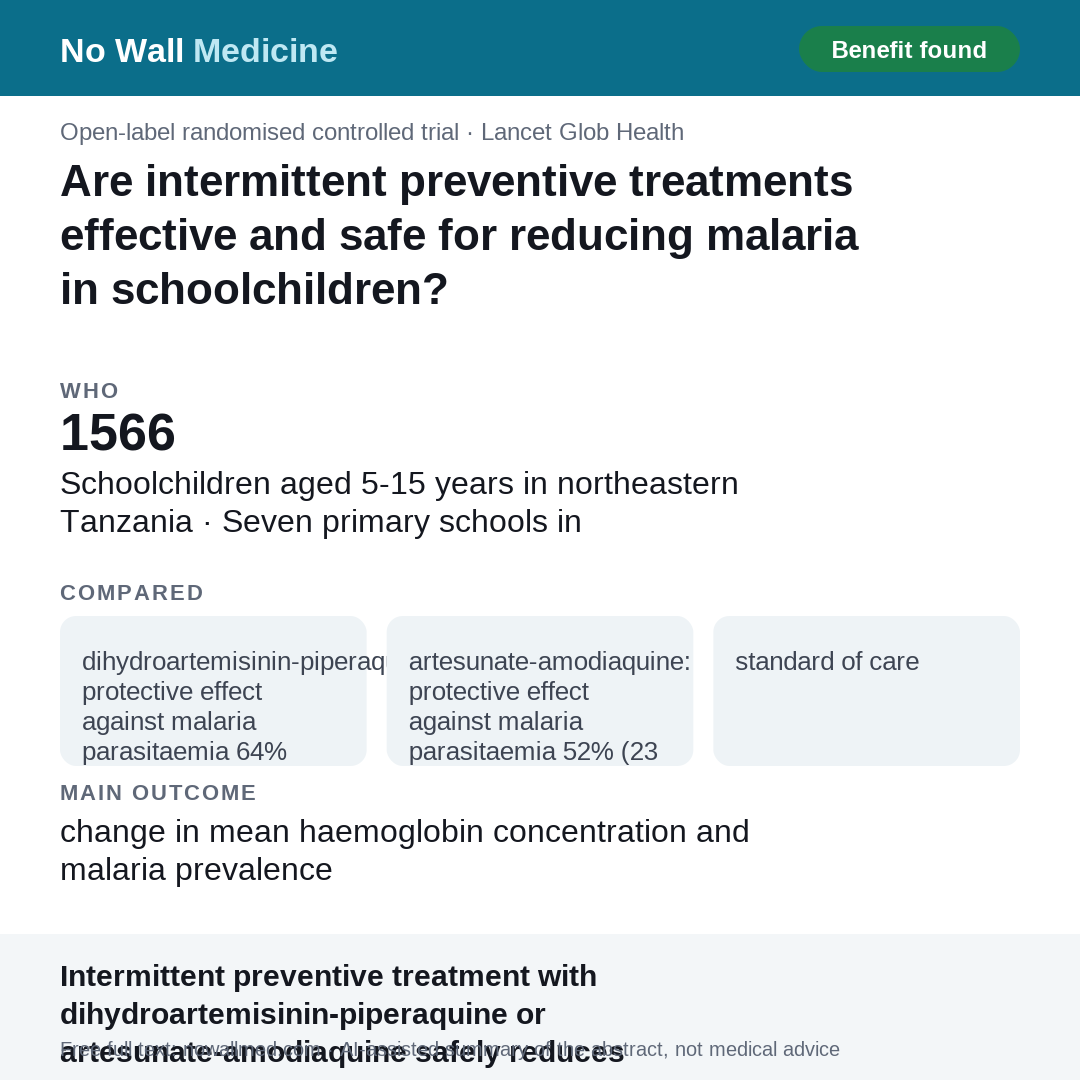
Clinical question: Are intermittent preventive treatments effective and safe for reducing malaria in schoolchildren?
Why it matters: It is unknown if intermittent preventive treatment for malaria in school-aged children can effectively reduce malaria parasites, clinical malaria, and anemia in high transmission settings.
Key points
- Researchers randomized 1566 schoolchildren in Tanzania to receive dihydroartemisinin-piperaquine, artesunate-amodiaquine, or standard care.
- At month 12, dihydroartemisinin-piperaquine and artesunate-amodiaquine were associated with a 0.5 g/dL increase in mean hemoglobin concentration compared to the control group.
- The protective effect against malaria parasites was 64% for dihydroartemisinin-piperaquine and 52% for artesunate-amodiaquine at month 12, though no significant differences were noted at month 20.
Limitation the authors note: Due to COVID-19-related school closures, only two schools were visited at month 12.
Headline and key points written with AI from the paper’s abstract, with every number checked against it. Read the paper before relying on them.
Was this summary helpful?
Abstract
Background
In high transmission settings, most school-aged children harbour malaria parasites without showing symptoms, often leading to anaemia and possibly impaired psychomotor and cognitive abilities. We aimed to assess the effectiveness and safety of intermittent preventive treatment for malaria in school-aged children (IPTsc) living in highly endemic areas. Methods
We did an open-label randomised controlled trial in seven primary schools in northeastern Tanzania. Schoolchildren aged 5-15 years were individually randomly assigned (1:1:1) to receive dihydroartemisinin-piperaquine, artesunate-amodiaquine, or standard of care (control) using a balanced block design. Drugs were administered by schoolteachers, with supervision from study nurses, at months 0 (baseline), 4, and 8, and were given in line with manufacturer's recommendations with dose based on the child's bodyweight. The primary endpoints were change from baseline in mean haemoglobin concentration at months 12 and 20, and clinical incidence of malaria and prevalence of parasitaemia at months 12 and 20 in the intervention groups versus the control group. The outcome data were collected through longitudinal surveys conducted every 4 months. Data were analysed on the basis of intention to treat (including all randomised participants) and per protocol (comprising children who completed the full 3-day regimen of all three IPTsc treatment rounds as assigned). This study is registered with ClinicalTrials.gov (NCT03640403). Findings
Of the 1797 children scheduled for clinical screening, 1566 were enrolled and randomly allocated (526 to receive dihydroartemisinin-piperaquine, 527 to receive artesunate-amodiaquine, and 513 to receive standard of care). Due to COVID-19-related school closures, only two schools were visited at month 12 (135 children in the dihydroartemisinin-piperaquine group, 131 in the artesunate-amodiaquine group, and 118 in the control group). At month 12, compared with the control group, the change from baseline in mean haemoglobin concentration was increased by 0·5 g/dL (95% CI 0·2 to 0·8; p<0·0001) in the dihydroartemisinin-piperaquine group and 0·5 g/dL (0·2 to 0·7; p=0·0020) in the artesunate-amodiaquine group in the intention-to-treat analysis (with similar findings in the per protocol analysis). In the same period, in the intention-to-treat analysis, the prevalence of malaria parasitaemia increased from 28·5% (138 of 485 participants) to 33·6% (39 of 116) in the control group, but decreased from 28·0% (139 of 497) to 12·0% (15 of 125) in the dihydroartemisinin-piperaquine group (-21·6 percentage points [95% CI -31·9 to -11·3], p=0·0001 vs control at month 12) and from 24·7% (124 of 502) to 16·0% (20 of 125) in the artesunate-amodiaquine group (-17·6 percentage points [-28·4 to -6·9], p=0·0015). The decrease for artesunate-amodiaquine was larger in the per protocol analysis (-25·3 percentage points [-36·3 to -14·2], p<0·0001). The protective effect of IPTsc against malaria parasitaemia was 64% (95% CI 39 to 79; p<0·0001) for dihydroartemisinin-piperaquine and 52% (23 to 70; p=0·0015) for artesunate-amodiaquine in the intention-to-treat analysis, and was slightly higher on per protocol analysis. The protective effect against clinical malaria at month 12 was 20% (95% CI 9 to 29; p=0·0002) for dihydroartemisinin-piperaquine and 19% (8 to 28; p=0·0004) for artesunate-amodiaquine. No significant differences in any primary outcomes between the intervention and control groups were noted at month 20. Dihydroartemisinin-piperaquine and artesunate-amodiaquine were associated with a small number of mild adverse events, and there were no treatment-related serious adverse events or deaths. Interpretation
IPTsc with dihydroartemisinin-piperaquine or artesunate-amodiaquine is a safe and effective approach to reducing malaria parasitaemia, clinical malaria, and related morbidities, and is feasible to implement through programmes delivered by schoolteachers. Funding
Flemish Interuniversity Council (VLIRUOS), EU EDCTP2 programme (MaReCa project), and Global Minds 2019. Translation
For the Swahili translation of the abstract see Supplementary Materials section.
Abstract reproduced under the article’s CC BY licence.
Subject terms
Cite this article
Makenga G, Baraka V, Francis F, et al. Effectiveness and safety of intermittent preventive treatment with dihydroartemisinin-piperaquine or artesunate-amodiaquine for reducing malaria and related morbidities in schoolchildren in Tanzania: a randomised controlled trial. Lancet Glob Health. 2023. doi:10.1016/S2214-109X(23)00204-8
Spotted a mistake? Suggest a correction