Blended in-person and online parenting programme did not reduce child maltreatment in rural Thailand
Effectiveness of a blended in-person and online parenting programme in reducing violence against children in rural Thailand: a cluster randomised controlled trial
Cluster-randomised, assessor-blinded trialNo clear difference
Does a blended parenting programme reduce violence against children in rural Thailand?
Who
240
Primary caregivers aged 18 years or older living with children · 12 sub-district health-promoting hospitals in Udon Thani, Thailand
Compared
Intervention
Control
Main outcome
Frequency of physical or emotional abuse in the past four weeks
Result: incidence rate ratio 1.46 (95% CI 0.83-2.57)
Bottom line: The blended parenting programme showed no significant reduction in overall child maltreatment at one-month follow-up.
Funded by: LEGO Foundation, Oak Foundation, and World Childhood Foundation
Lancet Reg Health Southeast Asia · 2026-05-28Download image
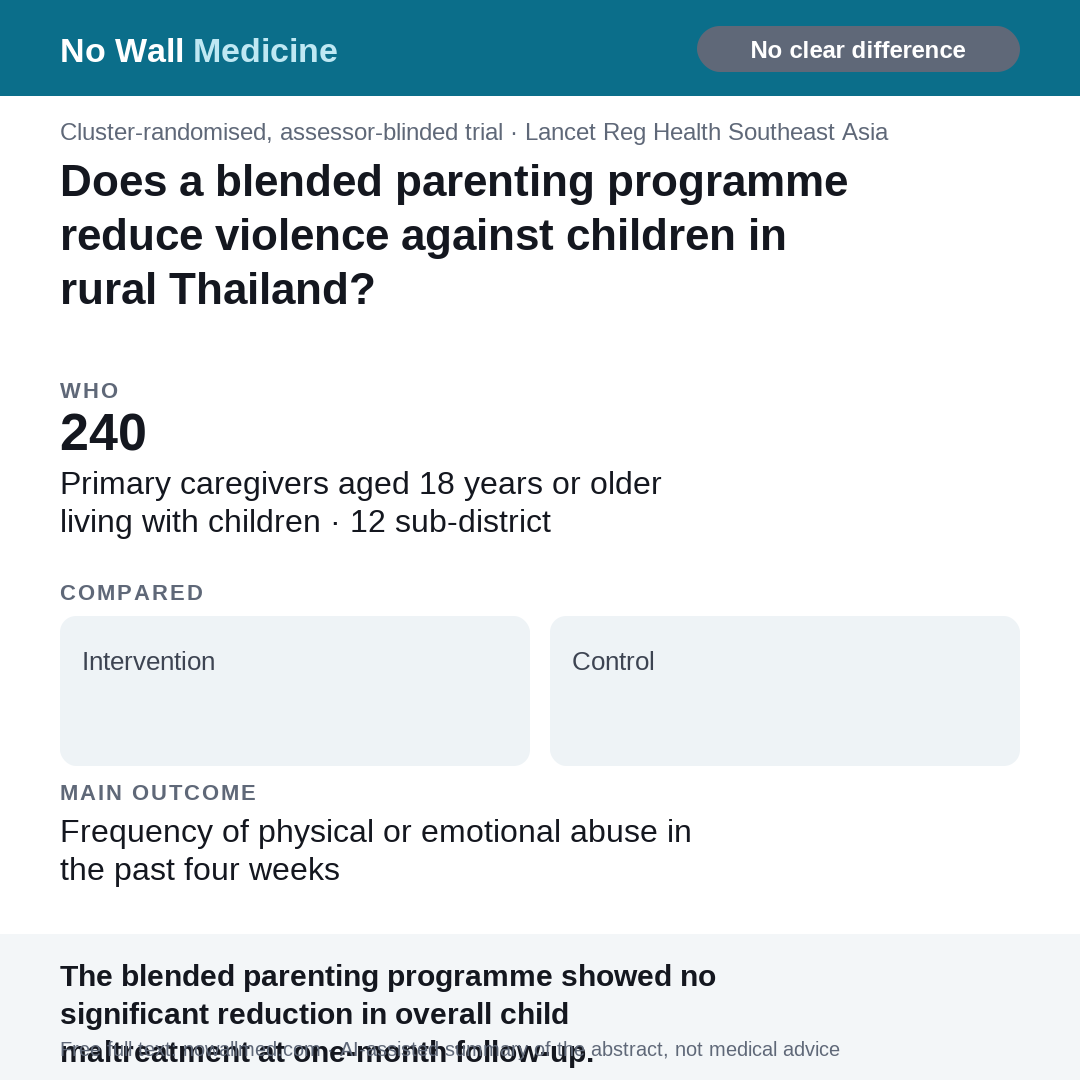
Clinical question: Does a blended parenting programme reduce violence against children in rural Thailand?
Why it matters: Violence against children is a substantial public health concern in Thailand, but the effectiveness of blended in-person and online messaging-based parenting programmes has not been evaluated.
Key points
- Researchers studied 240 caregivers in 12 sub-district health-promoting hospitals who were assigned to either a nine-week blended programme or a control group.
- The intervention showed no significant differences in overall child maltreatment between groups, with an incidence rate ratio of 1.46 (95% confidence interval 0.83-2.57).
- No differences were observed for physical abuse, though estimates for emotional abuse were higher in the intervention arm (incidence rate ratio 2.57, 95% confidence interval 1.27-5.20).
Headline and key points written with AI from the paper’s abstract, with every number checked against it. Read the paper before relying on them.
Was this summary helpful?
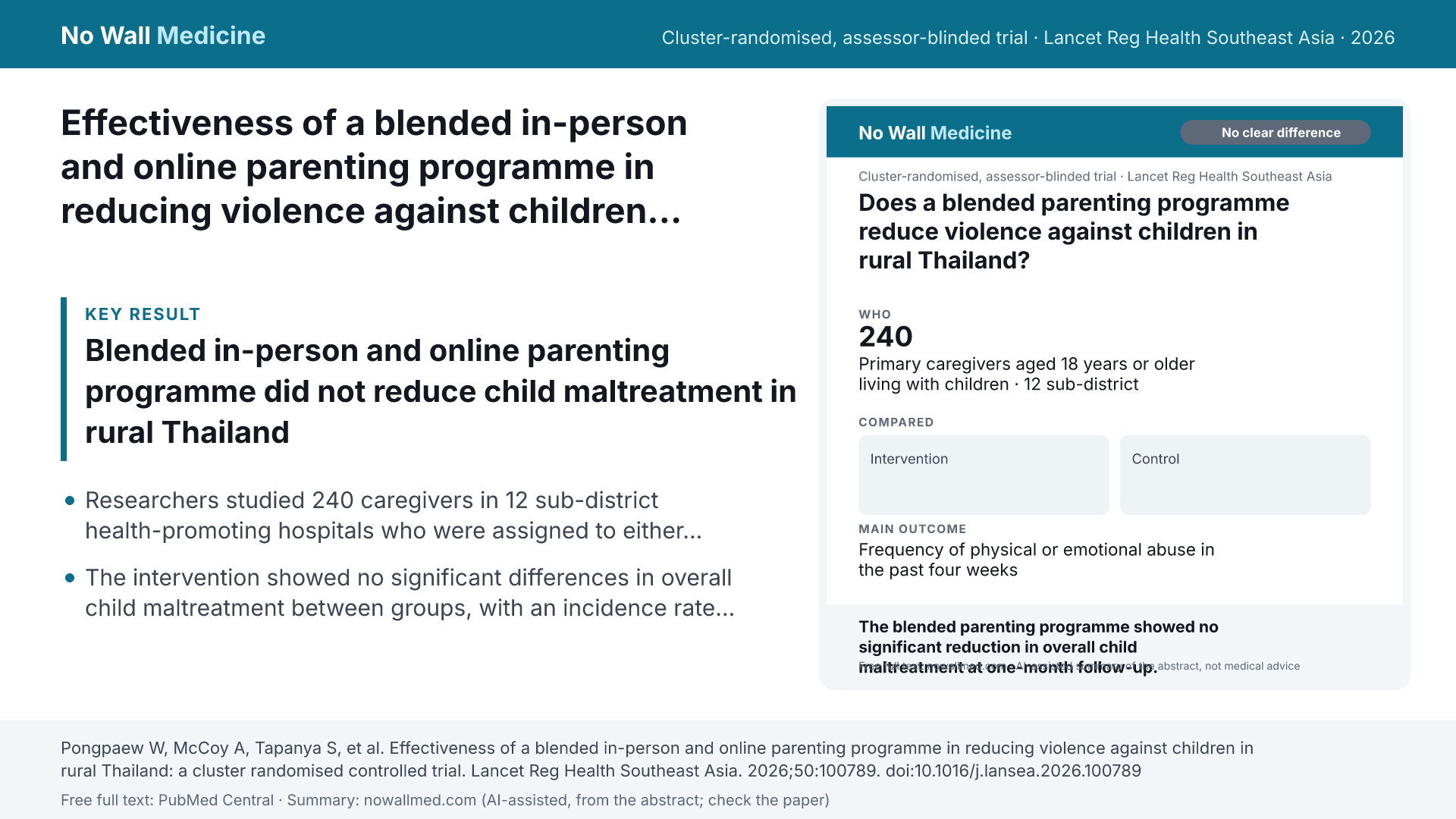
Headline, design, result, key points, caveat and citation as plain text.
Cite this article
Pongpaew W, McCoy A, Tapanya S, et al. Effectiveness of a blended in-person and online parenting programme in reducing violence against children in rural Thailand: a cluster randomised controlled trial. Lancet Reg Health Southeast Asia. 2026;50:100789. doi:10.1016/j.lansea.2026.100789
Spotted a mistake? Suggest a correction