Effectiveness of a community-based education and peer support led by women's self-help groups in improving the control of hypertension in urban slums of Kerala, India: a cluster randomised controlled pragmatic trial
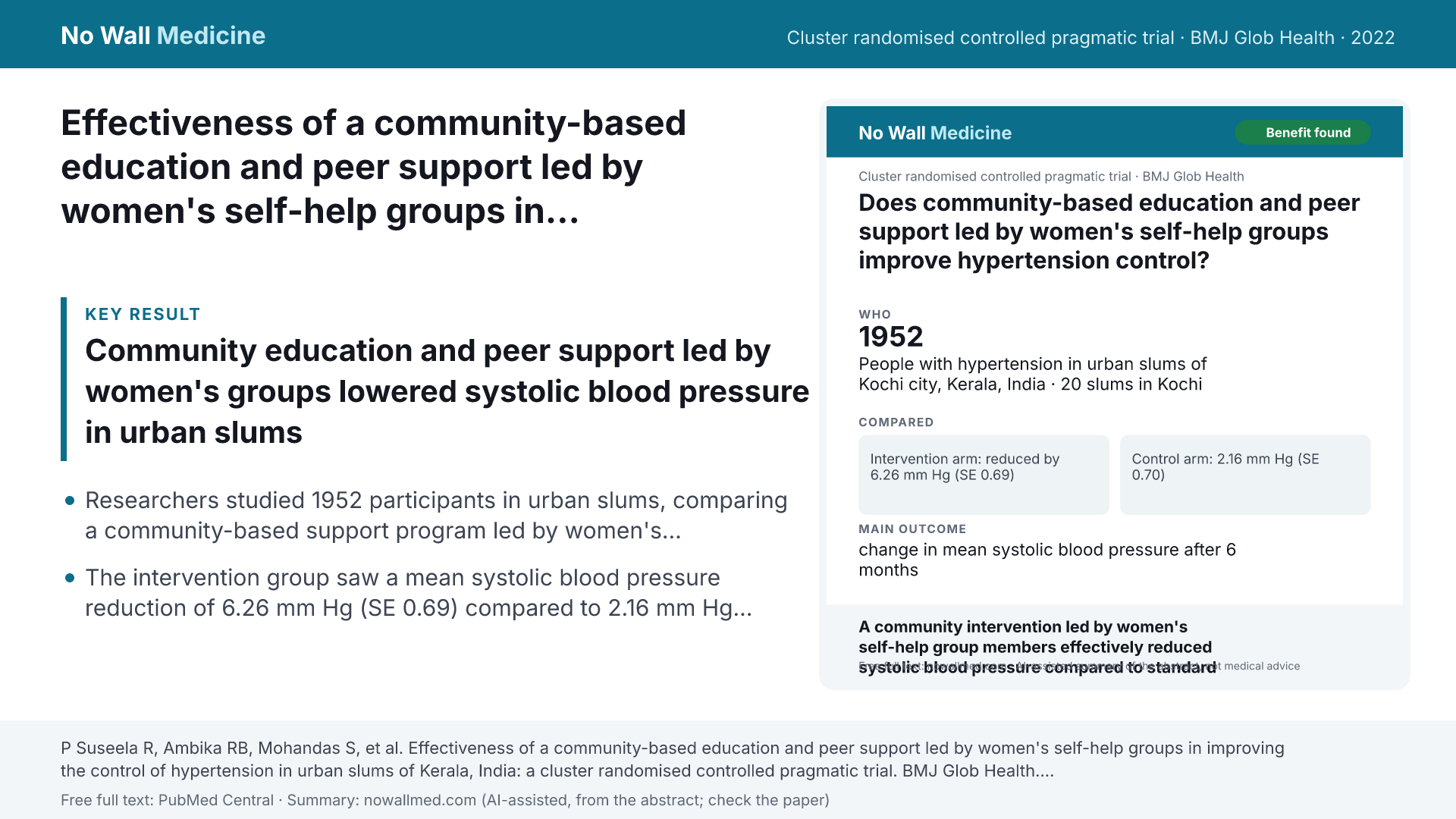
Key result: Community education and peer support led by women's groups lowered systolic blood pressure in urban slums
Key points
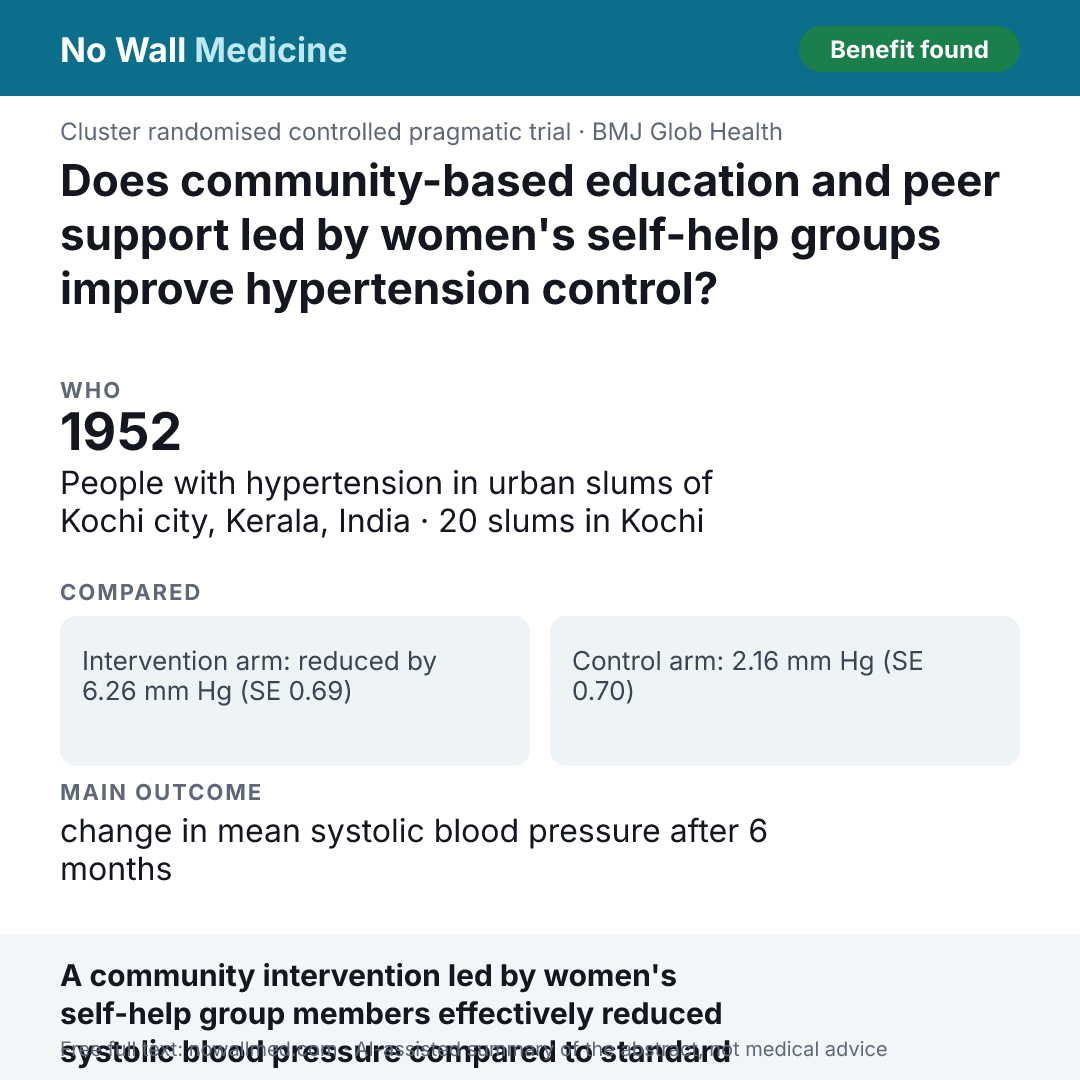
- Researchers studied 1952 participants in urban slums, comparing a community-based support program led by women's self-help groups to standard medical care.
- The intervention group saw a mean systolic blood pressure reduction of 6.26 mm Hg (SE 0.69) compared to 2.16 mm Hg (SE 0.70) in the control group.
- The net difference in systolic blood pressure reduction between the two groups was 4.09 (95% CI 2.15 to 4.09) after 6 months.
Why it matters: Uncontrolled hypertension is a major public health problem because less than 20% of people with the condition achieve their target blood pressure goals.
Discussion prompts
- Would these patients look like yours? Who was left out?
- Is the main outcome one that matters to patients?
- Is the difference large enough to change what you do?
Cite: P Suseela R, Ambika RB, Mohandas S, et al. Effectiveness of a community-based education and peer support led by women's self-help groups in improving the control of hypertension in urban slums of Kerala, India: a cluster randomised controlled pragmatic trial. BMJ Glob Health. 2022;7(11). doi:10.1136/bmjgh-2022-010296
Free full text: PubMed Central · Summary and visual abstract: nowallmed.com/a/effectiveness-of-a-community-based-education-and-peer-support-led-by-1yurrxe/ (AI-assisted from the abstract; check the paper before relying on it).