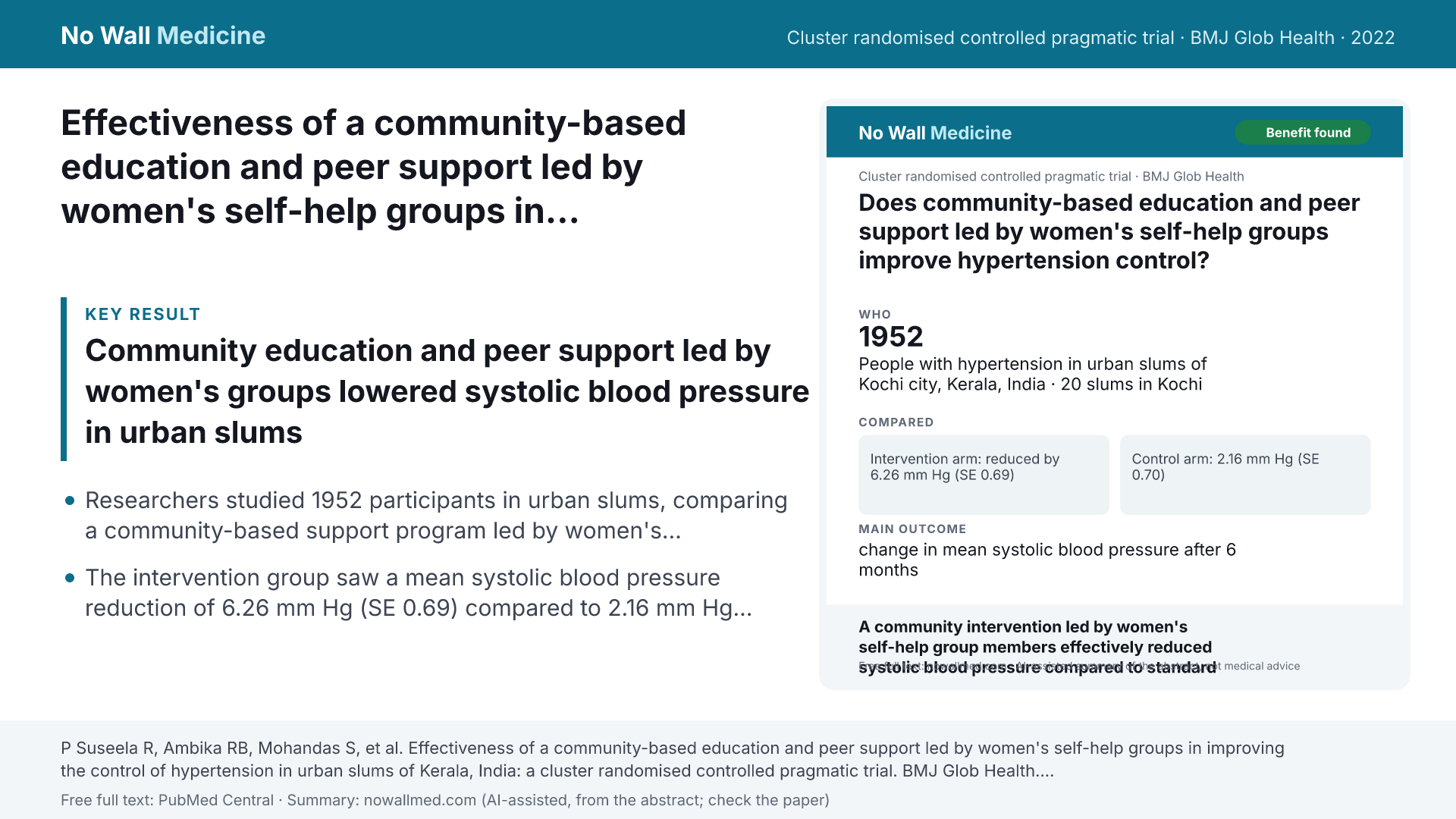
Community education and peer support led by women's groups lowered systolic blood pressure in urban slums
Effectiveness of a community-based education and peer support led by women's self-help groups in improving the control of hypertension in urban slums of Kerala, India: a cluster randomised controlled pragmatic trial
Cluster randomised controlled pragmatic trialBenefit found
Does community-based education and peer support led by women's self-help groups improve hypertension control?
Who
1952
People with hypertension in urban slums of Kochi city, Kerala, India · 20 slums in Kochi city, Kerala, India
Compared
Intervention arm: reduced by 6.26 mm Hg (SE 0.69)
Control arm: 2.16 mm Hg (SE 0.70)
Main outcome
change in mean systolic blood pressure after 6 months
Result: 4.09 (95% CI 2.15 to 4.09)
Bottom line: A community intervention led by women's self-help group members effectively reduced systolic blood pressure compared to standard care.
BMJ Glob Health · 2022-11-17Download image
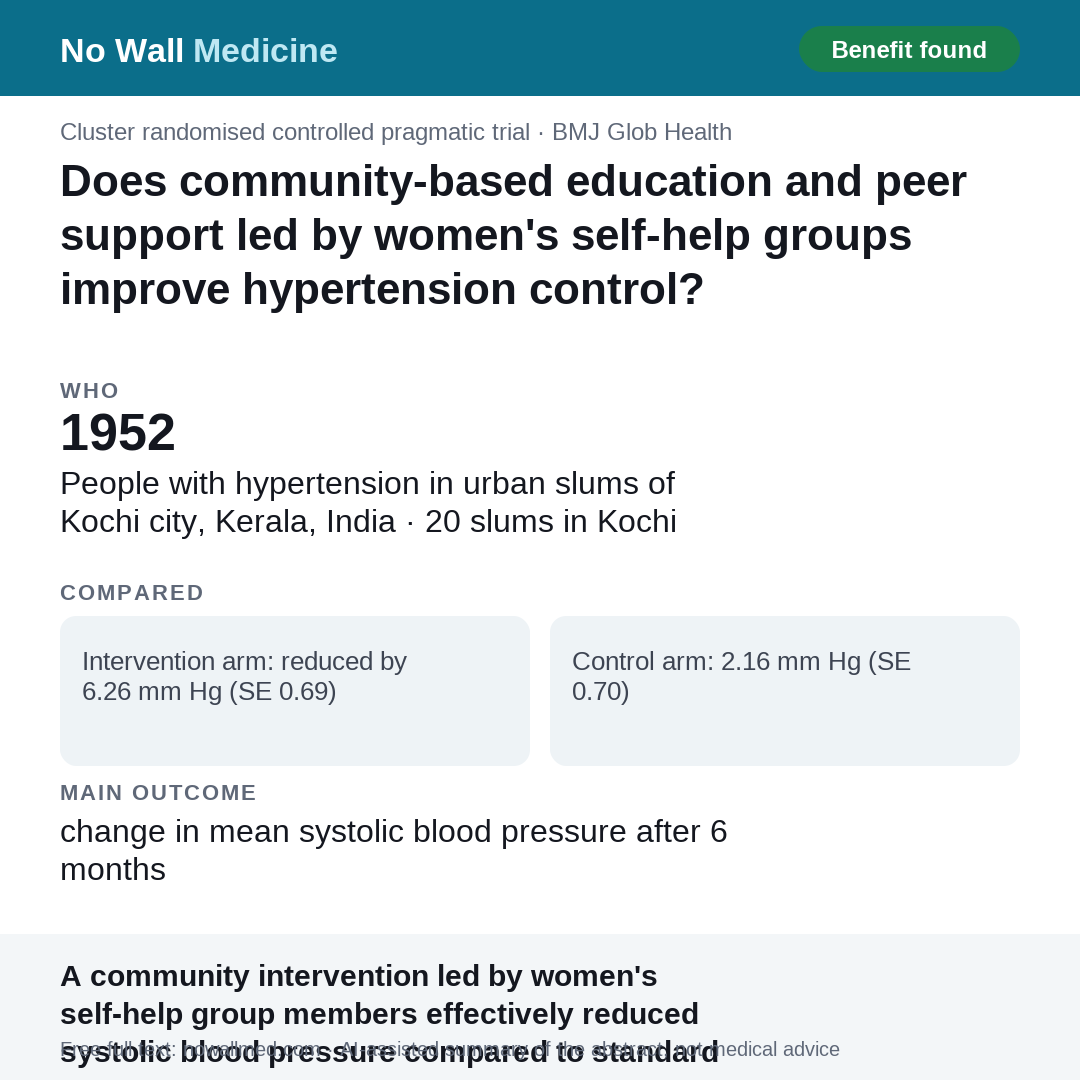
Clinical question: Does community-based education and peer support led by women's self-help groups improve hypertension control?
Why it matters: Uncontrolled hypertension is a major public health problem because less than 20% of people with the condition achieve their target blood pressure goals.
Key points
- Researchers studied 1952 participants in urban slums, comparing a community-based support program led by women's self-help groups to standard medical care.
- The intervention group saw a mean systolic blood pressure reduction of 6.26 mm Hg (SE 0.69) compared to 2.16 mm Hg (SE 0.70) in the control group.
- The net difference in systolic blood pressure reduction between the two groups was 4.09 (95% CI 2.15 to 4.09) after 6 months.
Headline and key points written with AI from the paper’s abstract, with every number checked against it. Read the paper before relying on them.
Was this summary helpful?
Abstract
Background
With less than 20% of people with hypertension achieving their target blood pressure (BP) goals, uncontrolled hypertension remains a major public health problem in India. We conducted a study to assess the effectiveness of a community-based education and peer support programme led by women's self-help group (SHG) members in reducing the mean systolic BP among people with hypertension in urban slums of Kochi city, Kerala, India. Methods
A cluster randomised controlled pragmatic trial was conducted where 20 slums were randomised to either the intervention or the control arms. In each slum, participants who had elevated BP (>140/90) or were on antihypertensive medications were recruited. The intervention was delivered through women's SHG members (1 per 20-30 households) who provided (1) assistance in daily hypertension management, (2) social and emotional support to encourage healthy behaviours and (3) referral to the primary healthcare system. Those in the control arm received standard of care. The primary outcome was change in mean systolic BP (SBP) after 6 months. Results
A total of 1952 participants were recruited-968 in the intervention arm and 984 in the control arm. Mean SBP was reduced by 6.26 mm Hg (SE 0.69) in the intervention arm compared with 2.16 mm Hg (SE 0.70) in the control arm; the net difference being 4.09 (95% CI 2.15 to 4.09), p<0.001. Conclusion
This women's SHG members led community intervention was effective in reducing SBP among people with hypertension compared with those who received usual care, over 6 months in urban slums of Kerala, India. Trial registration number
CTRI/2019/12/022252.
Abstract reproduced under the article’s CC BY NC licence.
Subject terms
Cite this article
P Suseela R, Ambika RB, Mohandas S, Menon JC, Numpelil M, K Vasudevan B. Effectiveness of a community-based education and peer support led by women's self-help groups in improving the control of hypertension in urban slums of Kerala, India: a cluster randomised controlled pragmatic trial. BMJ Glob Health. 2022. doi:10.1136/bmjgh-2022-010296
Spotted a mistake? Suggest a correction
Top studies every Monday
The week’s key trials and guidelines in your specialties, plus any topics you follow. By email, free.
Get the weekly digest