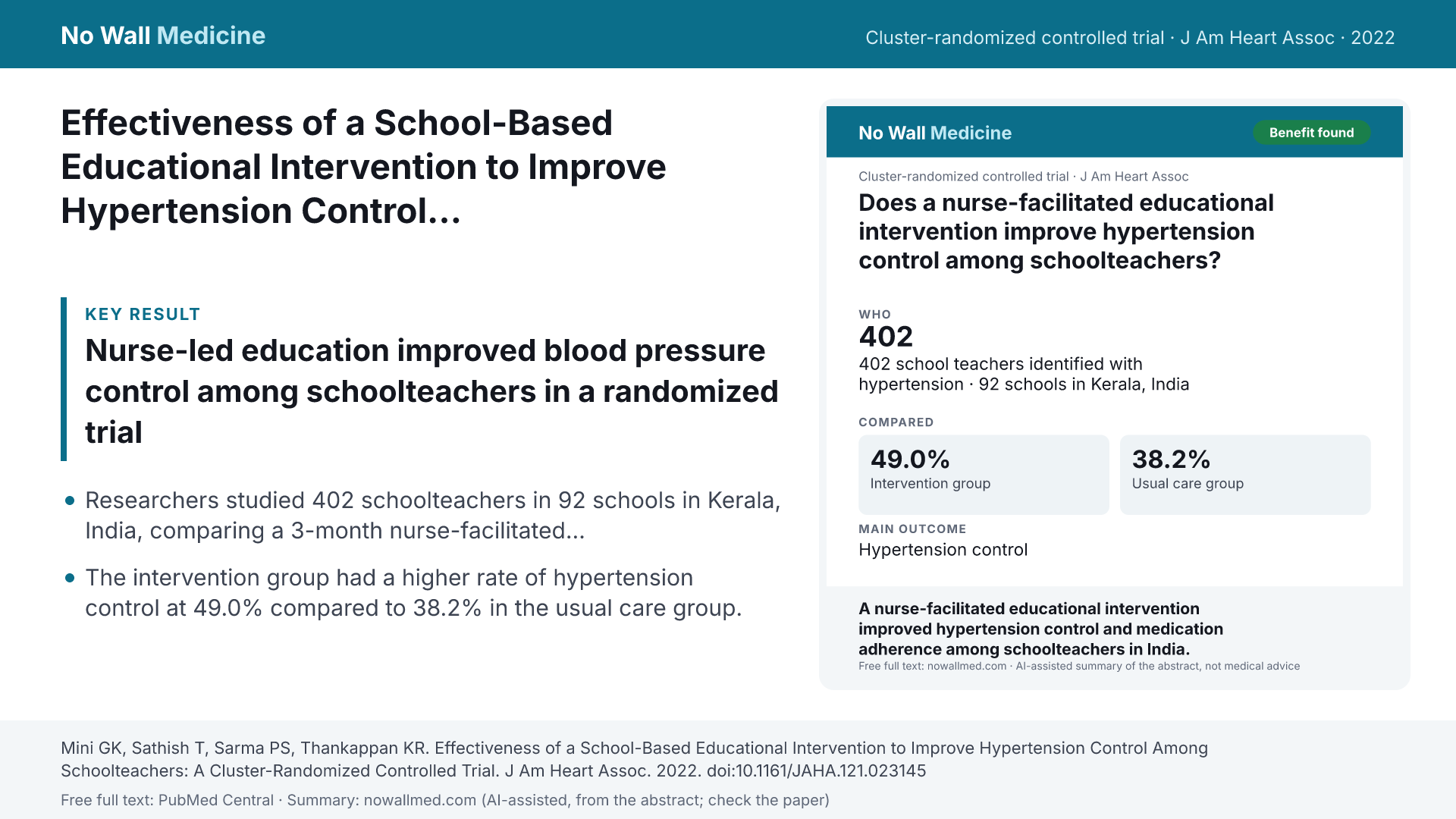
Nurse-led education improved blood pressure control among schoolteachers in a randomized trial
Effectiveness of a School-Based Educational Intervention to Improve Hypertension Control Among Schoolteachers: A Cluster-Randomized Controlled Trial
Cluster-randomized controlled trialBenefit found
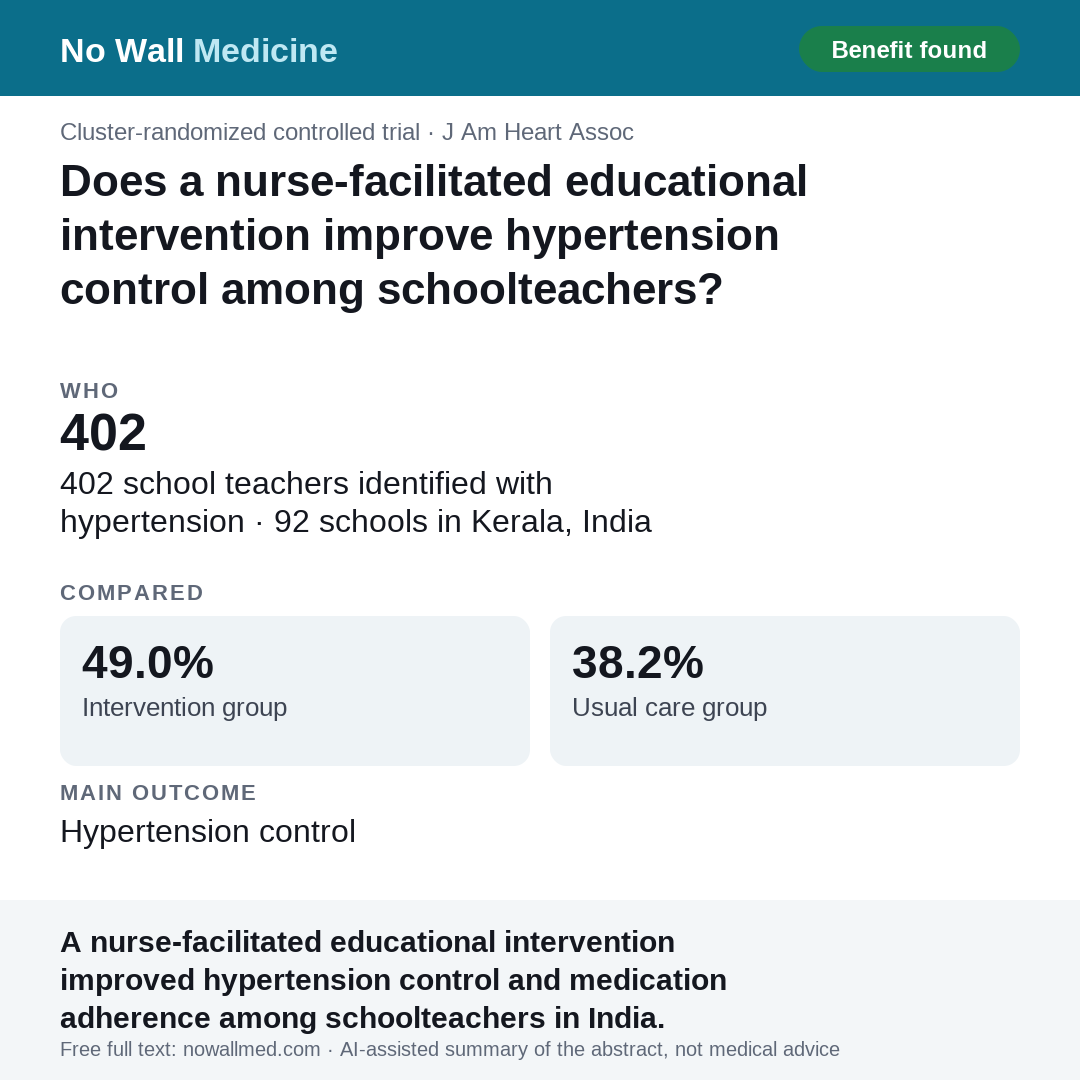
Does a nurse-facilitated educational intervention improve hypertension control among schoolteachers?
Who
402
402 school teachers identified with hypertension · 92 schools in Kerala, India
Compared
49.0%Intervention group
38.2%Usual care group
Main outcome
Hypertension control
Result: odds ratio 1.89 (95% CI, 1.06-3.35)
Bottom line: A nurse-facilitated educational intervention improved hypertension control and medication adherence among schoolteachers in India.
J Am Heart Assoc · 2022-01-13Download image
Clinical question: Does a nurse-facilitated educational intervention improve hypertension control among schoolteachers?
Why it matters: Hypertension control rates are low in low- and middle-income countries like India.
In absolute numbers
Intervention group: 49% · Usual care group: 38.2% → a difference of 10.8 percentage points, so about 10 people would need the treatment for 1 more to benefit (number needed to treat) over the trial’s follow-up.
Worked out by us from the two group results above, not reported by the authors. Check the paper for the exact outcome and timing.
Key points
- Researchers studied 402 schoolteachers in 92 schools in Kerala, India, comparing a 3-month nurse-facilitated educational program to usual care.
- The intervention group had a higher rate of hypertension control at 49.0% compared to 38.2% in the usual care group.
- Participants in the intervention group had a 4.2 mm Hg greater reduction in mean systolic blood pressure than the usual care group.
Headline and key points written with AI from the paper’s abstract, with every number checked against it. Read the paper before relying on them.
Was this summary helpful?
Subject terms
Cite this article
Mini GK, Sathish T, Sarma PS, Thankappan KR. Effectiveness of a School-Based Educational Intervention to Improve Hypertension Control Among Schoolteachers: A Cluster-Randomized Controlled Trial. J Am Heart Assoc. 2022. doi:10.1161/JAHA.121.023145
Spotted a mistake? Suggest a correction