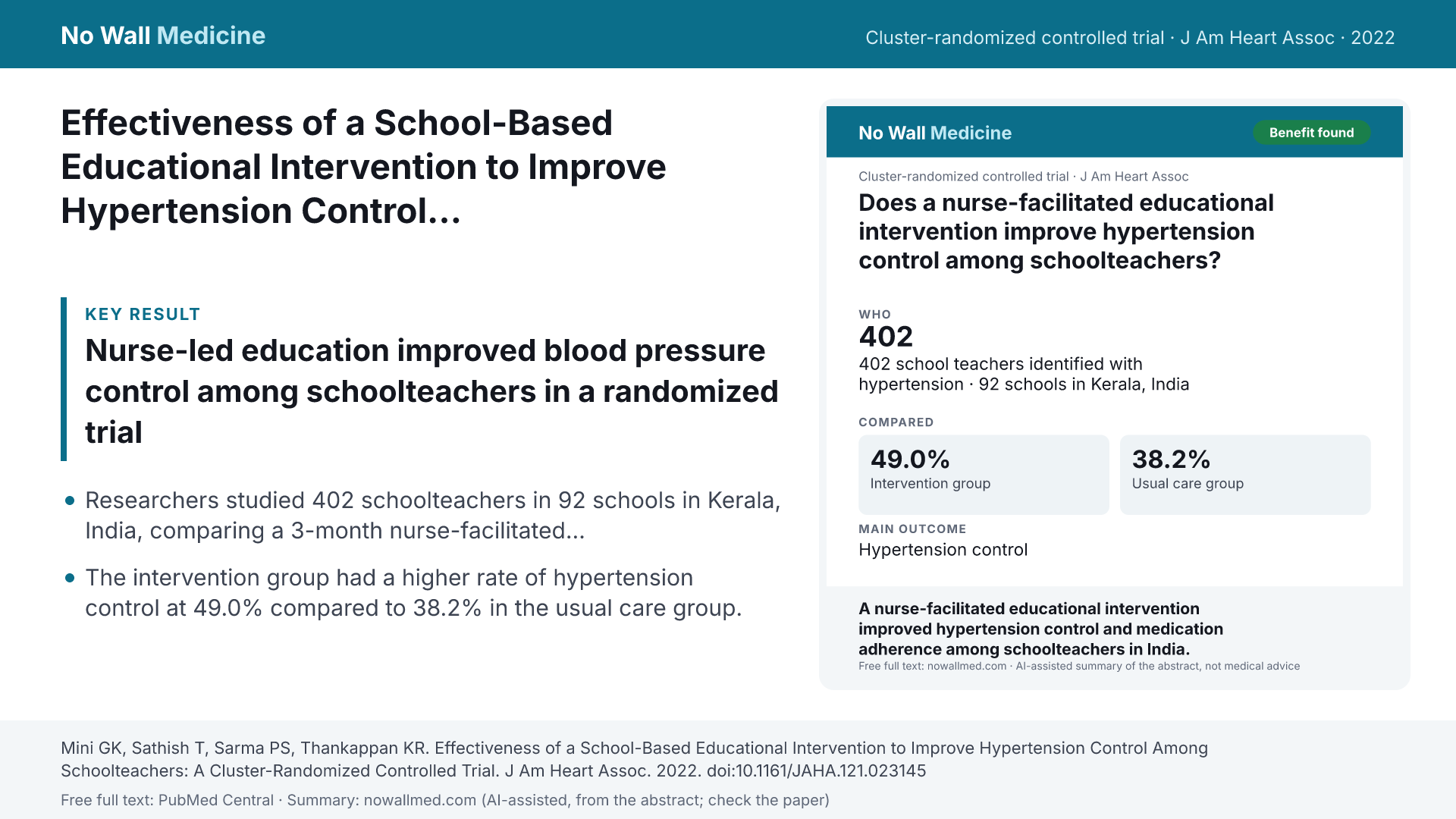
Effectiveness of a School-Based Educational Intervention to Improve Hypertension Control Among Schoolteachers: A Cluster-Randomized Controlled Trial
Key result: Nurse-led education improved blood pressure control among schoolteachers in a randomized trial
Key points
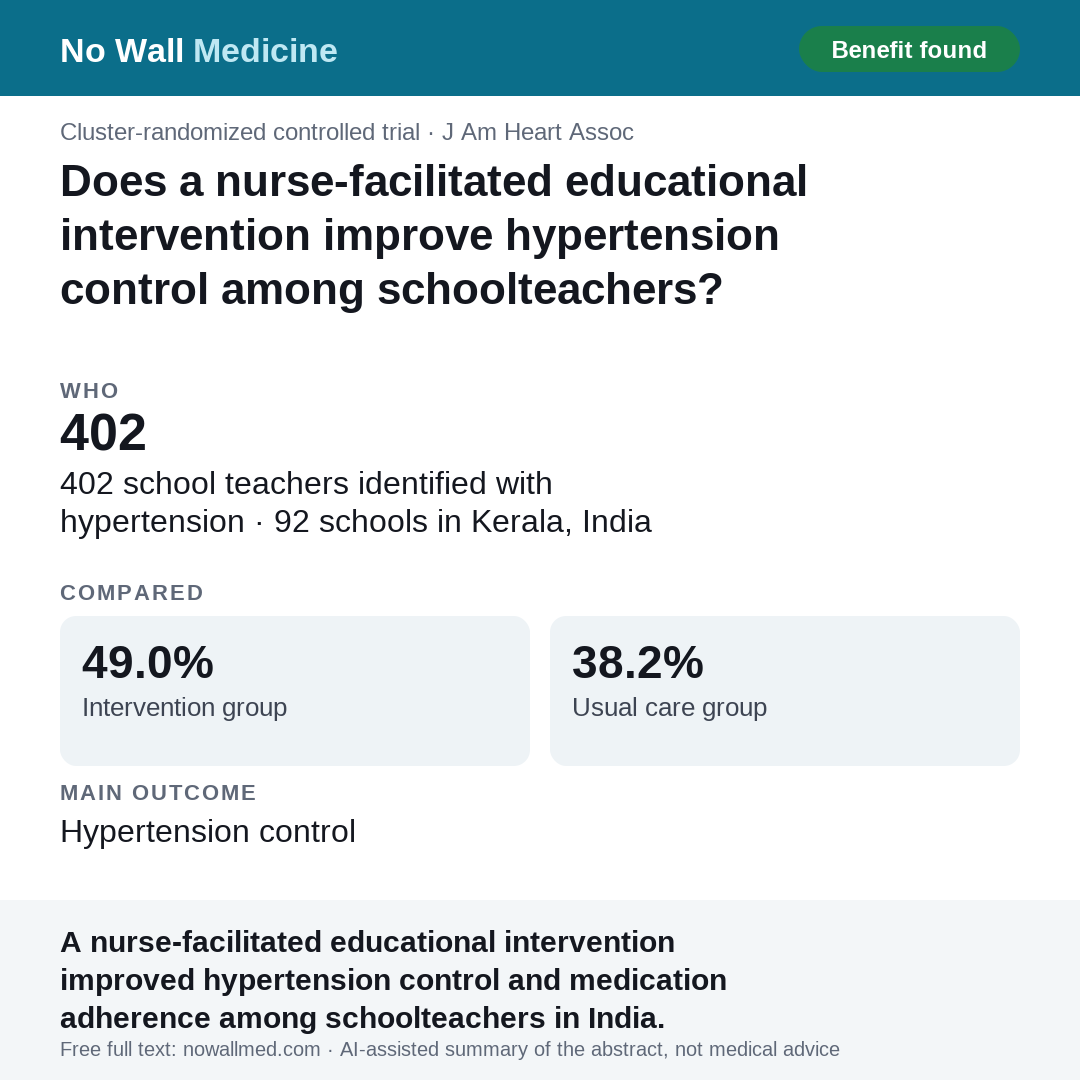
- Researchers studied 402 schoolteachers in 92 schools in Kerala, India, comparing a 3-month nurse-facilitated educational program to usual care.
- The intervention group had a higher rate of hypertension control at 49.0% compared to 38.2% in the usual care group.
- Participants in the intervention group had a 4.2 mm Hg greater reduction in mean systolic blood pressure than the usual care group.
In absolute numbers: Intervention group 49% vs Usual care group 38.2%, a difference of 10.8 percentage points (about 10 people treated for one more to benefit).
Why it matters: Hypertension control rates are low in low- and middle-income countries like India.
Discussion prompts
- Would these patients look like yours? Who was left out?
- Is the main outcome one that matters to patients?
- Is the difference large enough to change what you do?
Cite: Mini GK, Sathish T, Sarma PS, Thankappan KR. Effectiveness of a School-Based Educational Intervention to Improve Hypertension Control Among Schoolteachers: A Cluster-Randomized Controlled Trial. J Am Heart Assoc. 2022. doi:10.1161/JAHA.121.023145
Free full text: PubMed Central · Summary and visual abstract: nowallmed.com/a/effectiveness-of-a-school-based-educational-intervention-to-improve-1b7g2sr/ (AI-assisted from the abstract; check the paper before relying on it).